
Quick Answer
A double apron belly is a lower tummy with two stacked folds of skin and fat, usually one near the belly button and one over the pubic area, with a deep crease between them. It is most often caused by large weight changes, pregnancy or ageing skin. Weight loss shrinks both folds, daily skin care protects the two creases, and surgery is the only way to remove the loose skin.
- Two folds means two creases to keep clean and dry
- Surgeons treat it as a more complex shape than a single apron
- Sore, hot or swollen skin in either crease needs a GP or NHS 111
A double apron belly is when the lower tummy forms two separate overhanging folds rather than one. Instead of a single apron hanging over the pubic area, there is an upper roll, often at or near the belly button, a deep crease, and then a second roll below it. People also describe it as two belly rolls or a double belly overhang. This guide explains what causes the shape, how it differs from a B belly and a single apron, how to look after the skin in both creases, and why surgeons plan treatment differently when there are two folds.
This article is part of our belly guide hub. If you are new to the subject, our guide to the hanging belly explains why the stomach starts to overhang in the first place.
What Is a Double Apron Belly?
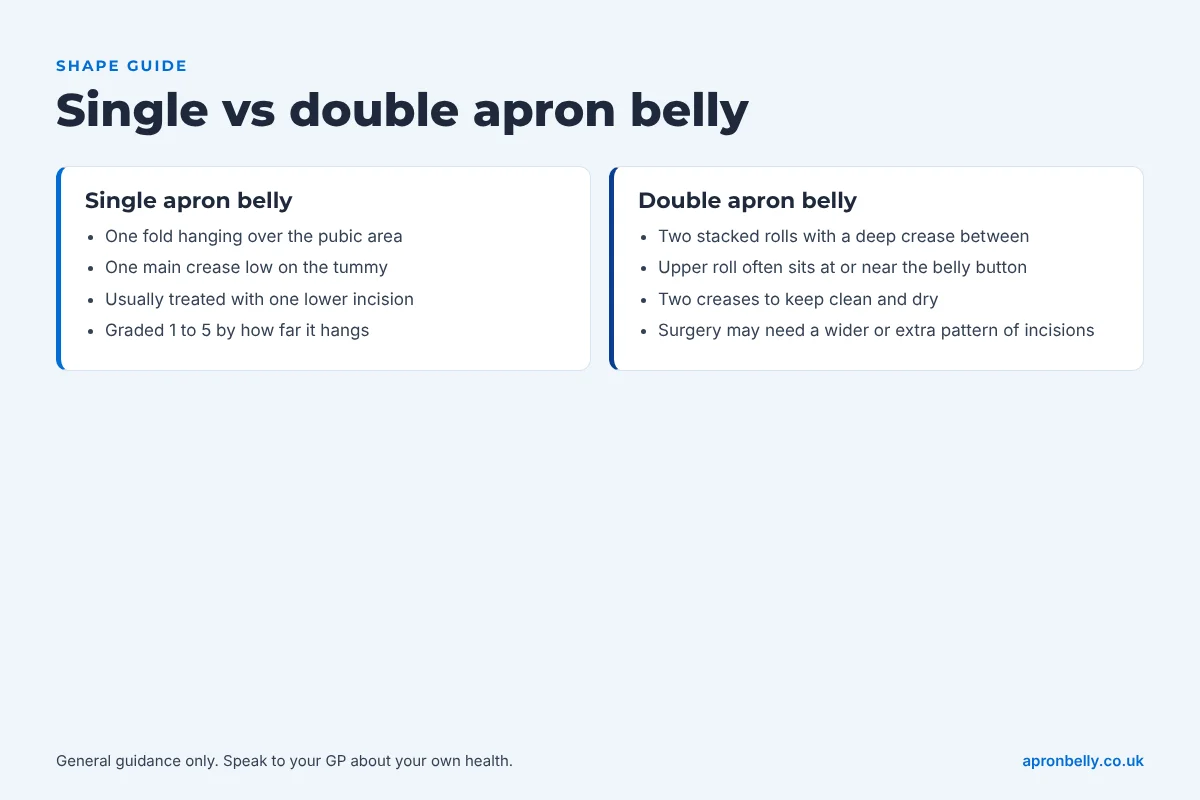
A double apron belly is an abdominal overhang made of two stacked folds, each with its own crease, instead of one single apron of skin and fat.
The upper fold
The upper fold usually forms around the level of the belly button. A natural crease often runs across the tummy here, and when there is extra fat and loose skin above and below it, the tissue above the crease starts to hang over it. In some people the belly button is hidden inside this upper crease.
The lower fold
The lower fold is the classic apron, or pannus, that hangs down over the pubic area and sometimes the tops of the thighs. On its own this is graded from 1 to 5 by how far it hangs, as our guide to apron belly grades explains. With a double apron belly, this lower fold sits beneath the upper one.
Two creases, not one
The practical difference is that there are two areas where skin rests on skin. Both stay warm and damp, both can rub, and the upper crease is often harder to see. This is why skin care and surgical planning both need a little more thought.
Double Apron Belly vs B Belly vs Single Apron
Several words describe a belly that does not sit flat, and they are easy to mix up. The table sets out the main differences.
| Shape | What you see | Overhang? | Usual main cause |
|---|---|---|---|
| Single apron belly | One fold hanging over the pubic area | Yes, one fold | Fat and loose skin after weight gain, pregnancy or weight loss |
| Double apron belly | Two stacked folds with a crease between them | Yes, two folds | Larger amounts of loose skin, often after big weight changes |
| B belly | A B shape from the side with a dip at or near the belly button | Not always | Fat distribution, sometimes a firm band of tissue at the waist |
Is it the same as a B belly?
Not quite. A B belly describes a shape seen from the side, and the lower part may simply bulge rather than hang. A double apron belly has two folds that genuinely overhang. A B belly can develop into a double apron belly over time if the skin loosens. Our full comparison of the B belly vs apron belly covers the B shape in detail.
How surgeons describe it
Plastic surgeons use rating scales to describe abdominal shape before surgery. One widely used example, the Pittsburgh Rating Scale, separates a single overhanging pannus from a double roll and a triple roll, and also scores how far a double roll wraps round towards the sides and back. A 2021 paper in Aesthetic Surgery Journal Open Forum sets out this scale in a study of tummy tuck surgery after large weight loss.
What Causes Two Belly Rolls?
A double apron belly forms when there is more loose tissue than the lower tummy can hold in a single fold. Several factors usually combine.
Large weight changes
Skin that has been stretched for a long time loses some of its ability to spring back. After a large weight loss, there is often more spare skin than one fold can take, so it settles into two. Our guide to the apron belly after weight loss explains why the skin behaves this way.
Fat distribution
Some people carry more fat in the upper tummy and some in the lower tummy. Where both areas are full, the natural crease near the belly button can act as a hinge, with tissue folding above and below it. Our article on what causes apron belly goes through the main drivers.
Pregnancy and ageing
Several pregnancies, a large baby or twins stretch the skin and the tummy muscles. With age, the skin also makes less collagen and elastin, so it becomes thinner and looser. Both make extra folds more likely.
Health Effects of a Double Belly Overhang
A double belly overhang is not dangerous in itself, but two folds bring two sets of skin problems and extra weight at the front of the body.
Skin in the creases
Warm, damp skin that rubs on skin can become red, sore and itchy, a type of rash called intertrigo. Yeast and bacteria grow easily in these conditions. Our guide to the apron belly rash explains how this looks and how it is treated.
Infection
Broken or cracked skin in a fold can let bacteria into the deeper layers, causing cellulitis. The NHS advises asking for an urgent GP appointment or contacting NHS 111 if your skin is painful, hot and swollen. Our page on apron belly health risks lists the other red flags.
Comfort and movement
Two heavy folds can pull on the back, rub when walking and make clothes harder to fit. At the severe end this overlaps with the problems covered in our guide to the large apron belly.
Caring for the Skin With Two Folds
The routine is the same as for a single fold, but it needs to cover both creases every time.
A daily routine for both creases
- Lift the upper fold first, then the lower fold, so you can see each crease fully
- Wash both creases with warm water and an unperfumed soap or soap substitute
- Rinse well so no product is left in either crease
- Pat each crease dry, then dry them a second time
- Keep the skin surfaces apart with soft cotton or a wicking fabric layer
Our step by step guide on how to wash under an apron belly gives more detail on products and drying.
The upper crease is easy to miss
Because the upper crease sits higher and is often partly hidden, it is easy to wash the lower fold and forget the upper one. A hand mirror or a long handled mirror helps you check both.
Clothing and support
Breathable cotton next to the skin, and waistbands that sit above or below a crease rather than in it, help. Some people find a support garment lifts both folds. Our comparison of apron belly support belts explains the options.
Treatment Options for a Double Apron Belly
Treatment depends on how much of each fold is fat and how much is loose skin.
Weight loss
Losing weight shrinks the fat inside both folds, so they become smaller and lighter, and some people find the upper fold flattens a lot. Loose skin does not fully shrink back. Our guide to apron belly fat vs loose skin helps you work out which you are dealing with.
Exercise
Exercise supports weight loss and strengthens the muscles of the trunk, which helps posture and comfort. It cannot target fat in one fold or tighten loose skin.
Surgery
A panniculectomy removes the hanging apron of skin and fat, while a tummy tuck also tightens the muscles and reshapes the whole abdomen. With two folds, a surgeon has more loose tissue to deal with, and a standard low incision may not remove the upper fold. Depending on the shape, a surgeon may suggest a longer incision, a pattern that also removes skin from the middle of the tummy, or treatment in more than one stage. Our comparison of panniculectomy vs tummy tuck explains the main differences, and the tummy tuck hub covers costs and recovery.

Why Surgery Planning Differs With Two Folds
If you are considering an operation, it helps to know why a double apron belly is not just a bigger version of a single one.
More skin in more directions
After large weight loss, skin is often loose both up and down and from side to side. A single horizontal cut removes up and down excess well but does less for side to side looseness. This is why surgeons sometimes add a vertical incision for these patients.
The belly button
When the upper crease sits at belly button level, the surgeon needs to plan where the belly button will end up after surgery. In some operations it is moved, and in some it is removed and a new one created.
Folds that wrap round
If the rolls continue round the sides or towards the back, a front only operation leaves extra tissue at the flanks. A surgeon may talk about a longer or circular incision in this case.
NHS or private
The NHS may fund removal of an overhanging apron when it causes problems such as repeated skin infections and your weight is stable. Each area sets its own criteria, and a tummy tuck for appearance alone is not usually available. Our guide to apron belly surgery on the NHS explains how to ask your GP.
A Worked Example
A 48 year old woman loses a large amount of weight over two years and is pleased with the result, but notices two folds on her lower tummy, with her belly button sitting in the upper crease. The lower crease gets sore in summer. She adds the upper crease to her daily washing routine, uses a cotton layer in both, and the soreness settles. A year later, with her weight stable, she sees her GP about repeated rashes, who explains the local criteria for surgery.
When to see a GP
- skin in either crease is painful, hot or swollen
- a rash keeps coming back despite good care
- the folds make walking, hygiene or work difficult
- you are thinking about surgery and want to know the local NHS criteria
Frequently Asked Questions
What is a double apron belly?
A double apron belly is a lower tummy with two stacked folds of skin and fat instead of one, separated by a deep crease. The upper fold often sits near the belly button and the lower fold hangs over the pubic area.
Is a double apron belly the same as a B belly?
Not quite. A B belly is a shape seen from the side, often with a crease at the belly button, and the lower part may not hang down. A double apron belly has two folds that actually overhang, each with a crease underneath.
Can a double apron belly go away with weight loss?
Weight loss shrinks the fat inside both folds, so they usually get smaller and lighter. Stretched skin does not fully shrink back, so after large weight loss some loose skin often remains, and only surgery removes it.
Can you get surgery for a double apron belly on the NHS?
The NHS may fund removal of an overhanging apron of skin when it causes problems such as repeated skin infections or difficulty walking and your weight has been stable. Each local NHS area sets its own rules, so ask your GP what applies where you live.
How do I stop the skin between the two rolls getting sore?
Wash both creases once or twice a day with an unperfumed product, pat them completely dry, then keep the skin surfaces apart with soft cotton or a wicking fabric. See a pharmacist for a mild rash and get urgent advice if the skin becomes hot, painful and swollen.
The Bottom Line
A double apron belly is a lower tummy with two stacked folds and two creases, usually after large weight changes, pregnancy or ageing skin. Weight loss shrinks the fat in both folds, a daily routine protects both creases, and surgery is the only way to remove loose skin. Because two folds involve more tissue and often a hidden belly button, surgeons plan the operation differently from a single apron.
Your next step
Use a mirror tonight to check both creases, and add the upper crease to your washing routine. If you want to put a number on the size of each fold, our guide on how to measure your apron belly grade walks you through it.
Featured image: measuring tape by Evan-Amos, Wikimedia Commons, public domain, cropped.