
The right apron belly support can take a surprising amount of strain off your back, your skin and your day. A good support band lifts the fold, lets air reach the crease and stops the weight from swinging when you walk. The wrong one digs in, rolls down and leaves you sorer than before. This guide explains the main types of apron belly support, who each one suits, how to measure for a proper fit and how to wear it safely.
We look at belts, binders, slings, lifters and tape, so you can choose based on what you actually need rather than a product photo.
What Does an Apron Belly Support Actually Do?
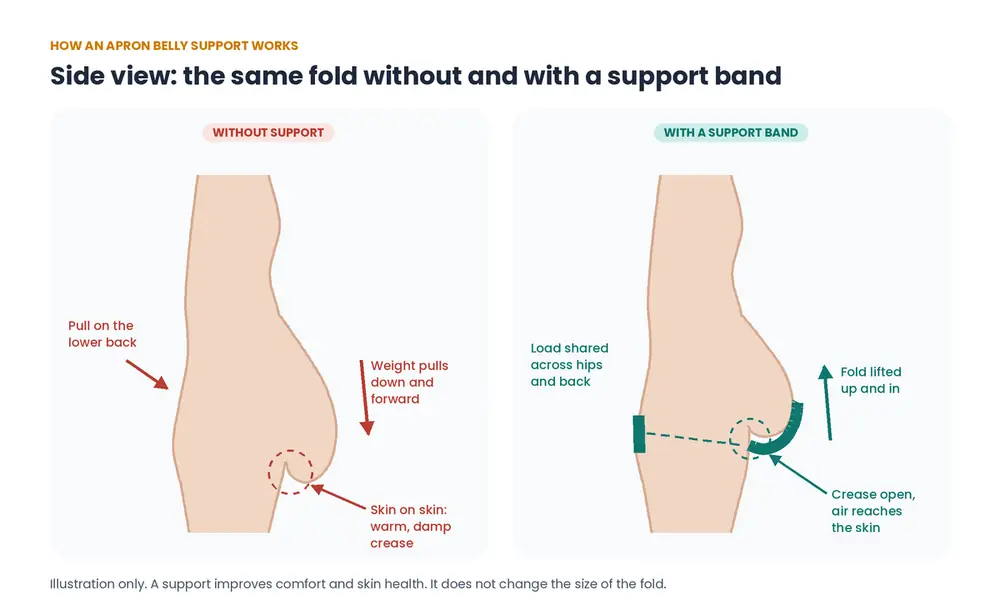
An apron belly, or panniculus, is a fold of skin and fat that hangs from the lower tummy. Our apron belly guide explains why it forms. When the fold is heavy, gravity pulls it down and forward all day. That creates three common problems.
- Back and hip strain, because the weight pulls your centre of gravity forward.
- Skin problems in the crease, because skin-on-skin contact traps heat and sweat.
- Movement discomfort, because the fold swings, rubs the thighs or gets in the way when you walk, bend or climb stairs.
An apron belly support works by lifting the fold up and slightly in. It shares the weight across your hips and back, opens the crease so it can breathe, and holds the tissue still when you move. It does not change your shape permanently, but it can make daily life much more comfortable.
The Main Types of Apron Belly Support
| Type | How it works | Best for | Watch out for |
|---|---|---|---|
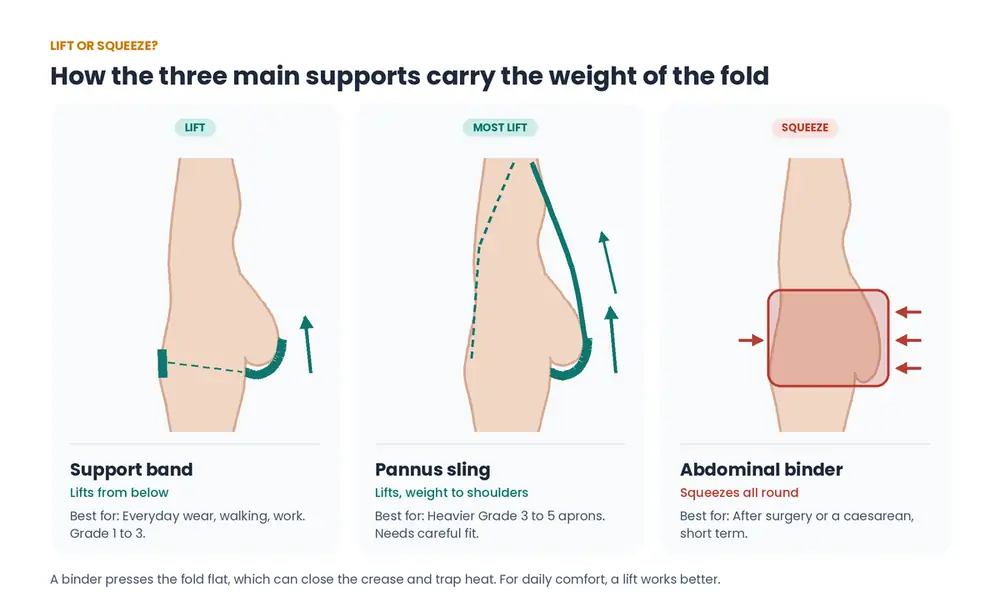
| Support band or belt | A wide elastic band that sits under the fold and fastens around the hips or lower back | Grade 1 to 3 aprons, walking, work | Can ride up if too narrow |
| Pannus sling or stomach lifter | A cradle under the apron with straps that go over the shoulders or around the back | Heavier Grade 3 to 5 aprons | Shoulder pressure, needs careful sizing |
| Abdominal binder | A wide panel wrapped around the whole tummy | After surgery or caesarean, short-term use | Squeezes rather than lifts. Can trap heat |
| Maternity support belt | A soft band under the bump that lifts from below | Pregnancy with an apron belly | Must not press across the top of the bump |
| Support underwear | High-waisted knickers with a firm front panel | Smaller aprons, everyday wear | Too tight a size rolls down into the crease |
| Kinesiology tape | Stretchy tape applied to lift the fold for a few hours | Short events, under swimwear or dresses | Skin irritation. Not for broken or sore skin |
Support Bands and Belts
A support band is the most popular option for everyday life. It is a wide strip of stretch fabric, usually 15 to 25 cm deep, that sits under the fold and closes with Velcro or hooks at the side or back. Some have a firmer front panel that curves under the apron like a hammock.
Look for these features:
- A breathable, moisture-wicking lining on the inside.
- A wide front panel that covers the whole width of the fold.
- Adjustable fastening so you can loosen it when sitting and tighten it when walking.
- Silicone grip strips along the top edge to stop it sliding down.
- Soft, flat seams so nothing presses into the crease.
Support bands work well for walking, standing jobs and exercise. Many people pair one with our favourite apron belly exercises so the fold does not bounce.
Pannus Slings and Stomach Lifters
For a larger or heavier apron, a band around the hips may not be enough. A pannus sling cradles the fold from below and transfers the weight through straps to the shoulders or upper back. Bariatric slings of this kind are also used in hospitals and care settings to help with washing and moving.
Slings give the most lift, but they need the most care with fit. Straps that are too tight can dig into the shoulders. Straps that are too loose let the fold drop back into the crease. If you have a Grade 4 or 5 apron, reduced mobility or skin problems, it is worth asking your GP for a referral to an occupational therapist or community nurse. They can advise on the right product and sometimes help with supply.
Abdominal Binders
An abdominal binder wraps around the whole tummy and applies even compression. Binders are often used after a caesarean, a tummy tuck or other abdominal surgery to support the wound and reduce swelling. Always follow your surgeon’s advice on how long to wear one.
For everyday apron support, binders are less ideal. They squeeze the fold flat rather than lifting it, which can push more tissue into the crease and trap heat. If you like the feel of compression, light shapewear for an apron belly that starts above the navel is often more comfortable.
Taping an Apron Belly
Some people use kinesiology tape to lift a small or medium apron for a few hours, for example under a swimsuit or a fitted dress. The tape is applied in strips from under the fold up towards the waist, with the fold held up while you stick it down.
Tape can be handy, but use it with care. Test a small strip on the skin for 24 hours first. Never apply it over broken, red or sore skin, and remove it slowly with oil. It is not a solution for all-day, every-day wear.
How to Measure for an Apron Belly Support
Poor sizing is the main reason supports end up in a drawer. Measure yourself standing, with a soft tape, before you buy.
- Hip measurement: around the widest part of your hips and bottom.
- Measurement under the fold: lift the apron gently and measure around the body just above the pubic bone.
- Fold depth: from the crease at the top of the apron to the lowest point, to choose the panel height.
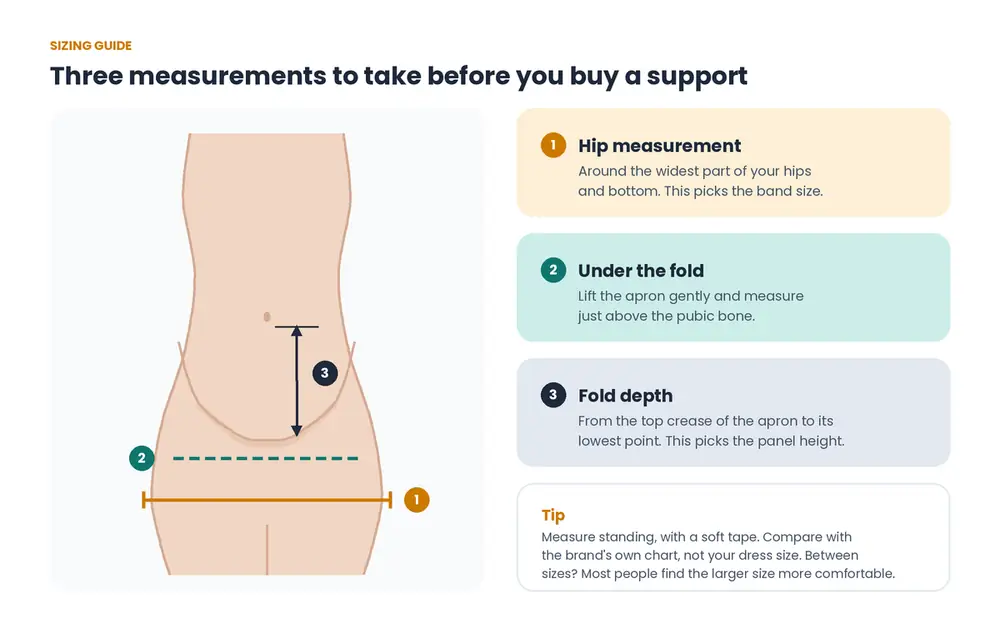
Compare these numbers with the brand’s size chart, not your dress size. If you sit between sizes, most people find the larger size with tighter adjustment more comfortable, particularly for all-day wear.
How to Wear a Support Safely
An apron belly support should feel like a lift, not a squeeze. Follow these simple rules.
- Put the support on while lying down or leaning back, so the fold is already lifted.
- Wear a thin cotton layer or a moisture-wicking liner between the band and your skin.
- Take it off for at least a few hours each day to let the skin breathe.
- Check the skin under the fold and along the edges every day for redness or marks.
- Wash the support often, following the care label, and keep a spare so one is always clean and dry.
Too much pressure over a long time can lead to skin breakdown. If you see red marks that do not fade within 30 minutes of taking the support off, loosen it or try a different style.
Supports, Skin Health and Lymphoedema
For many people the biggest benefit of a support is healthier skin. Lifting the fold lets air reach the crease, which reduces the moisture that causes intertrigo and fungal rashes. If your skin is already sore, treat the rash first with our apron belly rash treatment guide, then add the support.
Very large aprons can sometimes develop lymphoedema, a build-up of fluid that makes the tissue swollen, heavy and firm. The NHS lymphoedema page describes the main signs, which include swelling, a heavy aching feeling and repeated skin infections. If you notice these, see your GP before choosing a support. You may need specialist compression garments rather than an off-the-shelf band. Our guide to apron belly health risks explains how lymphoedema differs from other swelling.
If the skin under your apron becomes hot, swollen, painful or red and spreading, stop wearing the support and get medical advice the same day, as this can be cellulitis. The NHS cellulitis page explains when to call 111 or go to A&E.
Is a Support Enough, or Do You Need More?
A support is a comfort tool. It does not shrink the fold or remove loose skin. If your apron is causing repeated infections, pain or problems with daily life, it may be time to look at longer-term options. Our guide to getting rid of an apron belly covers lifestyle steps, and our apron belly surgery guide explains when a panniculectomy may be offered on the NHS.
Frequently Asked Questions
Do apron belly support belts actually work?
Yes, for comfort. A well-fitted support lifts the fold, eases back strain and helps keep the crease dry. It does not reduce the size of the apron over time.
Can I wear an apron belly support all day?
Many people wear one during the day, but take it off for a few hours and overnight. Check your skin daily and loosen it if it leaves deep marks.
What is the difference between a belly band and an abdominal binder?
A belly band lifts the apron from below. A binder wraps around the whole tummy and compresses it. Binders are mainly used after surgery.
Can I get an apron belly support on the NHS?
Sometimes. If your apron causes skin breakdown, lymphoedema or mobility problems, your GP, community nurse or occupational therapist may assess you for a support garment.
Is taping an apron belly safe?
Kinesiology tape is generally safe on healthy skin for short periods. Patch test first, never tape over sore or broken skin, and remove it gently with oil.
Can men use an apron belly support?
Yes. Most support bands and slings come in unisex sizes. Men with a heavy fold can follow the same sizing and skin care steps in this guide. Our guide to an apron belly in men explains the causes and health checks that matter most for men.