
Quick Answer
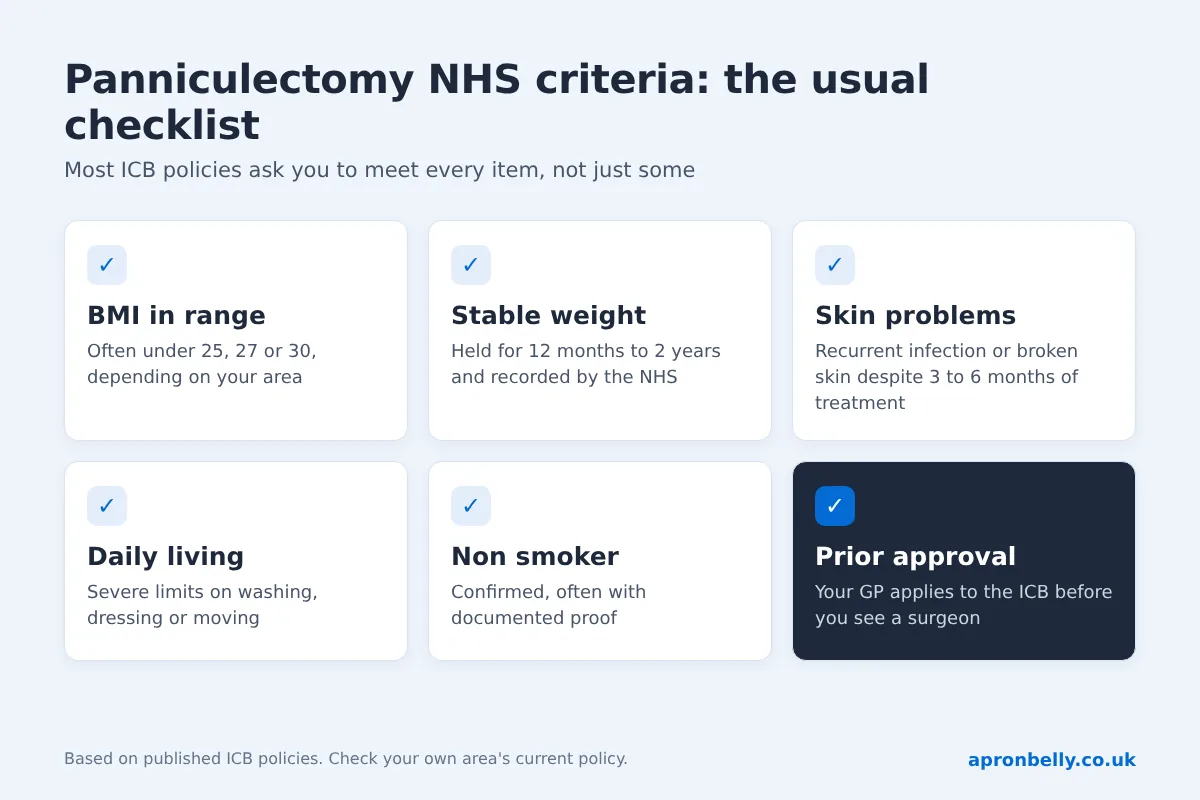
Panniculectomy NHS criteria are set by your local integrated care board, but most policies ask for the same things: a BMI in a set range (often under 25, 27 or 30), a stable weight for 12 months to 2 years, a real physical problem such as recurrent skin breakdown that has not cleared with treatment, and being a non-smoker.
- The apron often has to hang below the pubic area and limit daily living
- Some areas accept 75 per cent of excess weight lost instead of a low BMI
- Your GP must usually apply for prior approval before you can see a surgeon
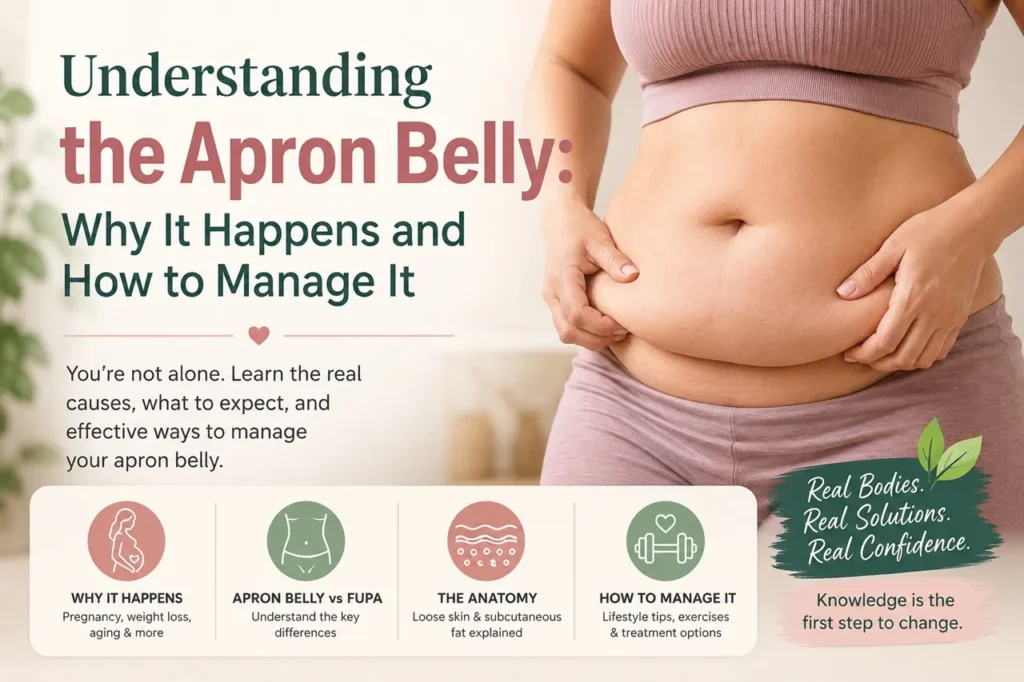
A panniculectomy removes the hanging apron of skin and fat from the lower belly. On the NHS it is not routinely funded, and whether you can have one depends on meeting a detailed checklist. This guide goes through the panniculectomy NHS criteria one rule at a time, with real examples from published NHS policies, a worked example of the excess weight loss rule and a self check table you can take to your GP.
This article is part of our apron belly surgery hub. For a broader overview of funding, read our guide to getting an apron belly operation on the NHS.
Who Sets the Panniculectomy NHS Criteria
Local policies, not one national rule
In England, funding for this operation is decided by each integrated care board (ICB). Most write a policy for “abdominoplasty and apronectomy” and class the procedure as low priority, meaning it is only paid for when strict conditions are met. Policies draw on guidance from the British Association of Plastic, Reconstructive and Aesthetic Surgeons, but each area sets its own numbers.
Panniculectomy, apronectomy and tummy tuck
Panniculectomy and apronectomy are two names for the same operation. A full tummy tuck (abdominoplasty) goes further by reshaping the whole abdomen and is usually treated as cosmetic. Our guide to panniculectomy vs tummy tuck explains the difference.
The BMI Rule
Typical BMI limits
Every policy sets a BMI limit, and this is where areas differ most. The examples below come from published ICB policies and show the range you may meet.
| ICB area | BMI rule | How long it must be stable |
|---|---|---|
| Derby and Derbyshire | 18 to 25, or at least 75% of excess weight lost | Lowest weight held for 1 year, recorded by the NHS |
| Leicester, Leicestershire and Rutland | 18 to 27 | 2 years |
| Cheshire and Merseyside | Under 30, or 30 to 40 for apronectomy alone with extra conditions | At least 12 months |
Policies are reviewed from time to time, so always check the current version for your own area.
Why BMI matters
The BMI limit is mainly about safety. Cheshire and Merseyside’s policy notes that its BMI cap is clinically driven to reduce surgical risk, because wound problems, infection and fluid collections are more common at a higher weight.
Weight Stability
How long is long enough
Surgeons want your weight to have settled before removing skin. If you are still losing weight, more loose skin may appear after the operation, and if weight goes back on, the result may not last. Most policies ask for 12 months to 2 years at a stable weight.
Getting your weight recorded
Some policies say the weight must be measured and recorded by the NHS, not just reported by you. Ask your practice to weigh you at regular appointments and note it in your record. That history is what the funding panel will look at.
The 75 Per Cent Excess Weight Loss Rule
How it works
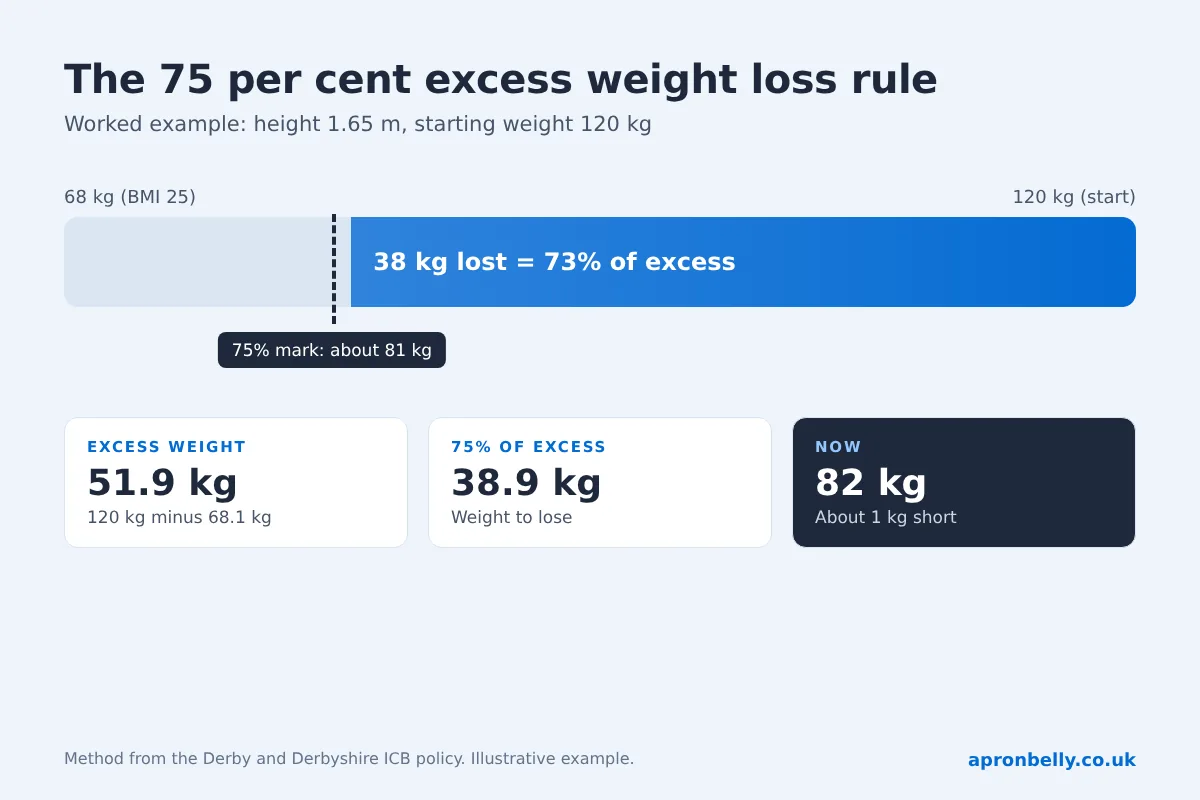
Some people cannot reach a BMI of 25 or 27, especially after a very high starting weight. Several policies offer an alternative: you must have lost at least 75 per cent of your excess weight. The Derby and Derbyshire policy defines excess weight as the amount above a BMI of 25, and divides the weight you have lost by that figure.
A worked example
A woman who is 1.65 m tall started at 120 kg, a BMI of about 44. At her height, a BMI of 25 equals about 68 kg, so her excess weight was about 52 kg. Losing 75 per cent of that means losing about 39 kg, which would bring her to about 81 kg.
| Step | Figure |
|---|---|
| Starting weight | 120 kg (BMI 44.1) |
| Weight at BMI 25 | 68.1 kg |
| Excess weight | 51.9 kg |
| 75% of excess | 38.9 kg |
| Target weight | About 81 kg |
| Current weight | 82 kg (BMI 30.1), so 73% of excess lost |
At 82 kg she is about 1 kg short of the 75 per cent mark under this rule. Under Leicester’s rule she would need a BMI of 27, which is about 73.5 kg. The same person can be close in one area and further away in another.
The Physical Problems You Must Show
Skin breakdown that does not settle
Most policies need evidence that the apron causes real harm to the skin. Cheshire and Merseyside looks for intertrigo with broken skin, such as cellulitis, ulceration or abscesses, lasting at least 3 months despite good skin care, dressings, suitable clothing and prescribed creams. Derby and Derbyshire asks for recurrent severe infection that has not responded to treatment for at least 6 months. Our guides to pannus cellulitis and apron belly rash treatment cover what to try and record.
Limits on daily living
Policies often ask for severe restrictions in activities of daily living. Derby and Derbyshire lists dressing, personal hygiene, moving around and meeting nutritional needs. Keep notes of what the apron stops you doing, such as washing properly or walking any distance.
The size of the apron
Some areas require the apron to hang below the mons pubis, the soft area over the pubic bone. In grading terms that usually means at least a grade 2 apron. Our guides to measuring your apron belly grade and large apron belly explain the scale.
Other Conditions Most Policies Include
Being a non smoker
Smoking slows wound healing, so almost every policy asks for a confirmed non smoker, often with documented proof of stopping before surgery.
Age and previous surgery
You usually need to be an adult who has finished growing, and you must not have had an abdominoplasty or apronectomy already.
Health and wellbeing checks
Cheshire and Merseyside excludes people with a diagnosis of body dysmorphic disorder or ongoing alcohol or drug misuse. Other policies ask for the problem to be both physical and psychological, so tell your GP honestly how the apron affects your mood and confidence.
The Evidence Your GP Will Need
What goes in the request
In most areas your GP or specialist must apply for prior approval before you can be listed for surgery. Our guide on how to ask your GP for a panniculectomy referral gives you a simple appointment script. Requests usually include:
- Details of the condition and how it affects daily living
- Your BMI and how long it has been maintained
- Your smoking status
- Records of skin problems and the treatments tried
- Clinical photographs, in areas that still ask for them
Approval is not a guarantee
Leicester, Leicestershire and Rutland’s policy makes clear that approval for an assessment does not guarantee surgery. The plastic surgeon still decides whether the operation is right for you, and you will need to give informed consent after hearing the risks.
Your Self Check Before You See the GP
| Criterion | Ask yourself | Where the proof comes from |
|---|---|---|
| BMI | Is my BMI within my ICB’s range? | Weight and height recorded at your practice |
| Stability | Has my weight been steady for 1 to 2 years? | Repeated weights in your GP record |
| Excess weight lost | Have I lost 75% of my excess weight, if my area allows this route? | Starting and current weights in your notes |
| Skin problems | Do I get infections or broken skin that keep coming back despite treatment? | GP or nurse notes, prescriptions, photos |
| Daily living | Does the apron stop me washing, dressing or moving well? | Your own diary and GP notes |
| Smoking | Am I a confirmed non smoker? | Smoking status in your record |
If You Do Not Meet the Criteria Yet
Work towards them
If your BMI is the barrier, NHS weight support can help you lose weight and build the recorded history policies look for. Our guide to NHS weight management services explains each level of help. Keep treating and documenting skin problems in the meantime.
Individual funding requests
If you do not meet the policy but your clinician believes your case is clinically exceptional, they can submit an individual funding request (IFR) to a panel. The bar is high, as you must be shown to differ from other people with the same condition.
Private surgery
Some people choose to pay privately. If you do, check that the surgeon is on the General Medical Council specialist register for plastic surgery and that the clinic is registered with the Care Quality Commission. Our apron belly surgery hub covers costs, recovery and risks.
Frequently Asked Questions
What BMI do you need for a panniculectomy on the NHS?
It depends on your local ICB. Published policies range from a BMI of 18 to 25 (Derby and Derbyshire), to 18 to 27 held for 2 years (Leicester, Leicestershire and Rutland), to under 30 held for 12 months (Cheshire and Merseyside, with a separate route up to 40 for apronectomy alone in some cases).
How long does my weight need to be stable?
Most policies ask for a stable weight for 12 months to 2 years before surgery is considered. Some, such as Derby and Derbyshire, say the weight must be measured and recorded by the NHS, so regular weigh ins at your GP practice help.
Is a panniculectomy free on the NHS if I have rashes?
Rashes alone are not usually enough. Policies typically look for chronic skin breakdown, such as intertrigo with broken skin, cellulitis or ulcers, that continues despite good skin care and treatment for at least 3 to 6 months, alongside the BMI and other rules.
Do I have to stop smoking for a panniculectomy on the NHS?
Yes, in almost every published policy. You will usually need to be a confirmed non-smoker, and some areas ask for documented proof that you have stopped before surgery.
What if I do not meet the panniculectomy NHS criteria?
Your clinician can submit an individual funding request if your case is clinically exceptional, though the bar is high. Otherwise you can keep working towards the criteria with weight support and skin treatment, or look at private surgery with a properly registered surgeon.
The Bottom Line
The panniculectomy NHS criteria are strict and vary by area, but they follow a clear pattern: a BMI in range, a stable weight that the NHS has recorded, persistent skin or daily living problems despite treatment, and being a non smoker. Find your ICB’s policy, compare it with the self check above and gather your evidence before you ask for a referral. For more on surgery options, visit our apron belly surgery hub.
Your next step
Search for your ICB’s name with “abdominoplasty apronectomy policy”, then book a GP appointment to go through each criterion with your records.
Featured image: surgical instruments laid out on a theatre table, Wikimedia Commons, CC0, cropped. This article is for general information and is not medical advice. NHS policies change, so always confirm the current criteria with your GP or ICB.