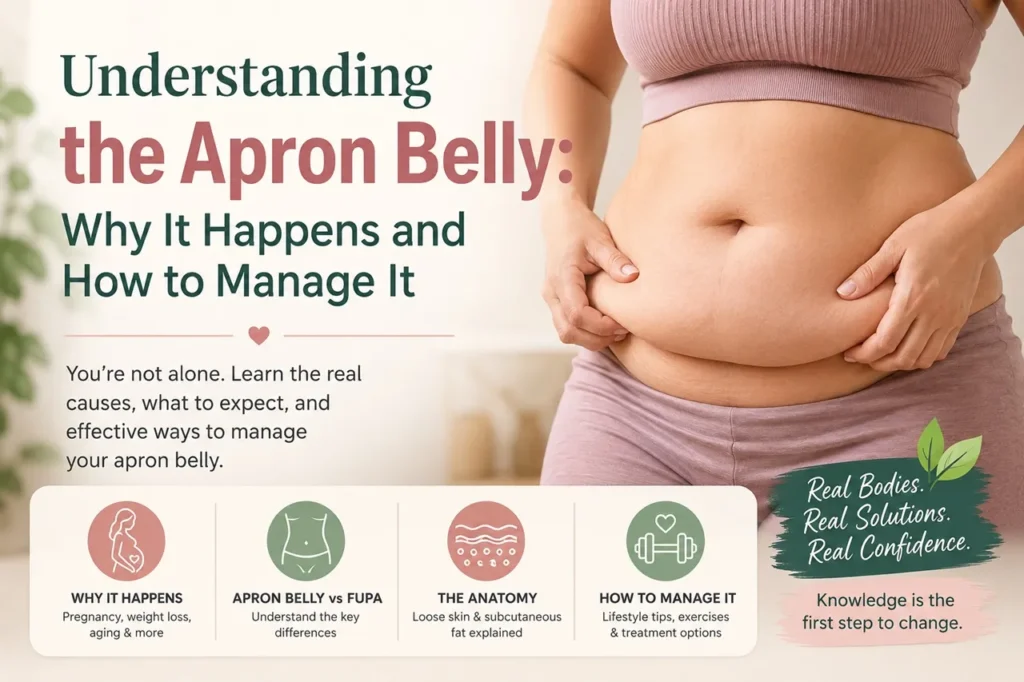
Reducing an apron belly after weight loss takes several steps. Keep your weight steady, eat enough protein and build core strength. Keep the skin fold clean and dry. These steps can shrink fat and improve comfort, but they cannot tighten badly stretched skin. Surgery, such as a panniculectomy or tummy tuck, is the only way to remove loose skin.
Key takeaways
- Most apron bellies after weight loss contain both subcutaneous fat and loose skin.
- Fat responds to diet and exercise, but redundant skin largely does not.
- Gradual weight loss of 0.5 to 1 kg per week is better for skin health.
- Keeping the skin fold clean and dry prevents most skin-fold problems.
- A panniculectomy removes the overhang. A tummy tuck also tightens the abdominal muscles.
You lost the weight. You put in the work, made the sacrifices, and transformed your body. But there’s still this fold of skin sitting below your waistline, and no amount of crunches seems to touch it.
That fold has a name: an apron belly, also known medically as abdominal pannus or pannus stomach. It’s one of the most common and least talked about realities of post-weight-loss body transformation. And it affects millions of people who have done everything right.
Here’s the truth: an apron belly is not a sign of failure. It’s a sign that your body went through something major. Skin is a living organ with a finite capacity to retract. When it’s been stretched over a long period, it doesn’t always bounce back, especially after major weight loss.
This guide covers 25 proven ways to reduce apron belly after weight loss, ranging from daily lifestyle habits to medical interventions. Not every approach will suit every person. But whether you’re looking for non-surgical solutions, clinical treatments, or simply want to understand what you’re dealing with, this is your comprehensive starting point.
The Science Behind Apron Belly: Is It Fat or Loose Skin?
Before diving into solutions, it’s worth understanding what you’re actually working with. The answer shapes which strategies will be most effective for you.
An apron belly can contain two distinct components:
- Subcutaneous fat: The layer of fat that sits directly beneath the skin. This type of fat is responsive to diet and exercise, and can be reduced over time.
- Redundant (loose) skin: Skin that has been stretched beyond its elastic capacity and no longer snaps back. This is largely unresponsive to diet and exercise.
Most people dealing with apron belly after weight loss have a combination of both. The ratio depends on how much weight was lost, how quickly the weight was lost, age, genetics, and the number of pregnancies. Our guide to apron belly fat versus loose skin explains simple ways to tell which one is more dominant.
Why traditional sit-ups often fail
Abdominal exercises build the muscles beneath the skin, but they don’t reduce subcutaneous fat in a targeted way, a concept known as spot reduction, which has been largely debunked by exercise science. And they certainly don’t tighten loose skin. This doesn’t mean exercise is useless, far from it. But the goal shifts from burning belly fat to building core support and improving posture.
A key anatomical factor worth mentioning is diastasis recti, a condition where the abdominal muscles separate along the midline. This is common after pregnancy and can make the lower abdomen protrude or hang more noticeably. It’s important to have diastasis recti assessed by a physiotherapist before attempting intense core work, as certain exercises can worsen the gap.
25 Proven Ways to Reduce Apron Belly After Weight Loss
Lifestyle and Nutrition Changes

1. Support Skin Elasticity Through Collagen-Rich Nutrition
Collagen is the structural protein responsible for skin firmness and elasticity. After major weight loss, collagen production can decrease, contributing to the appearance of loose skin.
Foods that support collagen production include:
- Bone broth
- Chicken and fish (which contain collagen-building amino acids)
- Eggs
- Leafy greens
- Berries
- Citrus fruits
The link between nutrition and collagen is indirect. Your body synthesises collagen using amino acids and cofactors, but a diet rich in protein and collagen-supporting nutrients creates the conditions for optimal skin health.
2. Prioritise Vitamin C Daily
Vitamin C is essential for collagen synthesis. Without adequate Vitamin C, the body cannot properly build or maintain collagen structures. Good sources include peppers, kiwi fruit, strawberries, broccoli, and oranges.
The NHS says most adults need 40mg of vitamin C a day. A varied diet with fruit and vegetables usually provides this.
3. Stay Hydrated
Hydration directly affects skin quality. Well-hydrated skin maintains better turgor, the technical term for its ability to resist deformation and bounce back. Chronic dehydration accelerates the appearance of sagging.
Aim for 2 to 3 litres of water per day, adjusting for body weight and activity level.
4. Eat Adequate Protein
Protein provides the amino acids your body uses to build and repair skin tissue. After weight loss, many people inadvertently under-eat protein, particularly if they’re still in a calorie deficit.
A general guideline from sports nutrition research suggests 1.2 to 2.0 grams of protein per kilogram of body weight daily to support muscle retention and tissue repair post-weight loss.
5. Avoid Rapid Weight Fluctuations
The skin stretches during weight gain and retracts (partially) during weight loss. The faster you lose weight, the less time the skin has to adapt. Repeated cycles of rapid weight loss and regain, often called yo-yo dieting, progressively reduce the skin’s elasticity.
Sustainable, gradual weight loss of 0.5 to 1kg per week is far better for skin health than aggressive calorie restriction that drops 2 to 3kg per week.
6. Limit Excess Sugar and Refined Carbohydrates
High sugar intake contributes to a process called glycation, where sugar molecules attach to collagen and elastin fibres, damaging them and reducing skin elasticity. Reducing processed sugar isn’t just good for metabolic health; it actively supports skin quality.
7. Incorporate Healthy Fats
Omega-3 fatty acids, found in oily fish, walnuts, and flaxseeds, support the lipid barrier of the skin and help maintain its suppleness. A diet chronically low in healthy fats can leave skin looking dry and less resilient.
Physical Exercises for Core Support and Posture
These exercises won’t spot-reduce fat or tighten loose skin directly. Their purpose is to strengthen the core muscles that sit beneath the apron belly, improve posture, reduce lower back pain, and support the abdominal wall. Over time, this creates a firmer foundation and can improve the area’s appearance.

Note: If you suspect diastasis recti, consult a physiotherapist before beginning any of these exercises.
8. Pelvic Tilts
Pelvic tilts gently engage the deep core muscles, including the transverse abdominis, the innermost abdominal muscle that acts like a natural corset.
How to do them:
- Lie flat on your back with knees bent and feet flat on the floor.
- Gently flatten your lower back against the floor by tightening your abdominal muscles.
- Hold for 5 to 10 seconds, then release.
- Repeat 10 to 15 times.
This is one of the safest starting exercises for people with abdominal pannus, especially post-pregnancy.
9. Modified Planks
Full planks place heavy pressure on the lower back. Modified planks (on knees) still effectively engage the core while reducing strain.
How to do them:
- Start on all fours, then lower onto your forearms.
- Keep your knees on the ground and your back straight.
- Hold for 20 to 30 seconds, building up to 60 seconds.
- Repeat 3 times.
10. Bridge Exercises
Bridges activate the glutes, lower back, and core simultaneously, which is key for overall abdominal support and posture.
How to do them:
- Lie on your back with knees bent, feet flat on the floor, hip-width apart.
- Press through your heels to lift your hips until your body forms a straight line from shoulders to knees.
- Hold for 2 to 3 seconds, then lower slowly.
- Repeat 10 to 15 times for 3 sets.
11. Bird-Dog Exercise
Bird-dogs build stability in the spine and deep core without placing pressure on the abdominal wall.
How to do them:
- Start on all fours, hands under shoulders, knees under hips.
- Extend your right arm and left leg simultaneously, keeping hips level.
- Hold for 3 to 5 seconds, then return to start.
- Alternate sides. Complete 10 reps per side.
12. Walking Daily
Walking is consistently underrated as a weight-management and core-conditioning tool. A 2026 review in iScience confirmed that regular walking, particularly at a brisk pace, reduces overall body fat, including abdominal fat.
Walking also improves posture and reduces lower back pain, both of which are common side effects of carrying extra weight at the front of the body.
Aim for 7,000 to 10,000 steps per day as a baseline goal.
13. Swimming and Aqua Exercise
Water-based exercise is particularly well-suited for people with an apron belly because the buoyancy reduces joint pressure, making movement more comfortable. Swimming engages the core, builds lean muscle, and supports cardiovascular health, all without the chafing or discomfort that higher-impact activities might cause.
14. Yoga and Pilates for Core Depth
Both yoga and Pilates emphasise deep core engagement, breathing, and postural alignment. Many poses, such as cat-cow, child’s pose, and the hundred, engage the transverse abdominis without the risks associated with conventional crunches.
Pilates, in particular, was originally developed for rehabilitation and is widely recommended for people with diastasis recti and for those experiencing post-weight-loss body changes.
Skincare, Hygiene, and Daily Management
Skin-fold hygiene is one of the most clinically important and most overlooked aspects of managing apron belly. When skin rests against skin, moisture, friction, and warmth create conditions where irritation, rashes, and yeast infections can develop.

15. Keep the Skin Fold Clean and Dry
Rinse the area beneath the belly fold daily with a mild, fragrance-free soap. After showering, pat thoroughly dry, do not rub. Allow the area to air out for a few minutes before dressing.
This single habit prevents most skin-fold complications.
16. Use Anti-Chafing Products
Friction under the apron belly is a daily source of discomfort. Options that help include:
- Barrier balms (such as Bepanthen or petroleum jelly)
- Cornflour-based powders to absorb moisture
- Moisture-wicking liner cloths placed inside the fold
Avoid talcum powder, which has been associated with skin irritation in sensitive areas.
17. Watch for Signs of Intertrigo
Intertrigo is a skin condition caused by friction and moisture in skin folds. Symptoms include redness, itching, a burning sensation, and sometimes a faint odour. It’s extremely common with abdominal pannus.
Mild cases usually respond to keeping the area clean and dry, along with an over-the-counter antifungal cream. If symptoms persist beyond a few days or the skin becomes cracked, painful, or weeps fluid, seek medical advice promptly.
18. Wear Supportive, High-Waisted Underwear
Standard underwear with thin elastic waistbands can cut directly into the skin fold, causing pain and worsening irritation. High-waisted underwear with wide, soft bands distributes pressure across a larger area, dramatically improving comfort.
Look for styles made from breathable, moisture-wicking fabrics like cotton or bamboo. Avoid synthetic fabrics that trap heat.
19. Use Compression Garments and Binders
Abdominal binders and compression garments serve multiple purposes:
- Provide gentle mechanical support to the lower abdomen
- Reduce the movement and friction of the skin fold during physical activity
- Improve posture by engaging core awareness
- Can improve comfort and confidence in clothing
Medical-grade compression garments are often recommended post-surgically, but they’re also useful for non-surgical management. Choose the correct size: garments that are too tight can restrict breathing and impair circulation.
20. Choose Clothing That Reduces Discomfort
Practical clothing choices make a big difference in daily quality of life:
- High-waisted jeans sit above the fold rather than cutting across it.
- A-line dresses and skirts skim over the lower abdomen without clinging.
- Tunics and wrap tops provide coverage without adding bulk.
- Stretchy, high-waisted leggings offer support without pressure points.
These aren’t concessions, they’re choices that prioritise comfort while maintaining personal style.
Skincare Treatments for Skin Quality

21. Dry Brushing
Dry brushing involves using a firm-bristled body brush on dry skin before showering, using upward strokes toward the heart. Proponents suggest it stimulates lymphatic drainage and increases circulation to the skin.
While clinical evidence on dry brushing specifically for loose skin is limited, it’s a low-risk habit that many find improves skin texture and provides sensory benefits. Use gentle pressure to avoid irritation, especially in sensitive areas.
22. Firming Moisturisers
Topical products containing ingredients such as retinol, hyaluronic acid, niacinamide, and caffeine may improve skin surface quality and temporarily increase skin firmness. They won’t dramatically tighten heavily stretched skin, but they can improve texture, hydration, and resilience over time.
Apply after showering, while the skin is still slightly damp, to maximise absorption.
Medical and Clinical Interventions
When lifestyle changes don’t produce the results you’re looking for, or when the apron belly is causing recurrent health problems, medical interventions become a legitimate consideration.

23. Non-Surgical Body Contouring Options
Several non-surgical treatments are available for loose skin and localised fat reduction. It’s critical to approach these with realistic expectations: they produce modest improvements in mild-to-moderate cases and are unlikely to greatly reduce a large abdominal pannus.
- Radiofrequency (RF) treatments (e.g., Thermage, Morpheus8): Use heat energy to stimulate collagen production and tighten skin. Results develop gradually over 3 to 6 months.
- High-Intensity Focused Ultrasound (HIFU): Delivers focused energy to deeper skin layers to trigger collagen remodelling.
- Cryolipolysis (CoolSculpting): Freezes and destroys subcutaneous fat cells. More effective for fat reduction than for loose skin.
- Laser treatments: Certain laser modalities (e.g., SculpSure) can reduce fat and mildly tighten overlying skin.
These treatments typically require multiple sessions and carry costs ranging from hundreds to thousands of pounds. Consult a qualified aesthetic physician or dermatologist before proceeding.
24. Panniculectomy
A panniculectomy is a surgical procedure that removes the pannus, the hanging fold of skin and fat itself. Unlike a full tummy tuck, a panniculectomy does not tighten the underlying abdominal muscles. It’s primarily a functional surgery designed to remove tissue that is causing medical problems, such as:
- Recurrent intertrigo or skin infections
- Interference with mobility or hygiene
- Chronic lower back pain caused by the weight of the pannus
Because of its functional nature, panniculectomy is sometimes considered medically necessary and may be funded by the NHS. However, NHS funding is rare and strict. Your GP refers you, and your local NHS board decides. Evidence of recurrent infections and failed conservative treatment is usually needed. Private medical insurance usually excludes cosmetic surgery, so check your policy. Privately, a panniculectomy costs from about £6,000.
Recovery: Most patients require 4 to 6 weeks before returning to light activity.
25. Abdominoplasty (Tummy Tuck)
A tummy tuck (abdominoplasty) is a more comprehensive cosmetic surgical procedure. In addition to removing excess skin and fat, it tightens the underlying abdominal muscles, making it particularly valuable when diastasis recti is present.
Tummy tuck results are long-lasting and can dramatically improve both the appearance and physical comfort of the abdomen. However, it is a major surgical procedure with meaningful risks, including:
- Infection
- Scarring
- Seroma (fluid accumulation)
- Blood clots
- Prolonged recovery
Recovery: Full recovery typically takes 6 to 8 weeks, with restrictions on strenuous activity for up to 3 months.
Abdominoplasty is typically classified as cosmetic surgery. The NHS rarely funds it, and private medical insurance usually excludes it. A private tummy tuck in the UK typically costs £6,500 to £9,500. Our apron belly surgery cost guide explains the full costs.
If you’re considering surgery, see a consultant plastic surgeon on the GMC Specialist Register with specialised experience in post-weight-loss body contouring. Request to see before-and-after pictures of patients with similar starting points.
Common Myths vs. Facts About Apron Belly

Myth: You Can Spot-Reduce an Apron Belly With Exercise
Fact: Spot reduction, the idea that exercising a specific body part burns fat from that area, has been consistently disproven in exercise science research. Core exercises build and strengthen the muscles beneath the apron belly, which can improve posture and provide better support, but they don’t selectively target subcutaneous fat or tighten the loose skin that forms pannus.
Myth: Losing More Weight Will Make It Disappear
Fact: For many people, further weight loss may actually make the apron belly more pronounced, not less. This is because additional fat loss reveals more of the loose skin that was previously occupied by fat. The skin itself doesn’t tighten just because the fat inside it is reduced.
Myth: Apron Belly Is Always Fat
Fact: Many people, particularly those who have lost large amounts of weight, find that their apron belly contains very little fat. It is primarily loose skin. This distinction matters enormously because fat responds to diet and exercise, while redundant skin does not.
If weight loss has slimmed your tummy but your hips and legs have barely changed, the cause may be different. Painful, stubborn fat on both legs that stops at the ankles can be a sign of lipoedema. Our guide on lipoedema or apron belly explains how to spot the difference and when to see your GP.
Myth: Creams and Oils Can Tighten Severely Stretched Skin
Fact: Topical products can improve skin hydration, texture, and surface quality, but they cannot penetrate deep enough to structurally repair severely stretched collagen and elastin fibres. They are a useful part of skin maintenance, but are not a treatment for a large amount of loose skin.
Myth: Only Overweight People Get an Apron Belly
Fact: Apron belly can affect people across a wide range of body types. Thin individuals with a history of large-volume weight loss or multiple pregnancies can have a large apron belly with little to no remaining fat.
When Should You See a Doctor About Your Apron Belly?
An apron belly is not always a cosmetic concern; it can become a genuine medical issue. Consult a healthcare provider if you experience:
- Recurrent rashes or infections in the skin fold that don’t resolve with home care.
- Chronic lower back pain that is aggravated by the weight of the pannus
- Difficulty with mobility or hygiene due to the size of the fold
- Ulceration or open sores in the skin fold area
- Serious psychological distress affecting daily quality of life
In these situations, medical intervention, including surgical options, may not only be cosmetically desirable but also medically necessary.
Frequently Asked Questions
Walking helps reduce overall body fat, including subcutaneous fat that may contribute to apron belly. It also strengthens the core and improves posture. However, walking alone cannot tighten loose skin that has lost its elasticity after major weight loss. It is a valuable part of a broader management strategy, not a standalone solution.
Yes. A C-section creates scar tissue above the incision line. This scar tissue can adhere to deeper structures, causing the overlying skin and fat to fold or overhang more noticeably.
Skin tightening after weight loss is highly variable. Mild-to-moderate skin looseness may improve noticeably over 1 to 2 years as the body continues to remodel collagen.
No. A FUPA (fat upper pubic area) refers to fat that accumulates above the pubic bone, sitting higher on the abdomen. An apron belly involves a larger fold of skin and fat that hangs down from the lower abdomen, sometimes extending over the pubic area. The two conditions can coexist but have different anatomical profiles and different management options.
A panniculectomy may be funded by the NHS in cases where the apron belly causes documented, ongoing medical problems such as recurrent skin infections, ulcers, or serious mobility impairment. Purely cosmetic requests are not typically funded.
Final Verdicts
Reducing apron belly after weight loss is rarely a single-step process. The 25 strategies covered in this guide work at different levels: nutrition and lifestyle changes address the fat component and support skin quality; targeted exercises build the core foundation; skincare and hygiene practices protect your comfort day-to-day; and medical interventions offer options when conservative approaches aren’t enough.
No single approach fits every person. Your ideal path depends on how much of your apron belly is fat versus loose skin, your overall health, your goals, and your circumstances. The most important thing is starting with accurate information, and you now have exactly that.
The body that carried you through weight loss, pregnancy, or whatever transformation you’ve been through deserves care and respect. Managing an apron belly isn’t about chasing a “perfect” body. It’s about feeling comfortable in the one you have.
If you’re ready to take the next step, speak with your GP or a qualified specialist to discuss which options are right for your specific situation.