
Quick Answer
The main difference in apron belly vs muffin top is where the fat sits and what it is made of. An apron belly is a fold of fat and often loose skin that hangs down from the lower tummy over the pubic area. A muffin top is soft fat that spills over the top of a waistband at the sides and front, and it often looks smaller or disappears when you take tight clothes off.
- Apron belly: hangs down from below the belly button and stays when you are undressed
- Muffin top: bulges outward above a waistband and is shaped mostly by clothing
- Both shrink with overall fat loss; only an apron belly may leave loose skin
Looking in the mirror and wondering about apron belly vs muffin top is common, because both describe extra softness around the middle and both show up most when you are dressed. They are not the same thing, though. One is a fold that hangs from the lower tummy, the other is fat that bulges over a waistband. Knowing which one you have helps you choose the right clothes, set realistic goals and spot when it is worth speaking to your GP. This guide explains the differences, how to check yourself at home and what actually helps each one.
This article is part of our belly guide hub. If your tummy hangs down rather than out, our guide to the hanging belly covers the causes in more detail.
What Is an Apron Belly?
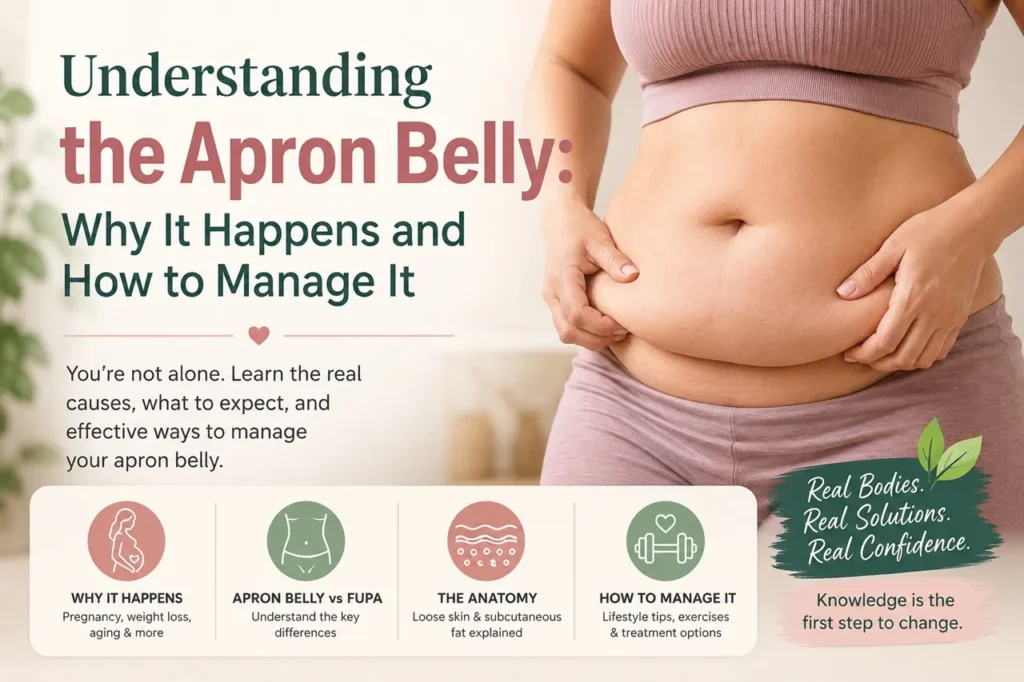
An apron belly is a fold of fat and skin that hangs down from the lower abdomen, a bit like an apron.
The medical name
Doctors call it a pannus or panniculus. It forms below the belly button and drapes over the pubic area. In larger cases it can reach the upper thighs. Clinicians grade it from 1 to 5 depending on how far it hangs, and our apron belly grade guide shows how to check yours.
Common causes
- weight gain, especially fat stored under the skin of the lower tummy
- pregnancy, particularly more than one, which stretches the skin and tummy muscles
- major weight loss, which can leave stretched skin behind
- ageing, as skin loses collagen and elasticity
- a caesarean scar, which can tether the skin and change the shape of the fold
How it behaves
An apron belly stays in place when you take your clothes off. When you lie down it tends to fall towards your sides. The skin under the fold can trap heat and sweat, which is why rashes and soreness in the crease are common.
What Is a Muffin Top?
A muffin top is soft fat that bulges over the top of trousers, jeans or a skirt, like the top of a muffin rising over its case.
Where it shows
It sits around the waistband, usually at the sides and front, and sometimes wraps round to the lower back. It is not a medical term. It describes a shape that clothing creates as much as the body underneath.
What causes it
- fat stored under the skin around the waist and hips
- waistbands that are too tight or sit too low, which push soft tissue up and over
- stretchy fabrics that grip at one line instead of spreading pressure
- weight gain in general, as the waist is one of the first places many people store fat
Why it can look worse in some clothes
A narrow, tight waistband acts like a belt. Soft tissue above it has nowhere to go but out. In a wider, higher or softer waistband the same body can look quite different.
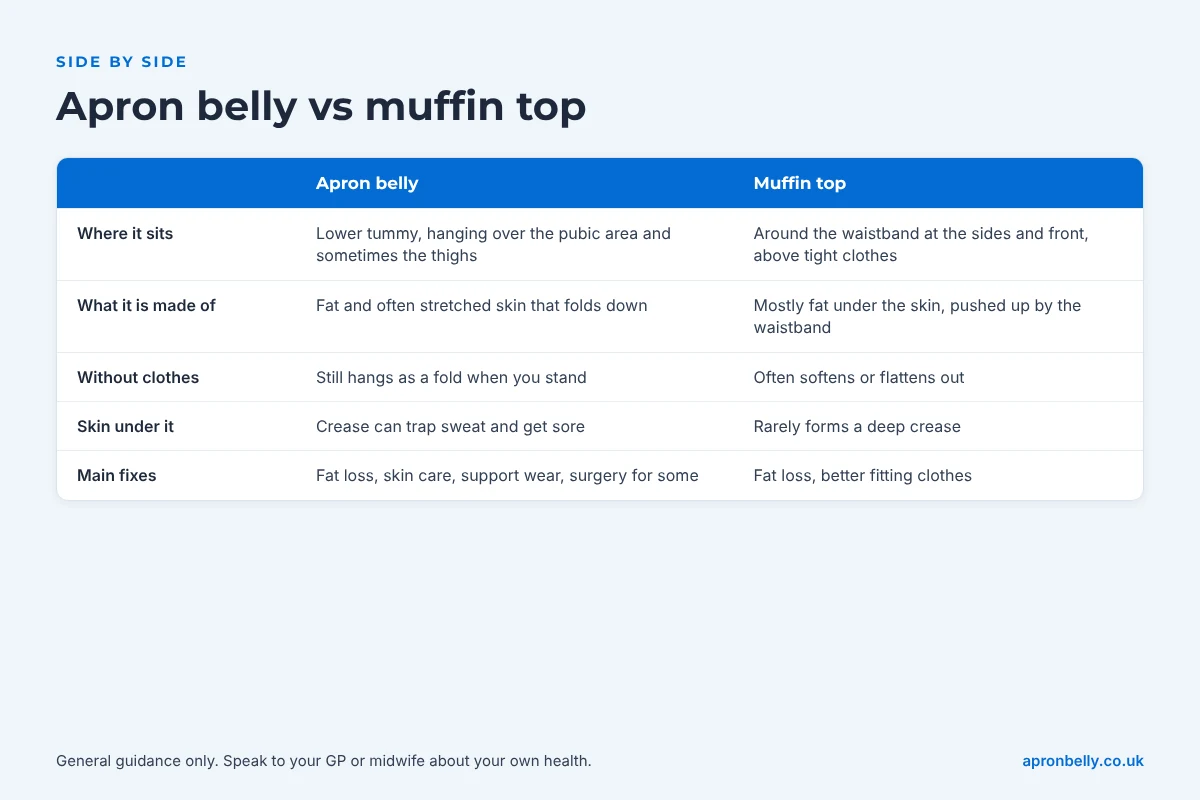
Apron Belly vs Muffin Top: Key Differences
The table below sets out the main differences side by side.
| Feature | Apron belly | Muffin top |
|---|---|---|
| Position | Lower tummy, hanging down over the pubic area | Waistline, bulging out over a waistband |
| Direction | Hangs downward | Pushes outward and upward |
| Made of | Fat, often with loose stretched skin | Mostly fat under the skin |
| Without clothes | Still present as a fold | Often softens or flattens |
| Skin fold | Deep crease that can trap moisture | Usually no deep crease |
| Medical term | Pannus or panniculus | None, it is everyday slang |
| Main fixes | Fat loss, skin care, support wear, surgery for some | Fat loss, better fitting clothes |
Direction and position
Think of an apron belly as vertical and a muffin top as horizontal. The apron hangs down from the lower belly. The muffin top rings the waist like a ridge. Love handles are a third shape again, sitting at the sides above the hips, and our comparison of apron belly vs love handles explains how to tell those apart.
Fat versus skin
A muffin top is almost always fat. An apron belly can be mostly fat, mostly skin, or a mix. This matters because fat responds to weight loss while stretched skin does not shrink much on its own.
Can you have both?
Yes. Many people have a muffin top at the waistband and an apron below it, especially after pregnancy or weight gain. In that case the muffin top is often the first to improve as you lose fat.
How to Tell Which One You Have
The undressed mirror test
Take off anything with a waistband and stand side on to a mirror. If there is a fold that hangs down from below your belly button, covering part of the pubic area, that is an apron belly. If the bulge mostly disappears and your waist looks smooth, the shape was largely a muffin top created by your clothes.
The lift test
Gently lift the lower tummy. If a crease appears underneath, with skin resting on skin, you have some degree of apron. If there is nothing to lift, you do not.
The waistband test
Put on your usual jeans, then a pair one size up or with a higher, wider waistband. If the bulge shrinks a lot, clothing is a large part of the picture. Our guide to the best jeans for apron belly covers fits that sit comfortably over both shapes.
Check your waist to height ratio
Whichever shape you have, it is worth checking how much fat you carry around the middle. The NICE guideline on assessing overweight and central adiposity uses waist to height ratio. Measure your waist halfway between the bottom of your ribs and the top of your hips, roughly just above the belly button, after breathing out normally. Divide it by your height in the same units.
| Waist to height ratio | What NICE says it means |
|---|---|
| 0.4 to 0.49 | Healthy central adiposity, no increased health risk |
| 0.5 to 0.59 | Increased central adiposity, increased health risk |
| 0.6 or more | High central adiposity, further increased health risk |
NICE uses these bands for adults with a BMI under 35. A simple target is to keep your waist under half your height. With an apron belly, measure at the waist point described above, not across the lowest part of the fold.

Does It Matter for Your Health?
Fat around the middle
Both shapes are signs of fat stored around the trunk. A higher waist to height ratio is linked with a higher risk of conditions such as type 2 diabetes and heart disease, whatever the visible shape. Some of this risk comes from fat deeper inside the tummy, around the organs, which you cannot see in the mirror. A firm, rounded tummy is often a sign of this deeper fat, and our guide to apron belly vs pot belly explains how to tell the two apart. Our article on apron belly vs belly fat explains the difference between fat under the skin and deeper fat.
Skin problems are mainly an apron belly issue
A muffin top rarely causes skin trouble. An apron belly can, because warm, damp skin in the crease is prone to rashes, odour and, less often, infection. Washing and drying under the fold every day helps, and our guide on how to wash under an apron belly sets out a simple routine.
When to see your GP
- the skin under your fold is often sore, cracked or smells despite good hygiene
- the fold gets in the way of walking, exercise or daily tasks
- you notice a new lump, bulge or pain in your tummy
- your waist is growing quickly without an obvious reason
What Helps a Muffin Top
Overall fat loss
You cannot burn fat from the waistline alone. A modest calorie deficit with regular activity reduces fat across the body, and the waist often responds early. Our guide to the calorie deficit for apron belly gives NHS aligned starting points that work for both shapes.
Better fitting clothes
- choose mid or high rise waistbands that sit at your natural waist
- look for wide, soft or curved waistbands instead of narrow, stiff ones
- size up at the waist and have the legs taken in if needed
- wear tops that skim over the waistband rather than tucking in tightly
Strength work
Building muscle supports posture and helps with fat loss over time. It will not spot reduce, but standing taller can change how the waistline looks in clothes.
What Helps an Apron Belly
Fat loss first
The fat part of an apron belly shrinks with steady weight loss. How much the fold lifts depends on how much of it is skin. Our full guide on the best way to get rid of apron belly sets out options by grade.
Daily comfort and support
Support garments can lift the fold, spread its weight and reduce chafing. Breathable fabrics and a dry crease keep skin healthier. Our guide to a stomach hanging over trousers covers fit tips for when the apron and waistband meet.
Surgery for some people
If a large fold remains after weight loss and causes ongoing skin or mobility problems, a GP can discuss whether a referral for surgery to remove it is appropriate. NHS funding is limited and has strict criteria, which our tummy tuck hub explains.
A Worked Example
A 38 year old woman notices a bulge over her jeans and assumes she has an apron belly. In front of the mirror without clothes, her waist looks smooth and there is no fold to lift. Her waist is 84 cm and her height is 165 cm, a ratio of 0.51. That puts her just inside the increased risk band. She switches to high rise jeans with a wider waistband, which removes most of the visible bulge, and aims for a small calorie deficit with daily walks. Her goal is to bring her ratio under 0.5.
What this shows
Clothing can create a muffin top on its own, but the measurement still gives a useful health check. Fixing the fit and working on overall fat loss tackle different parts of the problem.
Frequently Asked Questions
Is a muffin top the same as an apron belly?
No. A muffin top is fat that bulges over a waistband at the sides and front. An apron belly is a fold of fat and often loose skin that hangs down from the lower tummy over the pubic area, and it stays when you are undressed.
Can a muffin top turn into an apron belly?
It can over time. If you keep gaining weight, or after pregnancy or ageing stretches the skin, fat in the lower tummy can begin to hang down as a fold. Keeping a steady, healthy weight lowers the chance of this.
Which is easier to get rid of?
A muffin top is usually easier because it is mostly fat and is often made worse by tight clothes. An apron belly with a lot of loose skin may not fully go with weight loss alone.
Do waist trainers fix a muffin top or apron belly?
No. Waist trainers squeeze tissue while you wear them but do not remove fat or tighten skin. Very tight garments can also be uncomfortable and make breathing harder.
How do I know if my belly fat is a health risk?
Divide your waist measurement by your height. NICE says a ratio of 0.5 to 0.59 means increased health risk and 0.6 or more means further increased risk. Speak to your GP if you are worried.
The Bottom Line
In apron belly vs muffin top, the key difference is direction and makeup: an apron belly hangs down from the lower tummy and may include loose skin, while a muffin top bulges over a waistband and is mostly fat shaped by clothing. Both respond to overall fat loss, a muffin top often improves quickly with better fitting clothes, and an apron belly may also need skin care, support or, for some people, surgery. For more on shapes and causes, visit our belly guide hub.
Your next step
Today, do the undressed mirror test and measure your waist to height ratio. Write both down so you know which shape you have and where you are starting from.
Featured image: jeans on shop mannequins by Mark Hillary, Wikimedia Commons, CC BY 2.0, cropped.