
Quick Answer
The main difference in apron belly vs pot belly is the type of fat and the shape it makes. An apron belly is a soft fold of fat under the skin, often with loose skin, that hangs down from the lower tummy. A pot belly is a rounded tummy that pushes forward and often feels firm, because much of the extra fat sits deep inside the abdomen around the organs. This deeper fat is called visceral fat.
- Apron belly: hangs down, feels soft and can be lifted, with a crease underneath
- Pot belly: sticks out in front, feels firm and has little to pinch or lift
- Both shrink with overall fat loss, and visceral fat often responds well to it
Comparing apron belly vs pot belly is a good way to understand what is actually going on around your middle. Both make the tummy look bigger, but they are built from different kinds of fat, they sit in different places and they carry different health messages. A pot belly is mostly about fat stored deep inside, while an apron belly is mostly about fat and skin on the outside. This guide explains the differences, simple checks you can do at home, what the NHS says about waist size and what helps each shape.
This article is part of our belly guide hub. If your tummy hangs down rather than out, our guide to the hanging belly explains the causes in more detail.
What Is an Apron Belly?
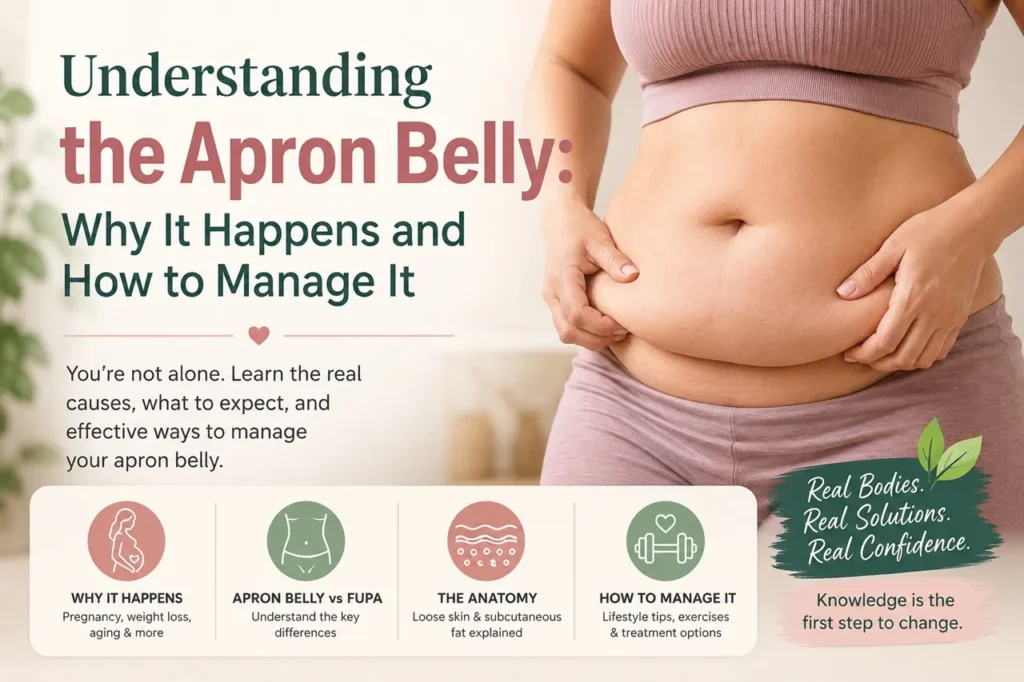
An apron belly is a fold of fat and skin that hangs down from the lower abdomen over the pubic area, a bit like an apron.
The medical name
Doctors call it a pannus or panniculus. It forms below the belly button and can range from a small overhang to a large fold that reaches the thighs. Clinicians grade it from 1 to 5 depending on how far it hangs, and our apron belly grade guide shows how to check yours.
What it is made of
An apron belly is mainly subcutaneous fat, which is the fat that sits just under the skin. You can pinch it and hold it. After pregnancy, major weight loss or with age, stretched skin often adds to the fold, which is why it may not disappear fully even when fat is lost.
How it behaves
An apron belly feels soft and moves when you do. It hangs down when you stand and falls to the sides when you lie down. The crease underneath can trap heat and sweat, so rashes and soreness in the skin fold are common.
What Is a Pot Belly?
A pot belly is a rounded tummy that sticks out in front, often from the ribs down to the belly button, and tends to feel firm rather than soft.
Where it shows
A pot belly sits higher and more centrally than an apron belly. From the side the tummy looks round, like a pot, while the arms and legs may stay fairly slim. It is not a medical term, and the same shape is often called a beer belly, although alcohol is only one of the causes. Our comparison of apron belly vs beer belly looks at that drinking angle in more detail.
Visceral fat explained
Much of the extra size in a pot belly comes from visceral fat. This is fat stored deep inside the abdomen, behind the tummy muscles and around organs such as the liver and intestines. A small amount protects the organs. Too much pushes the abdominal wall outwards from the inside, which is why a pot belly can feel tight and why there is often little to pinch.
Other reasons a tummy looks rounded
- bloating from wind, constipation or certain foods, which usually comes and goes
- a gap between the tummy muscles after pregnancy, called diastasis recti, which can make the middle bulge
- posture, as tilting the pelvis forward makes the lower tummy push out
- weak core muscles that give less support to the abdominal wall
These can make a tummy look rounder without much extra fat. Bloating usually changes through the day, while fat does not. If you think you have a gap between your tummy muscles after pregnancy, ask your GP about a referral to a physiotherapist.
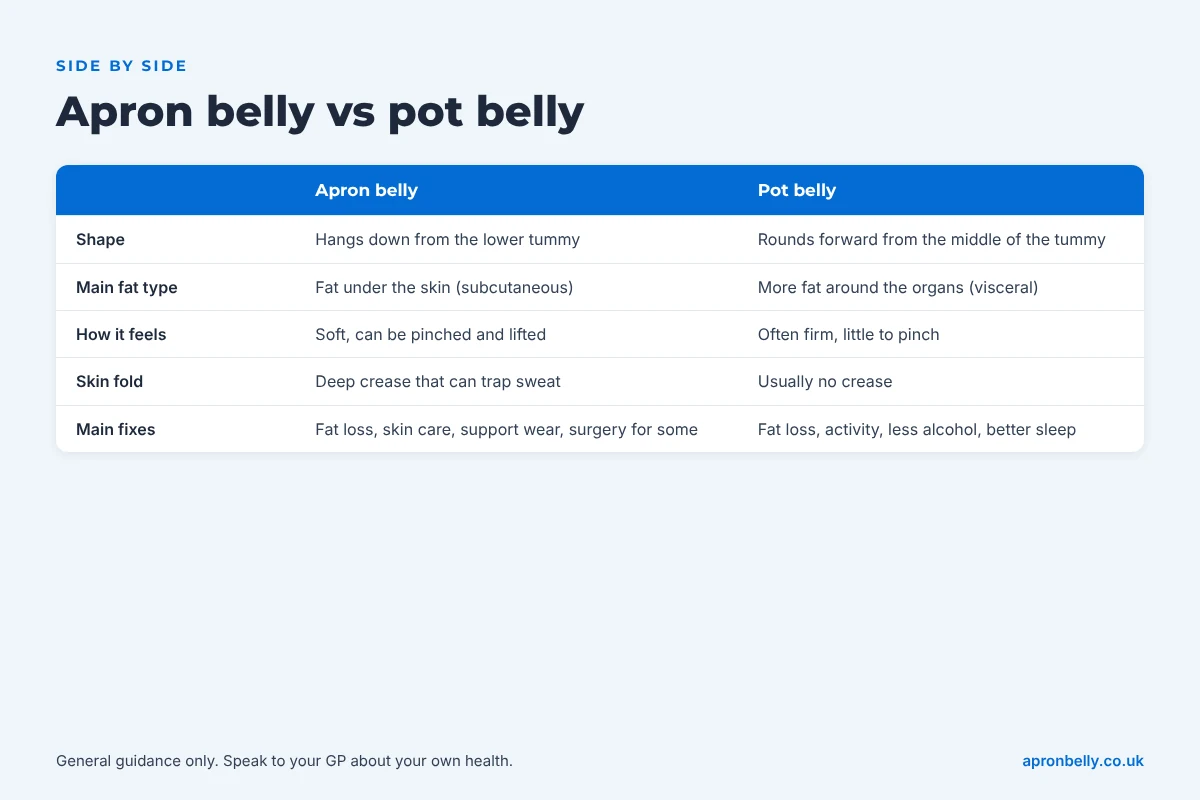
Apron Belly vs Pot Belly: Key Differences
The table below sets out the main differences side by side.
| Feature | Apron belly | Pot belly |
|---|---|---|
| Shape | Hangs down from the lower tummy | Rounds forward from the middle of the tummy |
| Main fat type | Subcutaneous fat under the skin | Often more visceral fat around the organs |
| Feel | Soft, can be pinched and lifted | Often firm, with less to pinch |
| Loose skin | Common, especially after pregnancy or weight loss | Uncommon, the skin is usually stretched tight |
| Skin fold | Deep crease that can trap moisture | Usually no crease |
| Main health message | Skin care, comfort and overall weight | Raised risk linked to fat around the organs |
| Main fixes | Fat loss, skin care, support wear, surgery for some | Fat loss, activity, less alcohol, better sleep |
Soft versus firm
The quickest clue is how the tummy feels. An apron belly is soft and squashy. A pot belly with a lot of visceral fat often feels hard when you press it, because the fat is behind the muscle wall rather than in front of it.
Under the skin versus around the organs
Subcutaneous fat is what you see and pinch. Visceral fat is hidden. Our article on apron belly vs belly fat explains these two types of fat in more depth, and why the hidden type matters more for long term health.
Can you have both?
Yes, and many people do. Someone can have a firm, rounded upper tummy from visceral fat and a soft fold below it from fat and loose skin. Other shapes can join in too, such as a muffin top over the waistband. In that case the pot belly part often shrinks first as you lose weight, while the lower fold may take longer.
How to Tell Which One You Have
The pinch test
Stand up straight and pinch the skin of your tummy above the belly button. If you can grab a thick, soft handful, much of your tummy fat is under the skin. If the tummy is large but you can only pinch a thin layer, more of the size is likely to be deeper visceral fat.
The lift test
Gently lift the lower tummy with both hands. If a crease appears underneath, with skin resting on skin, you have some degree of apron belly. A pot belly on its own has nothing to lift, because it rounds out instead of hanging down.
Measure your waist
Waist size is the simplest home guide to fat around the middle. Find the bottom of your ribs and the top of your hips, breathe out naturally and wrap a tape measure halfway between the two. The NHS uses the following waist sizes as a guide, and its advice on obesity also suggests keeping your waist to less than half your height.
| Waist size | Women | Men |
|---|---|---|
| Increased health risk | Over 80 cm (31.5 inches) | Over 94 cm (37 inches) |
| High health risk | Over 88 cm (34.5 inches) | Over 102 cm (40 inches) |
These figures do not apply during pregnancy. If you have an apron belly, measure at the waist point described above, not across the lowest part of the fold.

Why Pot Belly Fat Matters for Your Health
The risk of fat around the organs
Visceral fat is more active than fat under the skin and releases substances that affect how the body handles sugar and fat. Carrying a lot of it is linked with a higher risk of type 2 diabetes, high blood pressure, heart disease, stroke and fatty liver disease. You cannot see it in the mirror, so a firm, rounded tummy and a large waist are useful warning signs even if your weight looks normal.
Apron belly problems are mostly about skin and comfort
An apron belly is still a sign of extra fat, so the waist and weight advice applies too. Its own problems are often practical: chafing, rashes, odour and soreness in the crease, plus back strain and difficulty with clothes or exercise. Our guide on how to wash under an apron belly sets out a simple daily routine.
When to see your GP
Speak to your GP if any of these apply:
- your waist is more than half your height and your BMI is in the overweight or obese range
- you feel bloated regularly, or bloating has not settled after changing your diet
- your tummy is swelling and you are losing weight without trying
- you notice a new lump or swelling in your tummy
- the skin under your apron fold is often sore, cracked or smells despite good hygiene
Ask for an urgent GP appointment or call NHS 111 if bloating comes with tummy pain, vomiting, a high temperature or a new lump.
What Helps a Pot Belly
Overall fat loss
You cannot target visceral fat with a single exercise or food, but it often responds well to general weight loss. Even a modest loss can make a visible difference to a firm, rounded tummy. Our guide to the calorie deficit for apron belly gives NHS aligned starting points that work for both shapes.
Regular activity
The NHS physical activity guidelines recommend at least 150 minutes of moderate activity a week, such as brisk walking, plus strength exercises for all the major muscle groups on at least 2 days a week. Regular aerobic activity helps reduce visceral fat and keep it from returning, while strength work protects muscle as you lose weight.
Alcohol, sugary drinks and sleep
- cut down on alcohol, which adds calories without filling you up; our guide to alcohol and belly fat explains the UK units
- swap sugary drinks for water or sugar free options
- aim for regular, good quality sleep, as short sleep makes appetite harder to manage
- if you smoke, ask your GP or pharmacist about stop smoking support
What Helps an Apron Belly
Fat loss first
The fat part of an apron belly shrinks with steady weight loss, and the fold usually becomes smaller and lighter. How much it lifts depends on how much of it is loose skin. Our full guide on the best way to get rid of apron belly sets out options by grade.
Skin care and support
Wash and dry the crease every day, wear breathable fabrics and consider a support garment that lifts the fold and spreads its weight. These steps reduce rashes and make movement and exercise more comfortable.
Surgery for some people
If a large fold remains after weight loss and causes ongoing skin or mobility problems, your GP can discuss whether a referral for surgery is appropriate. NHS funding is limited and has strict criteria, which our tummy tuck hub explains. Surgery removes skin and fat under the skin, but it does not remove visceral fat, so it will not fix a pot belly.
A Worked Example
A 52 year old man has a round, firm tummy but slim arms and legs. He can only pinch a thin layer of fat above his belly button, and there is no fold to lift below it. His waist is 104 cm and his height is 178 cm. That puts him over the NHS high risk waist size for men, and his waist to height ratio is 0.58, well over the half your height target. These are classic signs of a pot belly driven by visceral fat.
He books a GP check, which includes his blood pressure and blood sugar. He then cuts his weekly drinking, starts brisk 30 minute walks on 5 days a week and adds 2 short strength sessions. His goal is to bring his waist under 94 cm first, then under half his height, which would be 89 cm.
What this shows
A pot belly can look less dramatic than a large apron belly, yet carry a bigger health message. Measuring your waist gives you a clear starting point and a target you can track.
Frequently Asked Questions
Is a pot belly the same as an apron belly?
No. A pot belly is a rounded tummy that pushes forward and often feels firm, usually because of fat stored deep around the organs. An apron belly is a soft fold of fat and often loose skin that hangs down from the lower tummy over the pubic area.
Which is more harmful, a pot belly or an apron belly?
A pot belly is often the bigger health warning, because it usually means more visceral fat around the organs, which is linked with type 2 diabetes, heart disease and stroke. An apron belly is still a sign of extra fat and can cause skin and comfort problems, so both are worth acting on.
Can a pot belly turn into an apron belly?
It can over time. If weight keeps rising, or after pregnancy, ageing or major weight loss stretches the skin, fat and skin in the lower tummy can begin to hang down as a fold. Many people have a pot belly above and an apron belly below.
Why is my pot belly hard?
A hard, rounded tummy usually means much of the extra fat sits behind the tummy muscles, around the organs, rather than under the skin. Bloating can also make the tummy feel tight. See your GP if the swelling is new, keeps coming back or comes with pain or weight loss.
Can you get rid of a pot belly without surgery?
Yes, in most cases. Visceral fat often responds well to overall weight loss, regular activity, cutting down on alcohol and better sleep. Surgery such as a tummy tuck does not remove visceral fat, so lifestyle changes are the main treatment for a pot belly.
The Bottom Line
In apron belly vs pot belly, the key difference is the type of fat and the shape it makes: an apron belly is soft fat and skin that hangs down from the lower tummy, while a pot belly is a firm, rounded tummy driven mostly by visceral fat around the organs. Both improve with overall fat loss and activity. A pot belly is the stronger health warning, and an apron belly may also need skin care, support or, for some people, surgery. For more on belly shapes and causes, visit our belly guide hub.
Your next step
Today, do the pinch and lift tests and measure your waist. Write the numbers down so you know which shape you have and where you are starting from.
Featured image: tape measure by Simon A. Eugster, Wikimedia Commons, CC BY-SA 3.0, cropped.