

Quick Answer
An ultrasound with apron belly usually works well, but the fold can make clear pictures harder to get. Sonographers often scan above the fold or ask you to hold it up, change your position, or offer an internal scan in early pregnancy. In England, if the 20 week scan images are not clear enough, you should be offered one repeat scan, completed by 23 weeks.
- Tell the sonographer about your apron belly at the start
- Wear a loose two piece outfit and follow your hospital’s bladder advice
- Ask what happens next if any part of the scan is incomplete
If you are pregnant and have an apron belly, it is natural to worry about your scans. Will the sonographer be able to see the baby? Will it hurt to have the fold moved? Will you be judged? This guide focuses on one part of your antenatal care: what to expect from an ultrasound with apron belly, how sonographers get the clearest pictures, what happens if a scan cannot be completed and what to ask your midwife. Most women with a pannus have their scans without problems, and knowing what to expect can make the day much easier.
This article is part of our belly skin hub. For the bigger picture, including skin care, birth and recovery, read our main guide to apron belly pregnancy.
Which Pregnancy Scans You Will Be Offered
The routine NHS scans
The NHS guide to pregnancy ultrasound scans says that in England you will be offered at least 2 scans. The first is the dating scan at 11 to 14 weeks. The second is the 20 week screening scan, which usually happens between 18 and 21 weeks. A scan usually takes about 20 to 30 minutes, and you may be offered more scans depending on your health and pregnancy.
| Scan or test | When | What it checks |
|---|---|---|
| Dating scan | 11 to 14 weeks | Due date, number of babies, and the nuchal translucency measurement if you choose screening |
| Quadruple test (if needed) | From 14 weeks and 3 days to before 20 weeks | A blood test for Down’s syndrome when the nuchal measurement cannot be taken |
| 20 week screening scan | 18 weeks to 20 weeks and 6 days | The baby’s body and organs, looking for 11 physical conditions |
| Repeat 20 week scan (if needed) | Completed by 23 weeks | Any views that were not clear the first time |
| Growth scans | Later pregnancy, if offered | Baby’s size when bump measurements are less reliable |
Are the scans safe?
Yes. The NHS states there are no known risks to you or your baby from ultrasound, and the scan is painless. Having an apron belly does not change this. It may mean the sonographer presses a little more firmly or takes a little longer.

Why an Apron Belly Can Make Scans Harder
How ultrasound works through tissue
Ultrasound sends sound waves through the skin and listens for the echoes. The more tissue the sound has to pass through, the more it weakens, so pictures can look grainier. A skin fold can also trap air and make it harder for the probe to sit flat.
It is about tissue, not judgement
National screening guidance lists maternal BMI alongside fibroids, abdominal scarring and the baby lying in an awkward position as common reasons why image quality is reduced. Sonographers scan people of every size every day. Needing a second look is a routine part of the process.
The baby’s position matters too
Many incomplete scans are simply down to the baby facing the wrong way. This can happen to anyone, which is why a short walk, a change of position or a second appointment often solves it.
What Happens During an Ultrasound With Apron Belly
Getting ready on the couch
You will be asked to lie on your back and uncover your tummy. The sonographer will usually tuck paper towel into your clothing to protect it from gel. If lying flat makes you dizzy or breathless, say so straight away, because a slight tilt to one side can help.
Where the probe goes
Depending on how far along you are and the size of your fold, the sonographer may scan above the apron, through the lower tummy with the fold lifted, or from the side. In later pregnancy the womb rises above most aprons, which often makes scanning easier. If you are unsure of your grade, our guide on the pannus belly explains how a fold is described.
Holding the fold
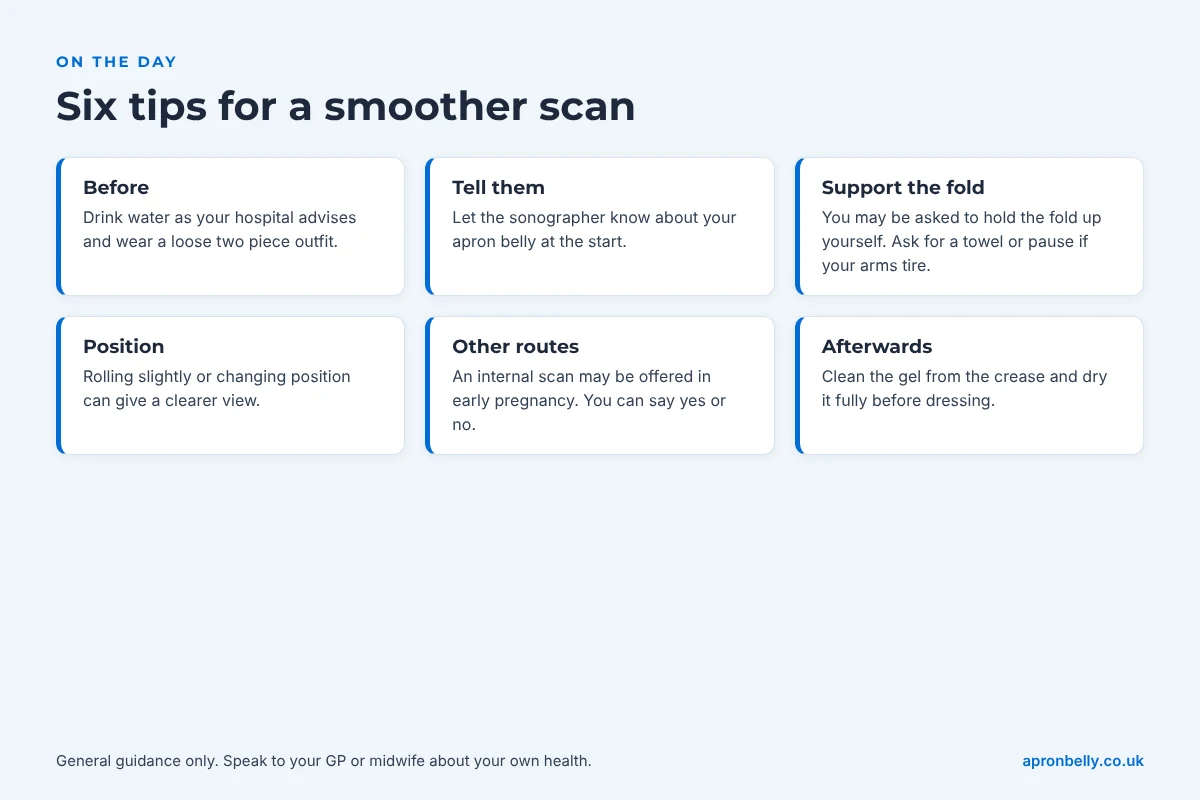
NHS sonography guidance suggests the patient supporting any excess tissue as one way to improve the picture. You may be asked to hold the fold up with your hands or a towel. It is fine to ask for a break if your arms tire, or to ask whether a partner can help.
Other techniques sonographers use
- changing how full your bladder is, by drinking water or emptying it
- asking you to go for a short walk so the baby moves
- adjusting your position, such as rolling slightly to one side
- using an internal (transvaginal) scan in early pregnancy where appropriate
- using the machine’s settings to sharpen the image
An internal scan uses a thin probe placed in the vagina. It is not used for every scan and you can always say yes or no. Ask the sonographer to explain why they are suggesting it.
Afterwards
Wipe the gel out of the crease and dry it fully before you dress. Gel left in the fold can irritate the skin. Our routine for washing under an apron belly works well after any appointment.
If the Scan Cannot Be Completed
At the dating scan
If you have chosen screening and the nuchal translucency measurement cannot be taken, for example because of the baby’s position or how far along you are, you can be offered the quadruple test instead. This is a blood test done by your midwife from 14 weeks and 3 days until before 20 weeks. It screens for Down’s syndrome only, not Edwards’ or Patau’s syndrome.
At the 20 week scan
According to the NHS fetal anomaly screening programme handbook, the scan should be done between 18 weeks and 20 weeks and 6 days. If image quality is reduced, including because of maternal BMI, one repeat scan must be offered and completed by 23 weeks. This may happen on the same day after a walk or position change, or at a new appointment.
If the repeat scan is still incomplete
There is no requirement to offer a further screening scan. You should be told clearly that screening is incomplete, and this is recorded in your notes. Ask your midwife what this means for you and whether any extra checks are planned later in pregnancy.
Growth scans later on
A large apron can make it harder to measure your bump with a tape. If your team cannot measure growth reliably, they may offer growth scans in the third trimester instead. Ask at your booking appointment how your baby’s growth will be checked.
Tips for a More Comfortable Scan
Before the appointment
- read your appointment letter for bladder instructions and follow them
- wear a loose top with trousers or a skirt that has a soft, stretchy waistband
- bring a small towel to help hold the fold or protect your clothes
- check whether you can bring a partner or friend, as hospital rules vary
During the scan
- tell the sonographer about your apron belly at the start
- say if anything hurts or if you need to change position
- ask the sonographer to explain what they can and cannot see
- you can ask for a chaperone if you would like one
Questions to ask your midwife
- Will I be offered extra growth scans, and from when?
- If my scan is incomplete, what are my options?
- Is an internal scan likely at my dating scan?
- Who should I contact if the skin under my fold becomes sore?
Looking After Your Skin and Confidence
Skin under the fold
Pregnancy raises body heat and sweating, and a skin fold that is repeatedly covered in gel and pressed by a probe can become irritated. Keep the crease clean and dry and wear breathable fabrics. If you notice a red, itchy or sore rash, our guide to the apron belly rash explains what helps, and speak to your midwife or pharmacist.
Feeling self conscious
Many women feel exposed during scans. It can help to remember that sonographers are focused on the pictures, not your body shape. If a comment upsets you, you can raise it with your midwife or the hospital’s Patient Advice and Liaison Service (PALS).
A Worked Example
A first time mum with a grade 3 apron belly attends her 20 week scan at 19 weeks. The sonographer scans above the fold and asks her to hold it up with a towel, but the baby is lying with its back to the probe. She is sent for a 15 minute walk and comes back. Most views are now clear, but one view of the heart is still not seen. She is given a repeat appointment at 22 weeks, where the scan is completed. Her midwife then explains that her bump will be checked with growth scans later in pregnancy.
What this shows
An incomplete first scan is common and usually solved with a walk, a new position or a second appointment. Asking questions at each stage helps you understand the plan.
Frequently Asked Questions
Can you see the baby on an ultrasound with an apron belly?
In most cases, yes. The fold can make images grainier, so the sonographer may scan above it, ask you to hold it up or change position. If the 20 week scan is not clear, you should be offered one repeat scan by 23 weeks.
Will I need an internal scan if I have an apron belly?
Not always. An internal (transvaginal) scan may be suggested in early pregnancy where it would give a clearer picture. It is your choice, and the sonographer should explain why it is being offered.
Does the sonographer have to lift my apron belly?
Sometimes the fold needs to be moved to reach the lower tummy. You may be asked to support it yourself, which can feel more comfortable. Say if you need a break or a different position.
What happens if my 20 week scan is incomplete?
One repeat scan should be offered and completed by 23 weeks. If it is still incomplete, there is no further screening scan, but you should be told that screening is incomplete and this is recorded.
Is ultrasound safe if I have to be scanned for longer?
Yes. The NHS says there are no known risks to you or your baby from ultrasound scans, and a longer or repeat scan does not change this.
The Bottom Line
An ultrasound with apron belly is very common and usually goes well. The fold can make pictures harder to get, so sonographers use simple techniques such as scanning above the apron, asking you to hold it up, changing position or offering an internal scan. If the 20 week scan is not clear, one repeat scan should be offered by 23 weeks. Tell your sonographer about your apron belly, ask questions and look after the skin in the fold. For more on skin care during pregnancy and beyond, visit our belly skin hub.
Your next step
Before your next scan, write down the questions above and take them with you. Ask your midwife how your baby’s growth will be checked later in pregnancy.
Featured image: a modern medical ultrasound scanner by Harrison Keely, Wikimedia Commons, CC BY 4.0, cropped.