
Quick Answer
Cycling is good for an apron belly because the saddle carries your weight and joints take less load, so it is easy to repeat. It shrinks the fold through overall fat loss, but it will not tighten stretched skin.
- Sit upright on a wide, comfortable saddle
- Build up to 150 minutes a week over four weeks
- Check with your GP after surgery, a birth or a hernia
Cycling for apron belly is one of the kindest ways to get moving when a heavier lower belly makes running or jumping feel out of the question. The saddle carries your weight, your knees and hips take far less load than on a pavement, and you can build up the effort as slowly as you like.
This guide explains what cycling with an apron belly can realistically change, what it cannot, and how to set up a bike so the fold does not get in the way. It covers indoor and outdoor options, fit adjustments for a fuller lower abdomen, chafing prevention, a four-week beginner plan and the safety checks that matter after surgery, birth or a hernia diagnosis.
Everything here follows NHS activity guidance. It is general information, so if you have a health condition or a recent operation, speak to your GP or physiotherapist before you start.
What Cycling Can and Cannot Do for an Apron Belly
Before you buy padded shorts, it helps to be clear about the outcome. Cycling is excellent for your heart, your mood and your overall fat levels. However, it does not act on one patch of the body on demand.
Why no exercise spot reduces belly fat
Pedalling works your thighs, glutes and calves hardest, yet the energy comes from fat stores across your whole body. Your genes, hormones and age decide where fat leaves first. For many women the lower belly is the last place to change, not the first. As a result, regular cycling for apron belly will reduce total body fat over months, and the fold usually becomes softer and lighter as part of that overall change.
Fat loss versus loose skin
An apron belly is often a mix of two things: subcutaneous fat and stretched skin. Exercise can shrink the first. It cannot tighten the second. If you have lost a lot of weight already, or had several pregnancies, the remaining overhang may be mostly skin. Our guide to apron belly fat versus loose skin explains how to tell which one you are dealing with, so your expectations match what a bike can deliver.
How Much Cycling for Apron Belly Do You Actually Need?
You do not need long, punishing rides. Consistency matters more than any single session, and the national target is very achievable on a bike.
The NHS 150-minute guideline
The NHS physical activity guidelines ask adults to do at least 150 minutes of moderate intensity activity a week, or 75 minutes of vigorous activity, plus strength work on two days. Riding a bike at an easy pace counts as moderate. Riding fast or up hills counts as vigorous. Five rides of 30 minutes meet the target.
Calories and intensity in context
Published estimates from Harvard Medical School suggest a person weighing around 84 kg burns roughly 290 calories in 30 minutes of moderate stationary cycling, compared with about 160 calories for walking at a brisk pace. Heavier riders burn more, lighter riders less. These numbers are useful for perspective, not for precise tracking. A moderate pace means you are slightly out of breath but can still hold a conversation. If you want a gentler comparison, see what walking can do for an apron belly, and consider mixing both.
Indoor vs Outdoor Cycling With an Apron Belly
Both options work. The right choice depends on your confidence, your joints and the weather.
Indoor options: stationary, spin and recumbent
An upright stationary bike is the simplest start. A recumbent bike has a bucket seat with a backrest and pedals out in front, so the belly sits in your lap rather than folding against your thighs. Spin bikes offer the hardest workouts but place you in a forward lean, which many women with a larger lower abdomen find uncomfortable at first.
Outdoor options: hybrid, e-bike and step-through frames
A hybrid bike with flat bars gives an upright position and stable handling on paths and quiet roads. A step-through frame removes the top tube, so you do not have to swing a leg over the saddle, which is a real relief when a heavy fold limits hip movement. An e-bike with pedal assist takes the fear out of hills and headwinds while still counting as moderate activity on the easier settings.

| Option | Position | Belly comfort | Joint load | Best for |
|---|---|---|---|---|
| Upright stationary bike | Upright | Good with raised bars | Low | Beginners at home or gym |
| Recumbent bike | Reclined, backrest | Excellent, no fold pressure | Very low | Back pain, knee pain, larger overhang |
| Spin bike | Forward lean | Fair, belly meets thighs | Low to moderate | Confident riders wanting intensity |
| Hybrid bike | Upright | Good | Low | Park paths, commuting |
| Step-through frame | Upright | Very good, easy mounting | Low | Limited hip mobility, heavy fold |
| E-bike | Upright | Very good | Very low | Hills, longer distances, nervous riders |
Bike Fit for a Heavier Lower Belly
A poor fit is the main reason new riders give up. The usual problems are a saddle set too low, bars too far away and a seat too narrow. Each one is fixable in minutes.

Saddle height and position
Set the saddle so that, with your heel on the pedal at its lowest point, your leg is almost straight. When you then pedal with the ball of your foot, your knee keeps a slight bend. Cycling UK’s DIY bike fit guide notes that most people ride with the saddle far too low, which overloads the knees. Keep the saddle level. Never tilt the nose upward, because that presses on soft tissue.
Upright posture and handlebar reach
For cycling with an apron belly, aim to have the top of the handlebars level with or slightly above the saddle. Raise the stem, flip it, or fit a riser if needed. Your elbows should stay softly bent, and your torso should feel open rather than folded. If the belly presses hard against your thighs on every pedal stroke, the bars are too low or too far forward.
Saddle width and step-through frames
Choose a wider, slightly padded saddle for upright riding. A narrow racing saddle is designed for a forward lean and will feel like a wedge in an upright position. Many bike shops can measure your sit bones for free. Finally, if swinging a leg over the saddle is awkward, a step-through frame removes the problem entirely.
Comfort, Chafing and the Fold
Pedalling rubs the underside of the apron against the thighs, and sweat makes it worse. A few habits prevent most soreness.
Clothing that protects skin
- Padded cycling shorts or leggings with a flat, soft waistband that sits under or well above the fold, never across it.
- A moisture-wicking base layer rather than cotton, which stays wet and rubs.
- Anti-chafe balm or a thin barrier cream applied under the fold and on the inner thighs before every ride.
- A soft cotton or bamboo liner tucked under the apron on hot days, changed as soon as it is damp.
Support bands and after-ride skin care
A light support band or sling can lift the apron slightly during a ride and stop it bouncing on rough paths. Our comparison of apron belly belts, slings and binders explains which styles breathe well enough for exercise. After riding, wash and dry the fold gently, then apply a barrier product if the skin looks pink. If it is already sore, follow our guide to apron belly skin care when the fold gets sweaty and sore before your next session.
A 4-Week Beginner Cycling Plan
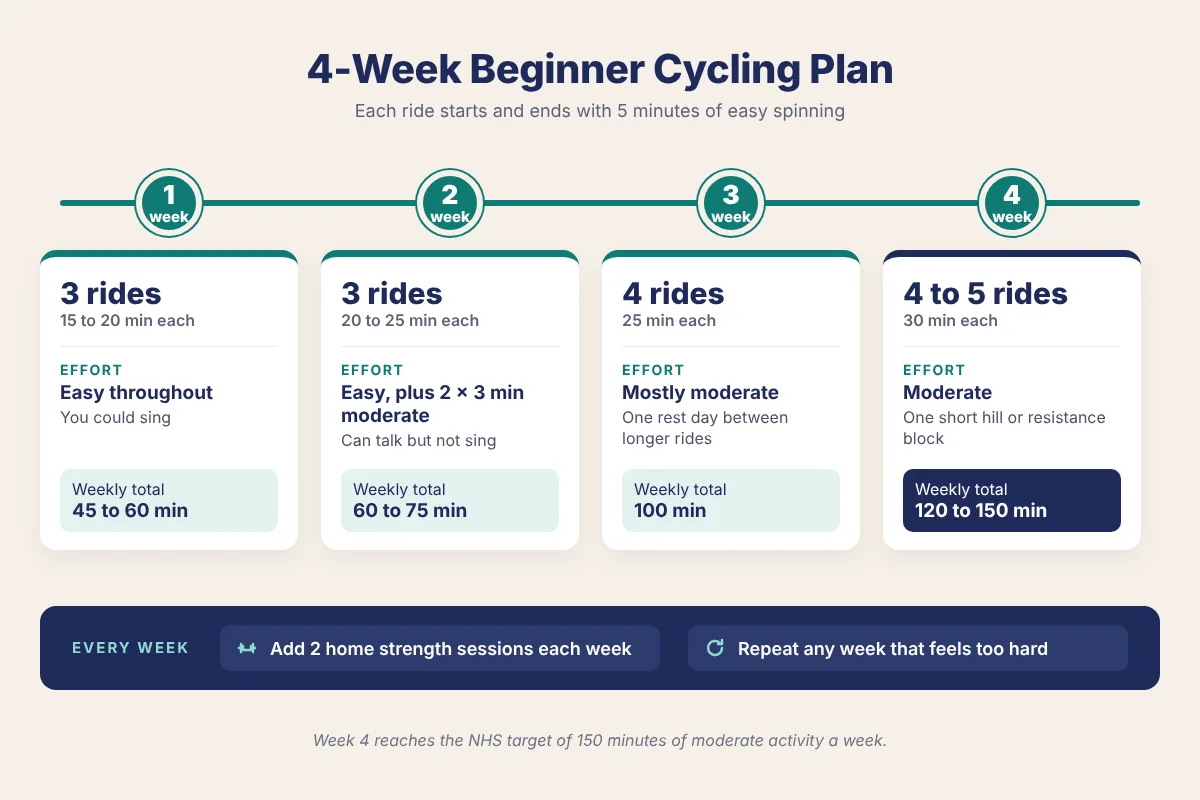
This plan assumes you have not exercised regularly for a while. It builds towards the NHS target by the end of week four. If a week feels too hard, repeat it rather than pushing on.
How to use the plan
Each ride starts with five minutes of easy spinning and ends with five minutes of the same. “Easy” means you could sing. “Moderate” means you can talk but not sing. Spread the rides across the week with at least one rest day between the longer ones. Pair the plan with effective apron belly exercises for beginners on two non-riding days to cover the strength part of the NHS guidance.
| Week | Rides | Length per ride | Effort | Weekly total |
|---|---|---|---|---|
| 1 | 3 | 15 to 20 minutes | Easy throughout | 45 to 60 minutes |
| 2 | 3 | 20 to 25 minutes | Easy, with two 3-minute moderate blocks | 60 to 75 minutes |
| 3 | 4 | 25 minutes | Mostly moderate | 100 minutes |
| 4 | 4 to 5 | 30 minutes | Moderate, one short hill or resistance block | 120 to 150 minutes |
After week four, keep the volume steady and vary the sessions. Some women alternate bike days with swimming or aqua aerobics to rest the saddle area, and add a beginner weights programme to protect muscle while fat comes off.
Safety Checks Before You Start Cycling
Cycling is low impact, but it still loads the abdomen. Some situations need professional advice first.
After tummy tuck or apron removal surgery
Surgeons commonly allow gentle stationary cycling from around week three to four after abdominoplasty, with outdoor riding and harder efforts from week six onwards, and isolated core work much later. Your own surgeon’s timeline overrides any general figure. Read our week-by-week tummy tuck recovery timeline for the full picture, and never ride if the wound pulls or swells.
Postnatal and diastasis recti
The NHS suggests checking for separated stomach muscles after birth and avoiding sit-ups, planks and high-impact exercise until the gap closes, usually by about eight weeks. Gentle upright cycling is generally well tolerated, but a forward spin position can increase pressure through the midline. Our guide to apron belly and diastasis recti covers the finger-width check and when to ask for a physiotherapy referral. After a caesarean, wait for your six-to-eight-week check before riding outdoors.
Hernia, blood pressure and joint pain
A bulge that becomes painful, hard or does not go back in needs a GP appointment before any exercise. Straining against resistance can worsen a hernia, so keep gears light. If you have high blood pressure, moderate cycling usually helps, but get it checked first if it is uncontrolled or you feel dizzy on exertion. For knee or hip pain, a recumbent bike or a higher saddle often removes the problem. Stop and seek advice if you get chest pain, sudden breathlessness or faintness during a ride.
Tracking Progress and When to See a GP
Scales are a poor judge of early progress, because water and the menstrual cycle shift the number. Track what cycling for apron belly actually changes.
What to measure
- Waist measurement at the navel and hip measurement at the widest point, once a fortnight, same time of day.
- Minutes ridden per week, aiming to hold 150 or more.
- Resting heart rate first thing in the morning, which usually falls as fitness improves.
- Photos from the side every four weeks in the same clothing and light.
Signs that need a GP appointment
Book an appointment if the skin under the fold develops a persistent rash or odour that does not settle with care, if you notice a new lump, or if cycling causes pelvic heaviness or leaking. Also speak to your GP if three months of regular cycling for apron belly brings no change in energy, waist size or stamina, as thyroid or hormone factors may need a look. If a gentler start would suit you better, yoga for apron belly is a good bridge towards the bike.
Frequently Asked Questions
Is cycling good for an apron belly?
Yes, within limits. Cycling is a low-impact way to reach the NHS target of 150 minutes of moderate activity a week, which supports overall fat loss and improves heart health. It will not remove fat from the belly alone, and it cannot tighten loose skin. Expect gradual softening of the fold as total body fat falls over several months.
Is a recumbent or an upright bike better for a heavy lower belly?
A recumbent bike is usually the more comfortable start. The backrest supports your spine and the belly rests in your lap instead of folding against your thighs. An upright bike works well too once the handlebars are raised level with the saddle. Try both at a gym for ten minutes each before committing to either.
How many minutes a week should I cycle?
Build towards at least 150 minutes of moderate cycling a week, spread over four or five days, as the NHS recommends. Begin with three rides of 15 to 20 minutes and add five minutes per ride each week. Add two short strength sessions on non-riding days to cover the muscle-strengthening part of the guidance.
Why does my belly rub on my thighs when I pedal?
The handlebars are probably too low or too far forward, which tips you into a lean that folds the abdomen. Raise the bars, shorten the reach and slide the saddle back a little. A wider saddle and an upright hybrid or step-through frame also help. Anti-chafe balm and moisture-wicking shorts protect the skin in the meantime.
Can I cycle with diastasis recti?
Gentle upright cycling is generally safe, because it does not demand the forward curl that sit-ups and planks require. Avoid an aggressive spin position and heavy gears that make you brace hard through the midline. If the gap is still wide eight weeks after birth, ask your GP for a physiotherapy referral before increasing intensity.
Will an e-bike still help me lose fat?
Yes. Pedal assist only adds to your own effort, so you still pedal throughout and your heart rate still rises, especially on hills and longer trips. The motor removes the barrier that stops many people riding at all. Use the lowest assist level that keeps you comfortable, and you will still accumulate the minutes that count towards the NHS target.
The Bottom Line
Comfort first, then consistency
Cycling for apron belly works because it is comfortable enough to repeat, and repetition is what changes body fat. Fit the bike so you sit upright on a wide saddle, protect the skin under the fold, and build to 150 minutes a week over four weeks. Keep expectations honest: the overhang will shrink with overall fat loss, but stretched skin needs a different conversation. If you have had surgery, a baby or a hernia diagnosis, check with your GP or physiotherapist first, then enjoy the ride.