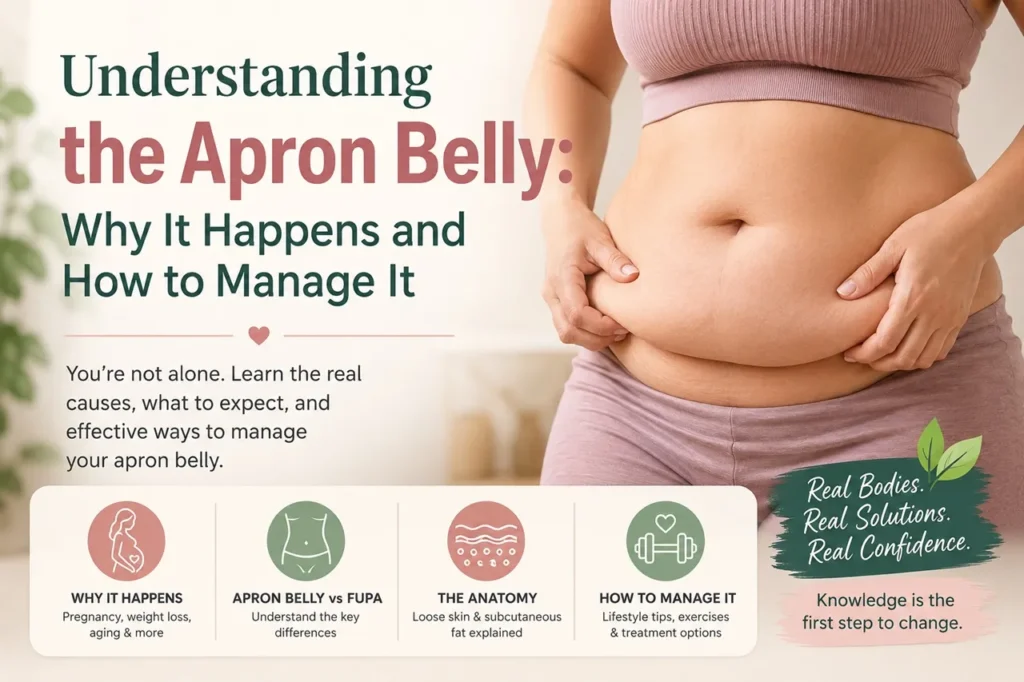
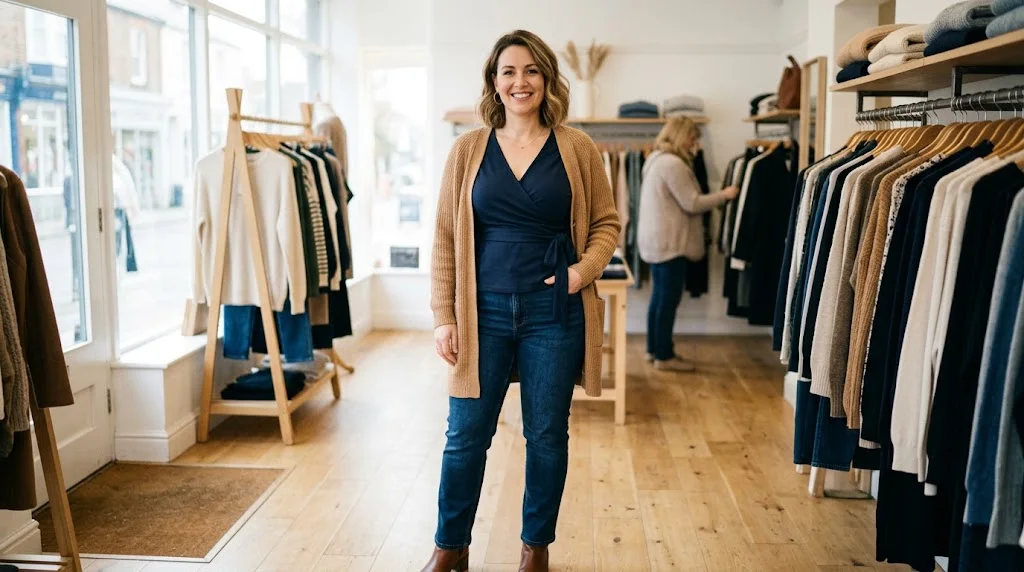
Learning how to hide an apron belly is mostly about where fabric starts, stops and settles. A hanging lower tummy is common after pregnancy, weight loss or with age. Clothes cannot change your body, but they can guide the eye.
This guide sets out 15 styling rules that work across jeans, dresses, workwear and evenings out. Each rule uses UK high street pieces. None of them asks you to squeeze into anything painful or give up clothes you love.
If you are new to the term, our guide to what an apron belly is explains the causes and grades. Then keep the quick-reference table below handy for your next trip to the changing room.
1. Choose a Rise That Sits Above the Fold
The rise of your trousers shapes most of the final look. Low-rise and mid-rise styles often sit under the apron or right in the crease. As a result, the waistband pushes the fold upwards and creates a visible shelf.
A true high rise sits at or close to the navel, above the overhang. Instead of lifting the tissue, it holds the area flat and smooth. That one change often matters more than any top you wear over it.
Rise lengths vary between brands, so check the product details rather than trusting the word “high” on the label. Our guide to the best jeans for an apron belly covers rise, stretch and fit checks in detail.
2. Pick Wide, Flat Waistbands Over Thin Ones
A thin waistband acts like a cord. It digs into soft tissue and leaves a ridge that shows through your top. A wide band spreads the pressure, so the fabric lies smoothly across your tummy instead of cutting in.
Look for waistbands about 5 cm wide or more, with a flat front and no bulky fly. Pull-on styles and side zips are often kinder than a thick metal button. They also feel easier after a big meal.
Yoga-style waistbands on trousers and skirts work well for everyday wear. Firm ones stay put without rolling down. If a waistband folds over when you sit, it is too narrow or too soft for your shape.
3. Choose Fabrics That Skim, Not Cling
Fabric weight decides whether clothes glide over the fold or sink into it. Heavier, structured fabrics hold their own shape. Light, stretchy fabrics collapse into every curve, including the crease underneath your apron, which draws attention to it.
Ponte, crepe, heavier viscose and cotton gauze are reliable choices. Denim with a small amount of elastane offers comfort without too much cling. For summer, relaxed linen blends feel cool and drape away from the body.
Treat thin jersey, ribbed knit and satin with care. Shiny fabric reflects light off every contour, so it highlights more than it hides. If you love a slinky top, wear it loose or layer something over it.
4. Let Your Hem Finish Below the Fold
Where a top ends matters as much as how it fits. A hem that stops right at the crease draws a line across the widest point. Your eye then lands exactly where you would rather it did not.
Tunic tops that reach mid-hip are the easiest everyday fix. The fabric falls in one smooth line past the apron and finishes lower down. Peplum tops flaring from the natural waist give a similar effect with more shape.
Cropped tops and boxy styles that end at the waist tend to work against you. If you prefer a tucked look, try a loose front tuck into high-rise trousers. This keeps some definition without pulling fabric tight.
5. Use Wrap Fronts to Create Diagonal Lines
Diagonal lines cut across the body at an angle, which breaks up a horizontal bulge. Wrap and faux-wrap tops do this naturally. The crossover front leads the eye upwards towards your face instead of down to your tummy.
A wrap also lets you adjust the fit around your middle. You can tie it slightly looser on bloated days and tighter on others. Most high street ranges carry wrap tops in jersey, crepe and printed viscose all year.
Asymmetric hems follow the same idea. A hem that dips lower on one side creates movement and hides the line of the fold. Pair either style with straight or wide-leg trousers for a balanced shape from top to toe.
6. Let Ruching and Draping Do the Work
Ruching is fabric gathered along a seam, usually at the side of a top or dress. Those small folds create texture across the tummy. As a result, any natural curve blends into the gathers rather than standing out.
Side-ruched dresses suit evenings, while ruched tees work for everyday. Draped necklines and cowl fronts add soft movement higher up the body. Together, they pull attention away from the lower tummy without needing heavy shapewear underneath every outfit.
Ruching is also popular in swimwear for the same reason. Our best swimsuit for an apron belly guide shows which cuts pair ruching with tummy panels. That makes a beach day far easier to enjoy.
7. Pick Dress Shapes That Flow From the Bust
Dresses can be the simplest answer because they often have no waistband at all. The best shapes are fitted at the top and then fall freely. That way, the fabric never has to touch the fold.
Empire line dresses have a seam just under the bust, so the skirt drops clear of the apron. A-line and fit-and-flare dresses release fabric above the tummy. Shirt dresses in crisp cotton add structure and a vertical line of buttons.
Thin bodycon jersey shows every line, so save it for days when you want light shapewear underneath. A thick ponte version with side ruching is far more forgiving. Smocked maxi dresses also feel comfortable on hot days.
8. Balance Your Trousers With the Right Leg Shape
The leg of your trousers affects how the whole body looks. A very skinny leg can make the middle look wider by contrast. In comparison, a slightly fuller leg balances the hips and tummy with ease.
Straight-leg trousers are a clean choice for work and weekends. Wide-leg styles in crepe or linen look elegant and feel cool. Bootcut jeans add a gentle flare at the ankle, which balances the silhouette from top to bottom.
Choose flat-front designs without pleats at the top, because pleats add bulk right where the fold sits. Similarly, skip patch pockets on the front. Smooth, simple fronts let the eye travel down the leg without stopping.
9. Add a Long Layer to Draw Vertical Lines
An open layer creates two long lines down the front of your body. The eye follows those lines from shoulder to thigh. Consequently, the tummy becomes a smaller part of the overall picture rather than its focus.
Longline cardigans, duster coats and longline blazers all do this well. Wear them open rather than buttoned. The best lengths finish at mid-thigh or below, well past the apron, so the hem does not create another line.
This rule works in every season. In spring, try a light trench left undone. In winter, a long wool coat does the same job, while a sleeveless gilet works for cooler evenings outdoors.
10. Dress in One Colour From Top to Bottom
Wearing one colour, or close shades of it, creates an unbroken column. Nothing stops the eye at your waist. This trick is often called tonal dressing, and it works with almost any budget or wardrobe.
Navy, charcoal, chocolate brown and deep green look smart and easy to match. Alternatively, try soft neutrals such as oatmeal and stone in summer. Then add a long open layer in a contrasting colour to frame the outfit.
You do not need to wear dark colours forever. Keep the shade around your middle plain and steady, then add brighter colour near your face. That small shift keeps outfits cheerful without drawing the eye to your tummy.
11. Put Pattern and Detail Up High
The eye goes first to pattern, shine and contrast. So place those details where you want people to look. A printed neckline, a bright scarf or a statement earring lifts attention towards your face.
Patterns themselves can help too. Small, busy prints break up a surface, so curves become harder to read. However, a large bold motif placed across the lower tummy does the opposite and acts like a spotlight.
Keep chunky pockets, buckles and embellishment away from the midsection. Instead, choose tops with interest at the shoulders, sleeves or collar. A pendant necklace that finishes above the bust adds a neat vertical line as well.
12. Wear Belts at Your Natural Waist Only
Belts are not off limits, but placement makes all the difference. A belt that sits on the fold creates a hard horizontal line. It can also dig in and push soft tissue over the top.
Instead, wear a belt at your natural waist, the narrowest part of your torso. This usually sits a little above the navel. Over a wrap dress or shirt dress, it defines your shape and leaves the skirt flowing freely.
Choose soft leather or fabric belts about 2 to 4 cm wide. Very thick belts can feel stiff when you sit down. Alternatively, a dress with a built-in tie at the waist gives the same effect with more comfort.
13. Size for Your Tummy, Then Tailor the Rest
Clothes that are too small around the middle pull, gape and show every line. It is better to choose the size that fits your tummy comfortably. Then deal with any extra room elsewhere.
A local alterations service can take in a waistband or shorten a hem at modest cost. As a result, trousers and dresses fit your real shape rather than a standard pattern. Small tweaks change how clothes hang.
Ignore the number on the label, because sizing varies widely between high street brands. Sit, bend and walk in the changing room before buying. If anything digs in after a minute, it will feel worse by lunchtime.
14. Start With a Smooth Base Layer
The layer closest to your skin shapes everything on top. Low-cut knickers often sit under the apron and leave a dent. High-waisted knickers that finish above the fold give a smoother line under trousers and dresses.
Our best underwear for an apron belly guide compares styles that stay in place. For special outfits, see the best shapewear for an apron belly guide. It explains which compression level suits a hanging fold rather than a rounded tummy.
Choose shapewear that starts above the navel and ends on the thigh. That way, it contains the fold rather than rolling under it. For lift rather than smoothing, an apron belly support belt may suit you better.
15. Put Comfort and Skin Health First
The skin under an apron can become warm, damp and sore. Clothes that trap heat make this worse. The most flattering outfit is one you can wear all day without rubbing or irritation.
Natural fibres such as cotton and linen let air move. The NHS advice on heat rash recommends loose cotton clothing, which suits most of the rules above. On hot days, a soft cotton liner in the fold can absorb moisture.
Cotton-rich bike shorts stop thighs rubbing under dresses. Take shapewear off at home and let the skin breathe. Our guide to apron belly skin care when the fold gets sore covers daily routines.
Quick-Reference Styling Table
Use this table as a shortcut when you are shopping or getting dressed in a hurry.
| Item | Look for | Usually skip |
|---|---|---|
| Trousers and jeans | High rise near the navel, wide flat waistband, straight, wide or bootcut leg | Low or mid-rise, front pleats, very skinny leg |
| Tops | Tunic or peplum to mid-hip, wrap front, side ruching, V-neck | Cropped or waist-length hems, thin clingy jersey |
| Dresses | Empire line, A-line, wrap, shirt dress, fit-and-flare | Thin bodycon, a seam or tie right on the fold |
| Fabrics | Ponte, crepe, heavier viscose, linen blends, cotton gauze | Satin, very shiny or ribbed fabrics worn alone |
| Layers | Open longline cardigan, duster coat, longline blazer | Short boxy jackets ending at the tummy |
| Colour and detail | Tonal outfits, print and sparkle near the face | Bold motifs or thick belts across the lower tummy |
| Underwear | High-waisted knickers, light shapewear from above the navel to the thigh | Low-cut briefs, tight shapers that roll down |
When Styling Is Not Enough: When to See Your GP
Clothes can hide the shape of an apron, but they cannot fix sore skin. Moisture and friction in the fold can lead to intertrigo, a common skin-fold rash. Wash the area gently each day, then pat it completely dry.
Keep the fold apart with breathable cotton. See a pharmacist or GP if a rash spreads, cracks, weeps, smells or lasts more than a few days. Our apron belly rash treatment guide explains common causes and remedies.
For some people, the fold causes repeated infections or limits daily life. Surgery to remove it, called a panniculectomy, is not routinely funded on the NHS. Instead, local integrated care boards set their own rules.
These criteria often include a stable weight for at least 12 months and a BMI within a set limit. Many also expect you to be a non-smoker with skin problems that persist despite treatment. Our guide to getting an apron belly operation on the NHS explains referral.
Frequently Asked Questions
What is the best thing to wear to hide an apron belly?
A high-rise trouser with a wide, flat waistband works for most people. Pair it with a tunic or wrap top that finishes below the fold. Choose heavier fabrics that skim the body, and add an open long layer.
Do high-waisted jeans hide an apron belly?
Yes, as long as the waistband sits above the fold, near your navel. A wide waistband and a little stretch hold the area smooth. Mid-rise jeans often sit in the crease and make the fold more visible.
Can I wear a bodycon dress with an apron belly?
You can. Choose thick ponte instead of thin jersey, and look for side ruching that hides the fold in its gathers. Light shapewear that starts above the navel gives a smoother line underneath.
What colours are best for hiding an apron belly?
Plain, deeper shades around the middle are the easiest, such as navy, charcoal or deep green. Wearing one colour from top to bottom creates a long line. Bright colour works well near your face.
Is it safe to wear shapewear every day with an apron belly?
Light shapewear is fine for most people when it fits well. Avoid very tight styles for long hours, take regular breaks and keep the skin under the fold clean and dry. Stop if it causes pain or rubbing.
How do I stop my apron belly rubbing in hot weather?
Wear loose cotton or linen, keep a soft cotton liner in the fold and dry the skin well after washing. Cotton-rich bike shorts under dresses help to stop thighs and the lower tummy chafing.
Final Thoughts
Knowing how to hide an apron belly comes down to a few repeatable habits. Keep waistbands above the fold, choose fabrics that skim and let hems finish lower down. Then use colour, layers and detail to guide the eye upwards.
You do not have to follow every rule every day, and choosing not to hide your shape is completely valid. Wear what feels comfortable, and see your GP if the skin becomes sore. Our apron belly vs FUPA guide explains how two common lower tummy shapes differ.