

An apron belly after a hysterectomy is a soft fold of skin and fat that hangs over the lower abdomen. Many UK women notice it months after surgery. Thankfully, it is common and usually manageable.
This overhang has a medical name, the pannus or panniculus. After a hysterectomy, it can form from swelling, weight gain, loose skin, scar tissue or hormone changes. Often, several of these causes overlap at once.
In this guide, you will learn why the overhang appears and how healing unfolds. You will also see when exercise is safe, what helps at home, and when surgery or a GP visit makes sense.
What Causes an Apron Belly After a Hysterectomy?
A hysterectomy removes the womb (uterus). Sometimes the surgeon also removes the cervix, fallopian tubes or ovaries. Each extra step can change how your abdominal muscles, hormones and lower belly behave during healing and afterwards.
First, surgery stretches and cuts through layers of tissue. Then, healing tissue holds extra fluid for weeks. After that, lower activity during recovery can reduce muscle tone and lead to weight gain around the tummy.
Age also plays a part, because many women have this operation in their forties or fifties. At this stage, collagen and skin elasticity decline. As a result, the lower belly may sag more than before.
Early Swelling Versus a True Apron Belly
In the first weeks, most belly changes come from inflammation and bloating. Women call this the swelly belly. Trapped gas, constipation and slow bowels after anaesthetic can all make the tummy look rounder and firmer.
A rare bowel slowdown, called postoperative ileus, can also cause pain and swelling for a few days. Fortunately, most early swelling settles over 6 to 12 weeks, although some evening puffiness may last several months.
In contrast, a true apron belly is a soft fold that stays after swelling has gone. It usually hangs lower, moves when you lean forward and may cover the scar. Simple bloating checks can help.
How Each Type of Hysterectomy Affects the Lower Belly
Surgeons use three main methods. An abdominal hysterectomy uses a cut across the bikini line, usually about 10 centimetres long. This approach disturbs the most tissue, so it carries the highest chance of a shelf.
A laparoscopic hysterectomy, or keyhole surgery, uses several small cuts and a camera. Meanwhile, a vaginal hysterectomy leaves no cut on the tummy at all. Both usually mean less swelling, less scarring and quicker healing.
However, any method can still lead to weight changes, especially if the ovaries come out. The table below compares the typical scar type, hospital stay, recovery time and the likely effect on your lower belly.
| Type | Scar on tummy | Typical hospital stay | Typical recovery | Effect on the lower belly |
|---|---|---|---|---|
| Abdominal | One cut, about 10 cm, along the bikini line | Up to 5 days | 6 to 8 weeks | Highest chance of swelling, scar tethering and a shelf |
| Laparoscopic (keyhole) | 3 to 4 small cuts | 1 to 4 days | Often 4 to 6 weeks | Mild swelling and gas pain; a shelf is uncommon |
| Vaginal | No tummy scar | 1 to 4 days | Often 4 to 6 weeks | Little direct change; weight and hormones matter more |
The Hysterectomy Shelf and Scar Tethering
Some women develop a hysterectomy shelf, which looks like a C-section shelf. Here, the scar heals firmly to deeper layers. Meanwhile, the skin and fat above it stay soft and fold over the tight line.
This pull is called scar tethering. It happens when internal adhesions bind skin to fascia or muscle. Consequently, the scar looks tucked in, while the tissue above bulges forward. Exercise alone rarely releases this band.
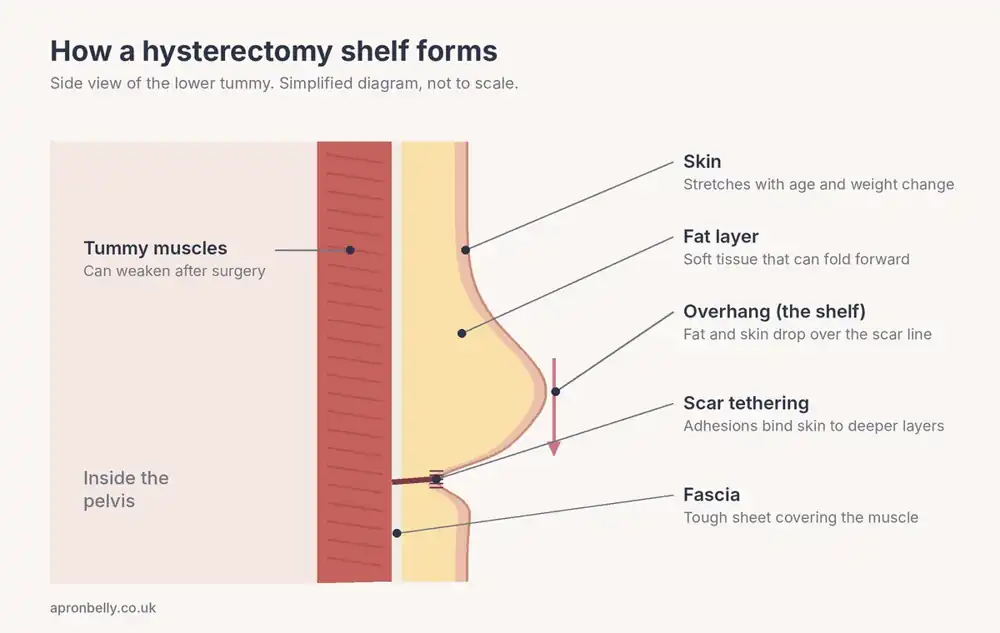
Gentle scar massage, once the wound has healed, may soften tissue. A women’s health physiotherapist can teach safe techniques. In marked cases, a surgeon can release the scar during a tummy tuck or scar revision.
Fat, Loose Skin or Muscle Separation?
Not every lower belly bulge after surgery is the same. A quick pinch test helps. If you can grab a thick, soft layer, it is mostly subcutaneous fat, which often responds to diet and activity.
If the skin feels thin, crepey and stretchy, the main issue is loose skin. Unfortunately, exercise cannot shrink skin much. Meanwhile, a soft dome down the middle when you sit up may suggest diastasis recti.
Many women have a mix of all three. Therefore, a GP or physiotherapist can check your tummy and explain what drives the shape. Knowing the cause helps you choose options that work for your body.
Oestrogen Loss After an Oophorectomy
If your ovaries are removed, called an oophorectomy, your oestrogen levels fall suddenly. This causes surgical menopause, even if you were still having periods. Symptoms can start within days rather than slowly over several years.
Lower oestrogen shifts fat distribution from hips towards the tummy. This visceral fat sits around organs and raises health risks. In addition, insulin resistance and a slower metabolism can make menopause tummy fat harder to lose.
Hormone replacement therapy (HRT) does not cause weight loss. However, it may ease hot flushes, poor sleep and low mood, which helps you stay active. Therefore, discuss HRT options with your GP or gynaecologist early.
Hysterectomy Recovery Timeline for Your Tummy
Most women spend 1 to 5 days in hospital. The NHS says full recovery after an abdominal hysterectomy takes about 6 to 8 weeks. Keyhole and vaginal methods often heal faster, sometimes within four weeks.
During weeks one and two, short walks and rest come first. By weeks three to six, longer walks and light chores usually return. Meanwhile, heavy lifting stays off limits until your surgeon or GP agrees.
From three months, swelling has mostly settled, so you see your true shape. Finally, at six to twelve months, scar tissue matures. Only then can you judge whether an apron belly needs help or surgery.
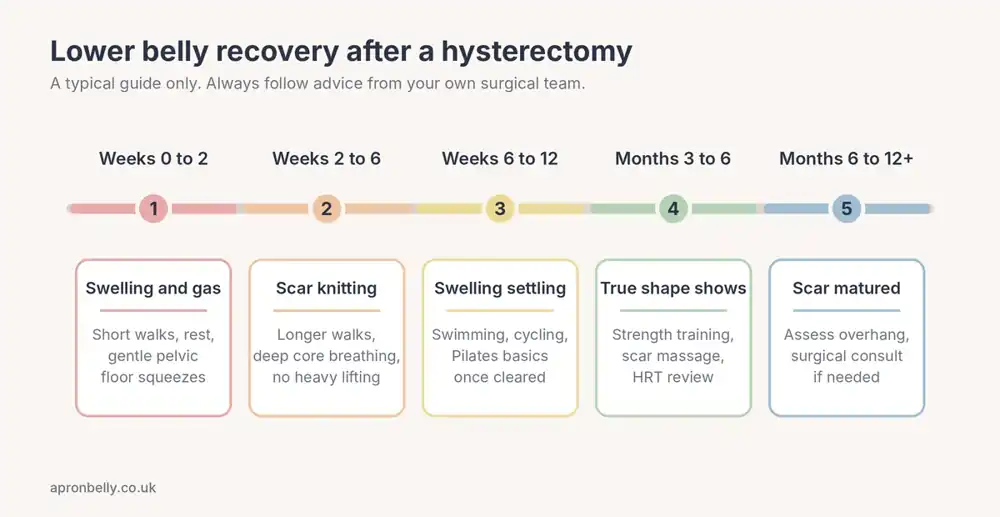
| Time after surgery | What is happening | Safe ways to help your tummy |
|---|---|---|
| Weeks 0 to 2 | Swelling, gas and wound healing | Short walks, rest, gentle pelvic floor squeezes, fibre and fluids |
| Weeks 2 to 6 | Swelling easing, scar knitting | Longer walks, deep core breathing, no heavy lifting |
| Weeks 6 to 12 | Most swelling settled | Swimming, cycling, Pilates basics once cleared, steady healthy eating |
| Months 3 to 6 | True shape visible | Strength training, scar massage, HRT review if ovaries removed |
| Months 6 to 12+ | Scar matured | Assess remaining overhang; consider a surgical consultation if it causes problems |
When Exercise Is Safe After a Hysterectomy
Walking is the safest first exercise, and the NHS encourages it from the day after surgery. The RCOG recovery guidance says many women can walk 30 to 60 minutes after two to three weeks. Build up slowly.

Swimming often resumes at two to three weeks once discharge stops and wounds heal. Afterwards, gentle low-impact exercise, such as cycling or Pilates, usually returns from six weeks. Always follow advice from your surgical team.
Avoid sit-ups, crunches, planks and heavy weights for at least 12 weeks, as they strain healing tissue. Later, strength training helps protect muscle and supports fat loss. Stop if you feel pain, pulling or heaviness.
Pelvic Floor and Deep Core Rebuilding
Your pelvic floor muscles support the bladder and bowel, and surgery can weaken them. Most women can begin gentle squeezes once the catheter is out. Aim for short and long holds, three times a day.
Next, add deep core work using the transversus abdominis, the corset muscle under your tummy. Gently draw your lower belly inwards as you breathe out. Hold for a few seconds, then relax fully and repeat.
Good posture and steady breathing support this work through the day. Over time, a stronger core flattens the lower tummy and supports the overhang. However, these exercises cannot remove loose skin, so keep expectations realistic.
Eating to Reduce Belly Fat Gently
Healing needs fuel, so crash diets are a poor choice after surgery. Instead, include protein at every meal to repair tissue and protect muscle. Eggs, fish, beans, lentils, yoghurt and chicken are simple, affordable options.

Next, add fibre from vegetables, oats, fruit and wholegrains. This eases constipation and keeps you full for longer. Moreover, drinking enough water also helps bowels move and reduces bloating in the early weeks after surgery.
Many women find a Mediterranean diet easy to follow, because it favours plants, fish and olive oil. Cutting back on ultra-processed foods, sugary drinks and alcohol supports a gentle calorie deficit without leaving you drained.
Everyday Comfort, Skin Care and Support Garments
While the tummy heals, a soft abdominal binder or support garment may ease discomfort and help you move. Please ask your surgical team first, though. Wear it for comfort, not to force the belly flatter.
Later, high-waisted knickers and gentle shapewear can smooth the overhang under clothes. Choose breathable fabrics and avoid tight waistbands that press on the scar. Comfort matters far more than any temporary slimming effect they offer.
Warm, damp skin under the fold can lead to intertrigo, a red, sore rash. Wash and dry the crease carefully each day. If redness spreads, smells or weeps, ask your pharmacist or GP about treatment.
Panniculectomy or Tummy Tuck After a Hysterectomy
If the overhang stays after a year of healthy habits, surgery may help. A panniculectomy removes the hanging skin and fat below the belly button. Surgeons offer it to ease rashes, pain and hygiene problems.
A tummy tuck, or abdominoplasty, goes further. The surgeon tightens the muscles, removes excess skin and repositions the belly button. A mini tummy tuck treats only the area below the navel, which suits smaller shelves.
Surgeons usually advise waiting at least six to twelve months after a hysterectomy. Your weight should stay stable for several months. Therefore, choose a plastic surgeon on the GMC specialist register at a CQC-registered clinic.
UK Costs and NHS Funding
In the UK, private prices vary by clinic, surgeon and region. As a rough guide, a private panniculectomy costs about £5,000 to £10,000. A full tummy tuck often costs between £6,500 and £9,500 in total.
These prices usually include the consultation, surgery, hospital stay and aftercare. However, extras such as compression garments, travel or time off work can add more cost. Always ask for a written quote before you book.
The NHS rarely funds tummy tucks for appearance alone. Your local ICB may fund a panniculectomy through an Individual Funding Request if the overhang causes health problems. You need a stable BMI and GP evidence.
When to See Your GP
Contact your GP or surgical team quickly if your scar becomes red, hot, swollen or leaks pus. Similarly, rising tummy pain, fever, heavy bleeding or smelly discharge need prompt checks. These may signal an infection.

Leg pain, calf swelling or breathlessness can point to a blood clot. Call 999 or go to A&E immediately. Also seek help for a new bulge near the scar, which may be an incisional hernia.
Book a GP visit if belly fat keeps rising or menopause symptoms affect life. Furthermore, ask about a physiotherapy referral for pelvic floor or core problems. Feeling low after surgery is common, so mention it.
Frequently Asked Questions
How Long Does Belly Swelling Last After a Hysterectomy?
Most swelling settles within 6 to 12 weeks. Mild evening puffiness can last up to six months, especially after an abdominal hysterectomy. If swelling is painful, hot or growing, contact your GP.
Does a Hysterectomy Cause an Apron Belly?
Not directly. However, surgery, scar tethering and weight gain can all make an existing overhang more noticeable. Oestrogen loss after an oophorectomy can also help a new one develop.
Can Exercise Get Rid of a Hysterectomy Shelf?
Exercise can reduce fat and strengthen your core, which softens the shelf. However, it cannot release a tethered scar or remove loose skin. Those usually need scar therapy or surgery.
When Can I Do Abdominal Exercises After a Hysterectomy?
Gentle pelvic floor and deep core exercises can usually start within days. Avoid sit-ups, crunches and planks for at least 12 weeks, and check with your surgical team first.
Will HRT Help Me Lose Belly Fat After a Hysterectomy?
HRT does not burn fat. However, it may reduce menopause symptoms after an oophorectomy, which makes sleep, activity and healthy eating easier. Discuss the risks and benefits with your GP.
Can I Get a Panniculectomy on the NHS After a Hysterectomy?
Possibly. NHS funding is limited and usually needs a stable BMI, ongoing skin problems and GP evidence. Your GP can explain local rules and the Individual Funding Request process.