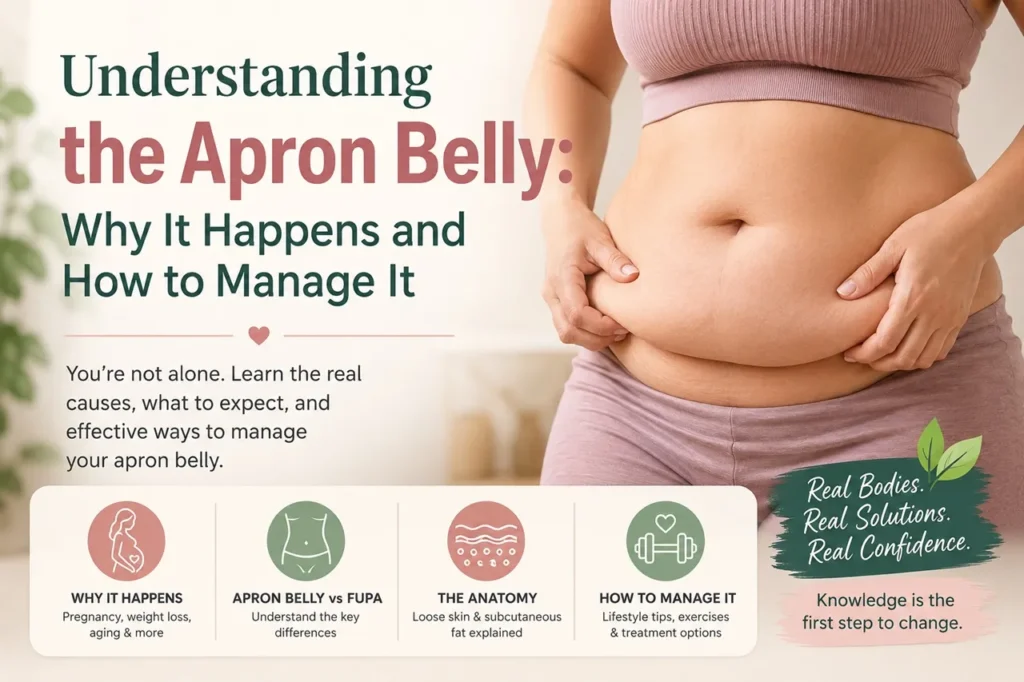
Your apron belly may start to feel heavier, firmer or more swollen than it used to. If so, you might wonder about apron belly lymphoedema. Lymphoedema is a long-term swelling caused by fluid that the lymph system cannot clear. It usually affects the legs or arms, but it can also settle in a hanging tummy fold.
This guide explains how lymphoedema can affect the lower tummy and which signs to watch for. It also shows how it differs from ordinary fat and from lipoedema. Finally, it covers cellulitis red flags, NHS referral, treatment and simple daily care.
Apron Belly Lymphoedema: The Quick Answer
An apron belly is a fold of skin and fat that hangs from the lower tummy. Doctors call it a pannus. Most of the time, the fold is soft, and its size changes slowly with your weight.
Sometimes, though, fluid builds up inside the fold as well. This is known as abdominal lymphoedema or pannus lymphoedema. In this case, the fold often feels heavy and tight, and the skin may thicken over time.
Here are the main clues at a glance:
- Swelling that leaves a dent when you press it for a few seconds.
- Skin that looks dimpled, like orange peel, or feels hard and leathery.
- A dragging, heavy ache that gets worse as the day goes on.
- Repeated skin infections in or under the fold.
None of these signs proves you have lymphoedema. Even so, they are all good reasons to book a GP appointment.
What Is Lymphoedema?
Your lymphatic system is a network of thin vessels and small glands called lymph nodes. It collects spare fluid from your tissues and returns it to the blood. It also helps your body fight infection.
The NHS lymphoedema guide describes it as a long-term condition that causes swelling in the body’s tissues. It happens when the lymphatic system does not work properly. As a result, fluid gathers under the skin instead of draining away.
There are two main types:
- Primary lymphoedema is rare. It comes from faulty genes that affect how the lymph system develops.
- Secondary lymphoedema is much more common. It can follow cancer treatment, infection, injury, inflammation or reduced movement.
Weight also plays a part. A 2025 UK consensus from the British Lymphology Society and Wounds UK calls obesity a known risk factor. Extra body fat can reduce how much fluid the lymph vessels carry. In turn, poorly drained tissue can store more fat, so the two problems can feed each other.
This is not about blame. Many things shape body weight, and lymphoedema deserves proper care at any size.
How Lymphoedema Can Affect the Lower Tummy
Lymph from the skin of the lower tummy mostly drains down towards the lymph nodes in your groin. A large pannus hangs over this route. Therefore, the weight and folding of the tissue may make drainage harder.
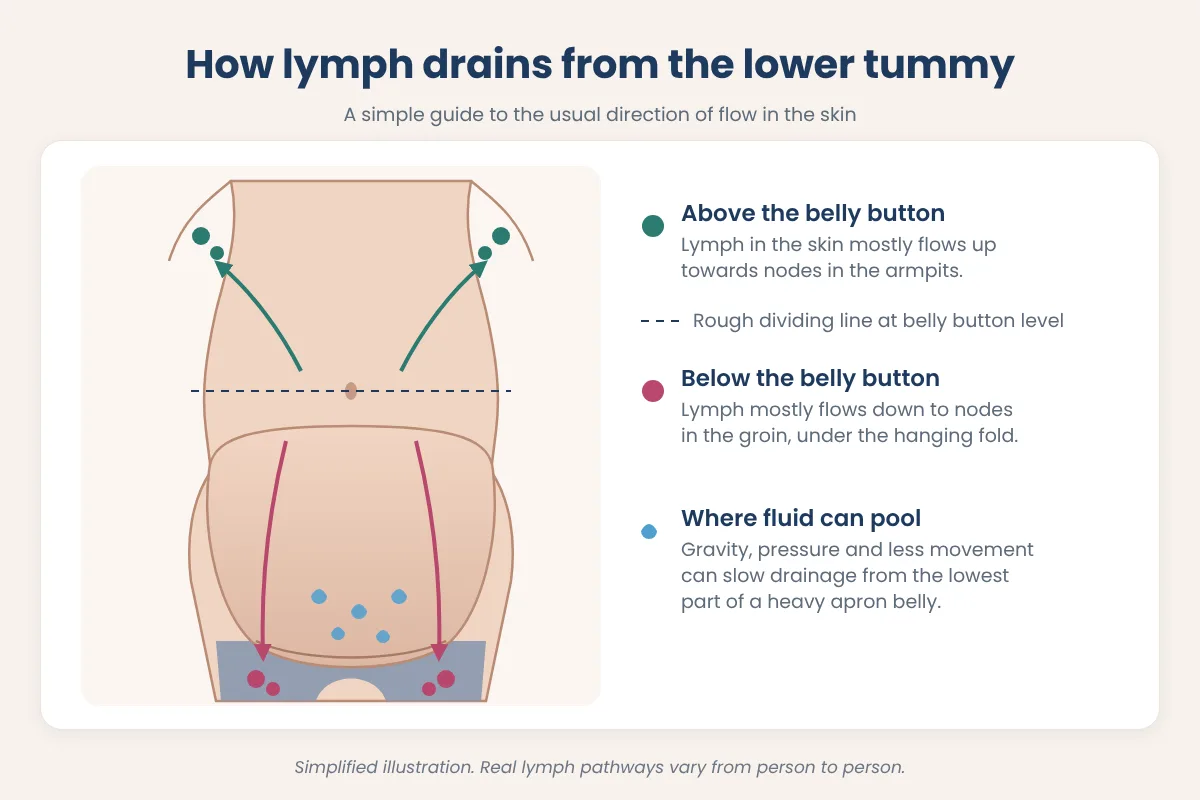
Why a Heavy Fold Can Struggle to Drain
Several factors may slow the flow of lymph in a large apron belly:
- Gravity pulls fluid down into the lowest part of the fold.
- The fold presses on the skin and tissue beneath it, especially when you sit.
- Less movement means the muscles pump lymph less often.
- Inflammation from repeated rashes or infection can damage small lymph vessels.
Lymphoedema in a pannus usually builds up slowly. In the early stages, the swelling may come and go. Later, the tissue can become firm and fibrous, and it no longer goes down overnight.
When Swelling Reaches the Pubic Area and Genitals
Lymph from the lower tummy, the pubic mound and the genitals drains to the same groin nodes. So swelling in an apron belly can sometimes spread lower. This is called genital lymphoedema. It can affect the vulva, the penis or the scrotum.
Genital swelling often follows cancer treatment in the pelvis or groin. However, it can also develop alongside severe obesity. It may make passing urine harder, and long spells of sitting can make it worse. Understandably, it can also affect comfort, confidence and intimacy.
Please do not feel embarrassed to mention it. Lymphoedema specialists treat this area often, with skin care, supportive underwear or shorts, and gentle drainage advice.
Massive Localised Lymphoedema: A Rare Form
Massive localised lymphoedema (MLL) is an uncommon condition first described in 1998. It causes a large, heavy mass of swollen tissue in one area. Case reports show it mainly affects people living with severe obesity, often with a BMI over 40.
It appears most often on the inner thigh and groin. Less often, it forms in the lower abdominal wall, inside a large pannus. The mass usually grows slowly over many years and is often painless. In addition, the skin over it may thicken, harden and take on an orange-peel look.
Because MLL can look like a tumour under the microscope, it is sometimes called a pseudosarcoma. It is not cancer. However, a small number of case reports describe a rare cancer called angiosarcoma developing later in the affected tissue. For that reason, a rapidly growing, discoloured or ulcerated mass always needs a specialist assessment.
Signs of Abdominal Lymphoedema to Watch For
The NHS lists swelling, an aching or heavy feeling and repeated skin infections among the main symptoms. In a tummy fold, these signs may include:
- Heaviness. The fold feels weighty and tight, and it may drag on your back.
- Pitting. Pressing a fingertip firmly into the skin for a few seconds leaves a dent.
- Skin thickening. The skin feels harder, tougher or harder to pinch than before.
- Peau d’orange. Small dimples make the skin look like orange peel.
- Deeper folds. New creases or lobes of tissue appear on the fold.
- Wart-like growths. Small bumps, blisters or raised patches form on the surface. Doctors call this papillomatosis.
- Leaking fluid. Clear or yellowish fluid seeps through the skin. This is known as lymphorrhoea.
- Recurrent cellulitis. The fold becomes red, hot and painful more than once.
Early lymphoedema is often soft and pits easily. Over time, the tissue can harden, so it may stop pitting. Keep a note of when changes started, and take dated photos if you feel comfortable doing so.
Apron Belly Fat, Lymphoedema or Lipoedema?
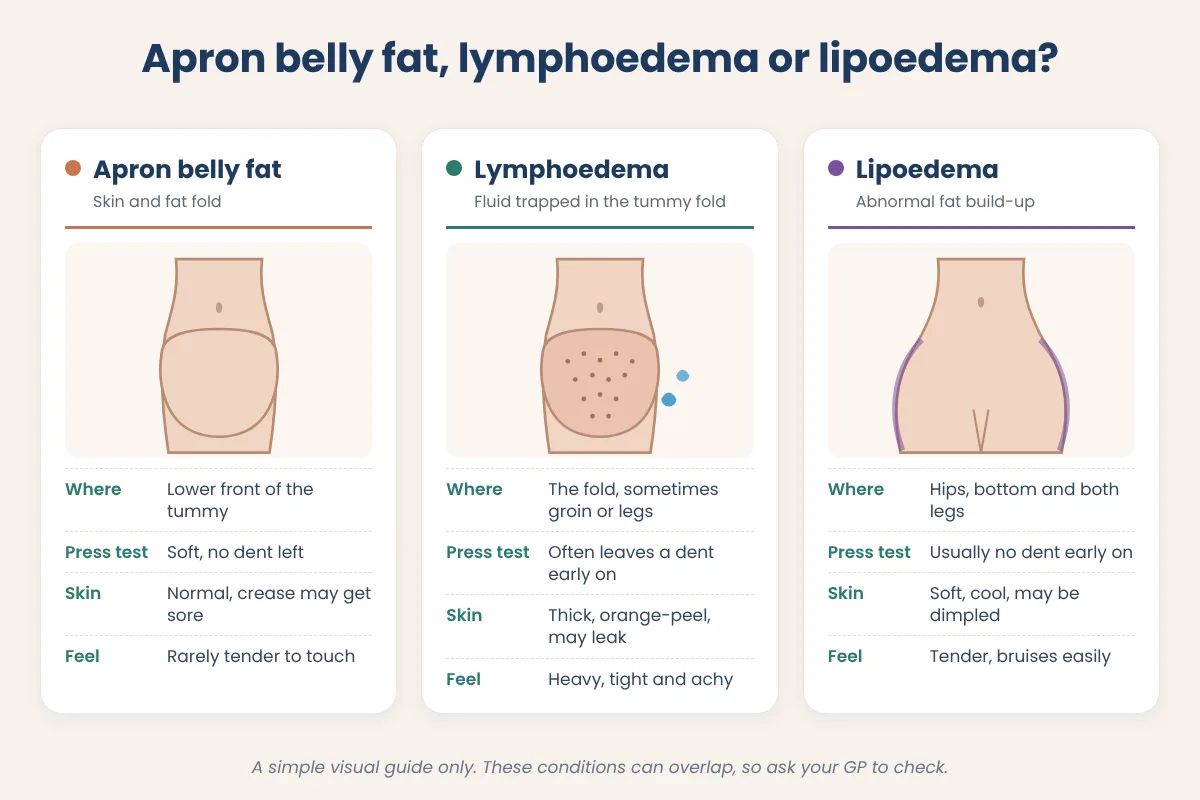
These three conditions can overlap, which makes them easy to confuse. In fact, one person can have more than one at the same time. The table below shows the usual differences.
| Feature | Apron belly fat | Abdominal lymphoedema | Lipoedema |
|---|---|---|---|
| What it is | A fold of skin and fat | Trapped lymph fluid, with later tissue changes | An abnormal build-up of fat |
| Main area | Lower front of the tummy | The fold itself, and sometimes the groin or legs | Hips, bottom and legs, and sometimes arms |
| Press test | Soft, with no dent | Often leaves a dent early on | Usually no dent in early stages |
| Skin | Normal, though the crease can get sore | Thick, tight, orange-peel or leaking | Soft, cool and sometimes dimpled |
| Feeling | Rarely tender to touch | Heavy, tight and achy | Tender, achy and bruises easily |
| Weight loss | Fat often shrinks, while loose skin may stay | Can ease symptoms, but rarely clears it alone | Affected fat changes very little |
Advanced lipoedema can also overload the lymph system. Specialists call this lipo-lymphoedema. Our guide to lipoedema or apron belly explains that condition in more detail.
Some other causes of swelling also need ruling out. For instance, a lump that pushes out when you cough may be a hernia rather than fluid. Our article on telling an apron belly from a hernia covers the warning signs.
Cellulitis: Red Flags and When to Get Help
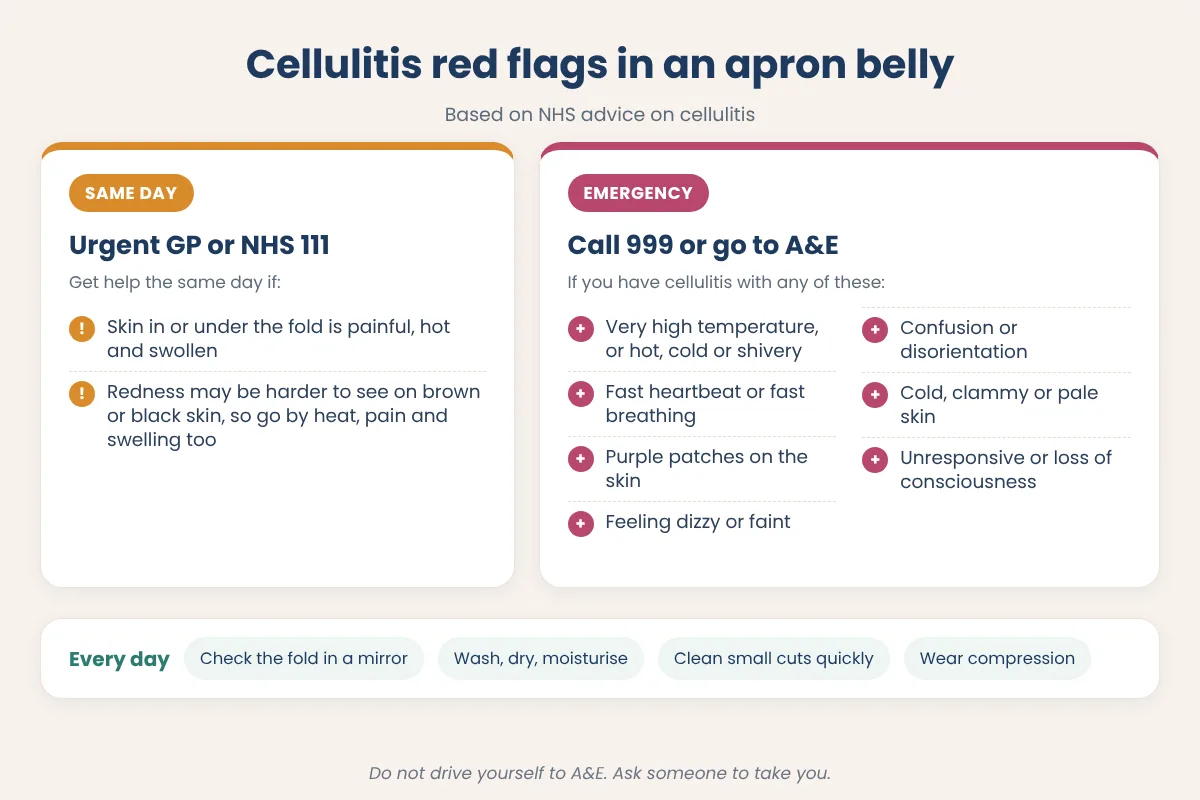
The NHS says cellulitis is the most common complication of lymphoedema. It is a bacterial skin infection. Swollen tissue and broken skin in a fold make it easier for germs to get in.
According to the NHS cellulitis guide, the skin becomes painful, hot and swollen. It usually looks red, although redness can be harder to see on brown or black skin. You may also feel unwell, with flu-like symptoms.
Ask for an urgent GP appointment or get help from NHS 111 if your skin is painful, hot and swollen.
Call 999 or go to A&E if you have cellulitis with any of these signs:
- A very high temperature, or you feel hot, cold or shivery.
- A fast heartbeat or fast breathing.
- Purple patches on your skin, which may be less obvious on brown or black skin.
- Feeling dizzy or faint.
- Confusion or disorientation.
- Cold, clammy or pale skin.
- Unresponsiveness or loss of consciousness.
Do not drive yourself to A&E. Instead, ask someone to drive you, or call 999 and ask for an ambulance.
Cellulitis is treated with antibiotics. Infections can keep coming back. After two or more episodes in a year, UK lymphoedema guidance says preventive antibiotics should be considered. Our guide to apron belly health risks covers other problems a large fold can cause.
Getting Diagnosed and Referred in the UK
Your GP is the usual first step. They will ask about your symptoms and look at the fold. They may also measure the area and check for other causes of swelling, such as heart, kidney or liver problems.
The NHS says diagnosis is often based on your symptoms, history and an examination. Further tests are only needed occasionally. If lymphoedema seems likely, your GP can refer you to a specialist NHS lymphoedema service.
Services vary across the country, so waiting times differ. Before your appointment, it helps to prepare:
- A short timeline of when the swelling and heaviness began.
- A list of any skin infections and the antibiotics you took.
- Dated photos of the fold, if you are comfortable taking them.
- Notes on how the fold affects walking, sleep, hygiene or work.
For a suspected MLL, a specialist may arrange a scan such as a CT. This helps rule out other kinds of lump before any treatment is planned.
Treatment for Pannus Lymphoedema
There is no cure for lymphoedema. However, the NHS says the main symptoms can usually be controlled. UK specialists build care around four parts: skin care, compression, movement and lymphatic drainage. Weight management is often added as well.
Skin Care
Healthy skin is your best defence against cellulitis. The BLS consensus advises washing, drying and moisturising every day, with extra care in skin folds. Use a soap substitute and a plain, unperfumed moisturiser. Our guide to apron belly rash shows how to treat soreness in the crease.
Compression
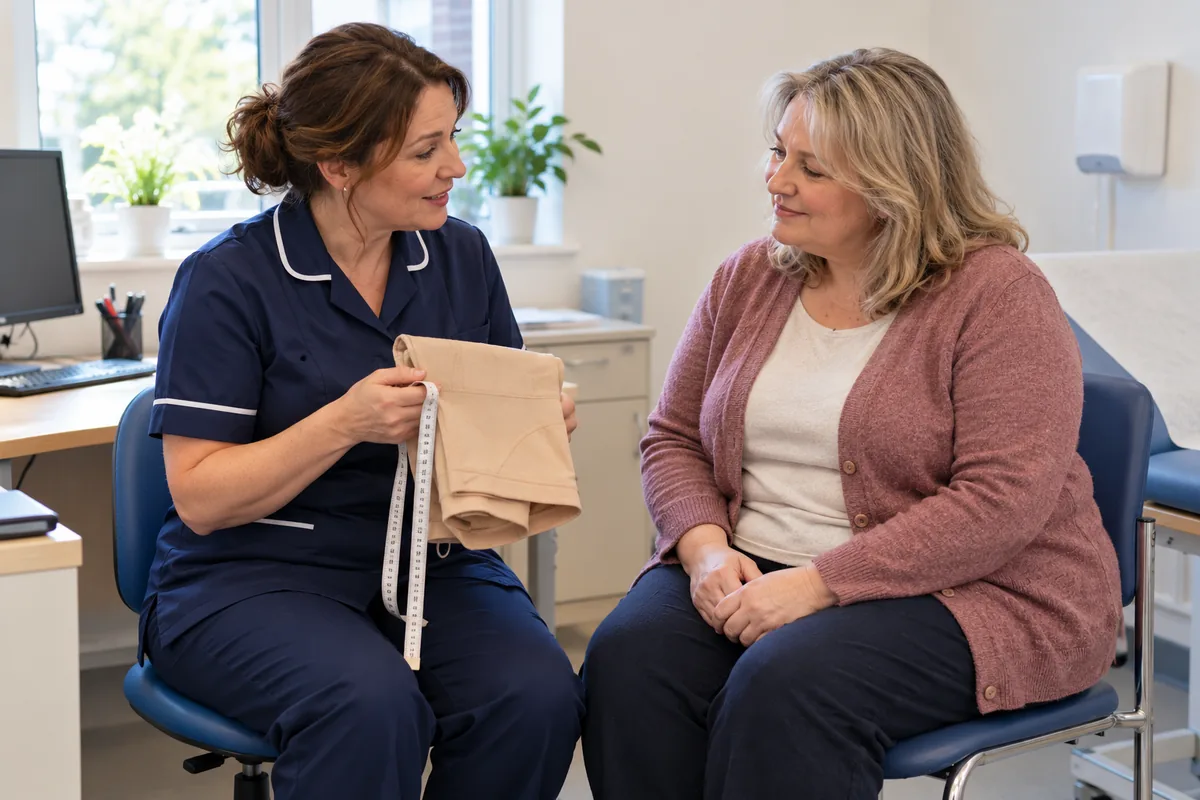
Compression helps push fluid out of the tissue and stops it building up again. For the tummy, a specialist may suggest compression shorts, a girdle-style garment or an adjustable wrap. Fit matters a great deal, so let a trained lymphoedema practitioner measure you. An everyday support belt is not medical compression. Even so, our apron belly support belt guide covers comfort options.
Manual Lymphatic Drainage and Decongestive Therapy
Manual lymphatic drainage (MLD) is a gentle, specialised massage that moves lymph towards working nodes. On its own, though, its effects are limited and short-lived. UK guidance therefore uses it only as part of a wider plan.
Decongestive lymphatic therapy (DLT) is a more intensive course. It usually combines bandaging, skin care, exercise and MLD over a few weeks. After that, you move on to garments and self-care to keep the swelling down. Your specialist may also teach you a simpler self-drainage routine.
Movement and Weight Management
Muscles act like a pump for lymph. So gentle, regular movement helps, even when it is not strenuous. Walking, heel raises and slow, deep breathing all count.
When weight is a factor, the BLS consensus treats weight support as a key part of care. Losing weight can ease symptoms and help other treatments work better. Even so, it may not fully reverse long-standing changes. Ask your GP about local weight management services if you would like support.
Surgery and Panniculectomy
A panniculectomy removes the hanging fold of skin and fat. For a very large, swollen pannus or an MLL, removing the tissue can ease weight, infections and mobility problems.
Still, surgery does not repair the lymph system itself. Reports on MLL note that swelling often returns after the tissue is removed. Wound problems are also more likely when tissue is swollen and skin is fragile. As a result, surgeons often ask for swelling and skin health to be as well controlled as possible first. Our guide to panniculectomy vs tummy tuck compares the options. For funding rules, see getting an apron belly operation on the NHS.
Daily Self-Care for Apron Belly Lymphoedema
Small habits, done every day, make a real difference to comfort and infection risk. Try building these into your routine:
- Lift the fold and wash the crease gently once or twice a day.
- Pat the skin fully dry, then apply a plain moisturiser to the outer skin.
- Place a soft cotton or moisture-wicking layer under the fold.
- Check the fold daily in a mirror for cuts, cracks, redness or leaking.
- Treat any small cut quickly with clean water and a clean dressing.
- Wear your compression garment as your specialist advises.
- Move little and often, and change position regularly when sitting.
- Avoid tight waistbands that cut into the fold.
If the fold leaks fluid, keep the skin clean, use an absorbent dressing and contact your lymphoedema team or GP.
Frequently Asked Questions
Can an apron belly cause lymphoedema?
A large, heavy apron belly may make it harder for lymph to drain from the lower tummy, especially alongside obesity. However, most apron bellies do not lead to lymphoedema. Signs such as pitting, skin thickening or repeated infections are a reason to see your GP.
What does abdominal lymphoedema look like?
The fold often looks swollen and feels heavy and tight. The skin may thicken, look dimpled like orange peel or develop small wart-like bumps. Some people notice clear fluid leaking through the skin. Early swelling usually leaves a dent when pressed.
Is massive localised lymphoedema cancer?
No, massive localised lymphoedema is not cancer. It is a rare build-up of swollen tissue, mostly seen with severe obesity. A few case reports describe a rare cancer developing later in the area. For that reason, specialists keep a close eye on it.
Can I get lymphoedema treatment on the NHS?
Yes. Your GP can refer you to a specialist NHS lymphoedema service for assessment and treatment. Services vary by area, so waiting times differ. Treatment usually includes skin care, compression garments, movement advice and, in some cases, lymphatic drainage.
Will a panniculectomy cure lymphoedema?
No. A panniculectomy removes the heavy fold, which can ease infections and mobility problems. However, it does not repair the lymph system, so swelling can return. Most people still need skin care and compression after surgery.
Does weight loss help abdominal lymphoedema?
Weight loss can ease symptoms and help other treatments work better. UK specialists treat weight support as a key part of care when obesity is a factor. Even so, weight loss alone may not reverse long-standing tissue changes.
When should I go to A&E with a red, swollen apron belly?
Call 999 or go to A&E if you have cellulitis with a very high temperature, shivering or fast breathing. A fast heartbeat is another warning sign. The same applies to purple patches, dizziness, confusion, or cold, clammy or pale skin. For painful, hot and swollen skin alone, ask for an urgent GP appointment or contact NHS 111.
Final Thoughts
A heavy, swollen apron belly is not something you simply have to put up with. Pitting, thickened skin and repeated infections can all point to lymphoedema, and specialist help is available. Your GP can check other causes and refer you to an NHS lymphoedema service.
Meanwhile, gentle daily skin care and regular movement protect your skin and comfort. Above all, act fast on cellulitis red flags. You deserve care that treats the swelling, the skin and you as a whole person.