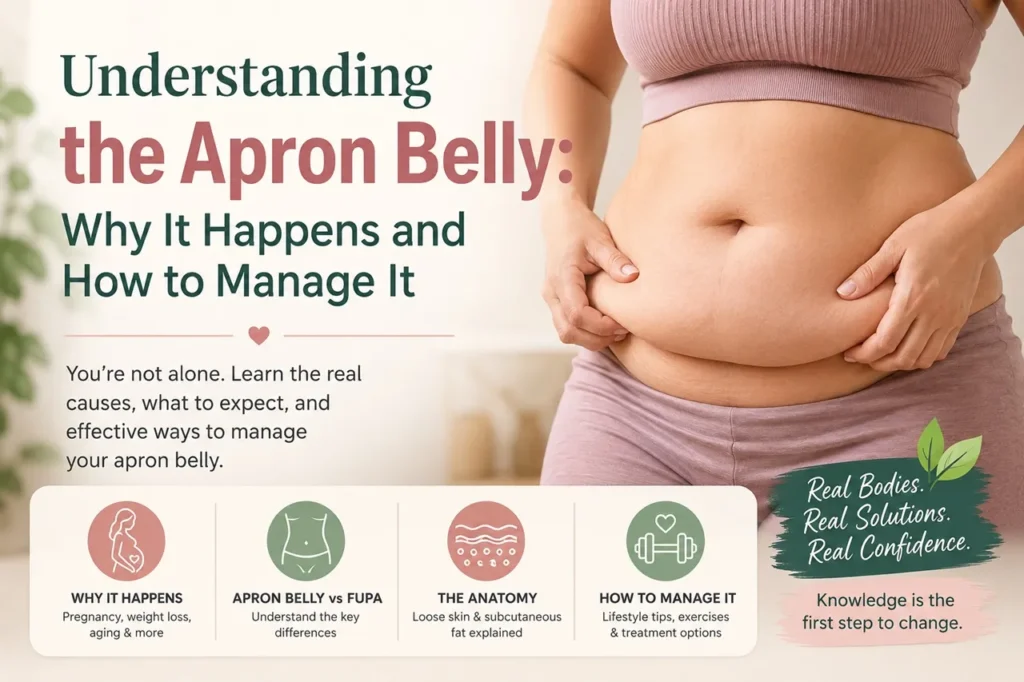

If you have an underactive thyroid, or suspect one, you may wonder if it explains the fold over your lower tummy. The underactive thyroid apron belly link is one of the most common questions people ask after a diagnosis. The honest answer is reassuring, but it is not quite what many people expect.
This guide explains how much weight hypothyroidism usually adds and why a fold is rarely a thyroid sign. It also covers UK testing, what levothyroxine can do for your weight and when to see your GP.

Underactive Thyroid Apron Belly: The Short Answer
An underactive thyroid does not directly cause an apron belly. It can add a little weight, but most of that extra weight is salt and water rather than fat. An apron belly, on the other hand, is a hanging fold made mainly of stretched skin and the fat just beneath it.
Here are the key points at a glance:
- Hypothyroidism usually adds only a modest amount of weight, and much of it is fluid.
- An apron belly, or pannus, usually builds up over years through weight changes, pregnancy and ageing.
- Thyroid fluid tends to show as puffiness in the face, hands and feet, rather than as one hanging fold.
- Treatment with levothyroxine often brings a small weight loss, but it will not tighten loose skin.
- A simple blood test is the only way to know whether your thyroid is involved.
What Is Hypothyroidism?
Your thyroid is a small, butterfly-shaped gland at the front of your neck. It makes hormones called thyroxine (T4) and triiodothyronine (T3). These hormones help control your metabolism, which is the process that turns food into energy.
The NHS describes an underactive thyroid, or hypothyroidism, as a condition where the thyroid does not make enough of these hormones. As a result, many of the body’s processes slow down.
What Causes It?
In the UK, the most common cause is Hashimoto’s disease. This is an autoimmune condition, where the immune system attacks the thyroid by mistake. According to the NHS, it is most common in women and usually starts between the ages of 30 and 50. However, anyone can get an underactive thyroid.
Other causes include:
- Surgery or radiotherapy on or near the thyroid.
- Treatment for an overactive thyroid.
- Certain medicines, such as lithium and amiodarone.
- Thyroiditis, which means inflammation of the thyroid.
- Rarely, a lack of iodine in the diet.
Having a family history of thyroid problems also raises your risk.
Thyroid Changes After Having a Baby
This point matters for many mums with an apron belly. The British Thyroid Foundation explains that postpartum thyroiditis can develop after pregnancy, usually in the first six months after birth. It often starts with an overactive phase and may then become underactive. The underactive phase can even look like postnatal depression.
Most women recover fully. Even so, ask your GP about a thyroid test if you feel exhausted or low after giving birth.
Underactive Thyroid Symptoms to Know
Symptoms usually develop slowly and get worse over time. In fact, you may not notice them for several years. The NHS guide to an underactive thyroid lists these common symptoms:
- Feeling extremely tired.
- Feeling cold more than usual.
- Putting on weight.
- Constipation.
- Difficulty concentrating or thinking clearly.
- Low mood or depression.
- Dry skin, dry hair or hair loss.
- A croaky, or hoarse, voice.
- Irregular or heavy periods.
The British Thyroid Foundation adds muscle aches, a puffy face and bags under the eyes.
Many of these symptoms are common and have other causes. That is why NICE advises doctors to bear in mind that one symptom alone may not point to thyroid disease.
How Much Weight Does an Underactive Thyroid Add?
Low thyroid hormone does slow your resting metabolism. However, the effect on weight is usually smaller than people expect.
Mostly Salt and Water, Not Fat
The British Thyroid Foundation shares guidance on thyroid and weight from the American Thyroid Association. It says most of the extra weight gained with hypothyroidism is due to a build-up of salt and water. In general, around 5 to 10 pounds (roughly 2 to 4.5 kg) may be due to the thyroid, depending on how severe the condition is.
The same guidance states that massive weight gain is rarely linked to hypothyroidism. The amount also tends to be greater in people whose thyroid is more severely underactive.
Weight Gain on Its Own Is a Weak Clue
According to the same guidance, if weight gain is your only symptom, the thyroid is less likely to be the sole cause. In most cases, an underactive thyroid comes with a cluster of other signs, such as tiredness, feeling cold and dry skin.
Why It Can Feel Like More
Fatigue, aches and low mood can make it harder to stay active. Over time, that may add to any weight you already carry. Our guide to apron belly vs belly fat explains how to tell which part of your tummy is fat and which is loose skin.
Why an Apron Belly Is Mostly Skin and Fat, Not a Thyroid Sign
An apron belly is a fold of skin and subcutaneous fat that hangs down over the lower tummy. It can range from a small overhang to a large fold that reaches the thighs.
The usual reasons for a fold are well known. They include weight gain followed by weight loss, pregnancy, ageing skin and your genes. Our medical guide to what causes an apron belly covers each of these in detail. Thyroid disease is not a direct cause on that list.
How Thyroid Changes Differ From a Fold
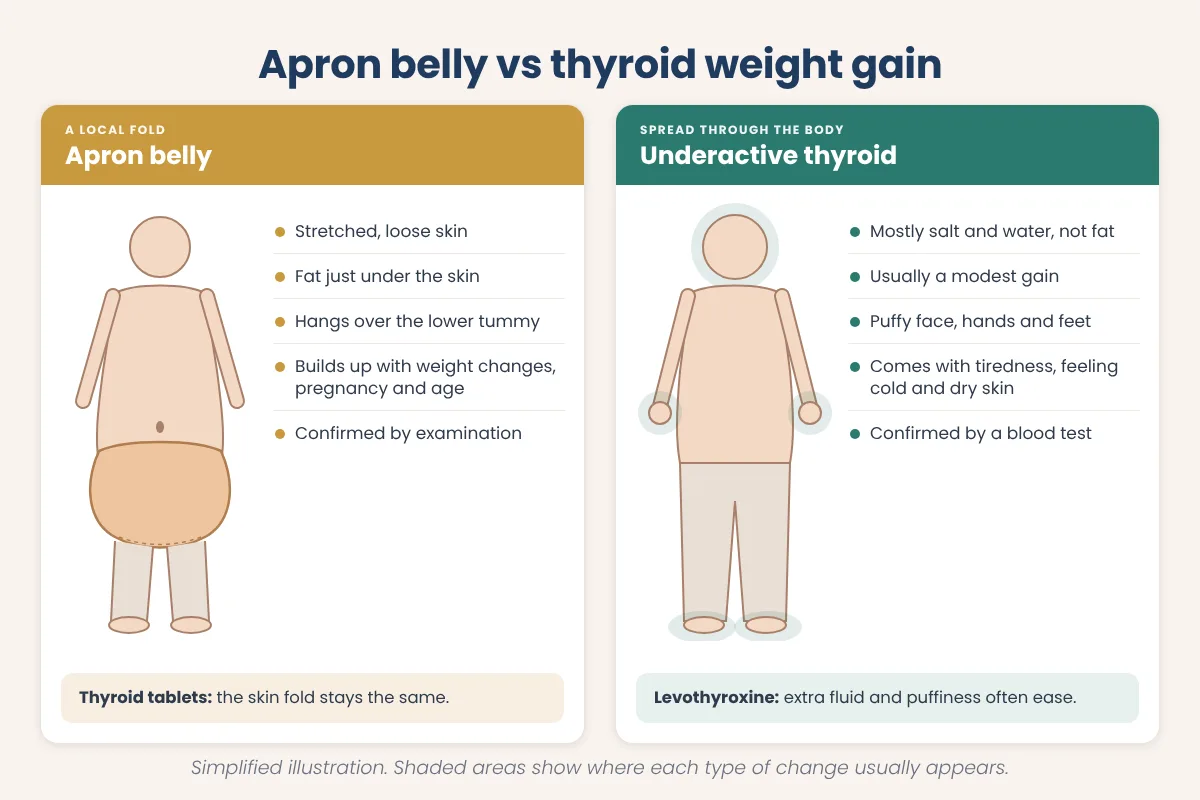
The fluid linked to hypothyroidism tends to spread through the body. As a result, it shows up as puffiness in the face, around the eyes, in the hands and in the feet. It does not gather as one hanging apron of skin.
In addition, a fold made mostly of stretched skin will not respond to thyroid hormone at all. Loose skin needs time, support or surgery, not medicine for your thyroid.
Quick Clues: Thyroid or Apron Belly?
| Feature | Underactive thyroid | Apron belly |
|---|---|---|
| What the extra weight is | Mostly salt and water | Loose skin and fat under the skin |
| Where you notice it | Face, eyes, hands and feet | A fold hanging over the lower tummy |
| Other signs | Tiredness, feeling cold, dry skin, constipation | Rubbing, sweating or rashes under the fold |
| Effect of levothyroxine | Puffiness and fluid often ease | The skin fold stays |
| How it is confirmed | Thyroid blood test | Physical examination |
Myxoedema: The Thyroid Swelling Worth Knowing About
Myxoedema is the medical name for the skin changes seen in more severe hypothyroidism. A 2011 review in Dermato-Endocrinology explains that it happens when substances called glycosaminoglycans, notably hyaluronic acid, build up in the skin. The skin looks swollen and puffy, yet it does not keep a dent when pressed.
This point helps tell it apart from other kinds of swelling. For example, early lymphoedema in a heavy fold often does leave a dent when you press it. Our guide to apron belly and lymphoedema explains that condition in full.
Myxoedema Coma Is Rare
The NHS notes that, in very rare cases, a severe underactive thyroid can lead to myxoedema coma. This life-threatening emergency needs hospital treatment, but it is very unlikely with proper care.
How an Underactive Thyroid Is Diagnosed
Your GP will ask about your symptoms and family history, and may examine your neck. To confirm the diagnosis, they will arrange a blood test.
The TSH and T4 Blood Test
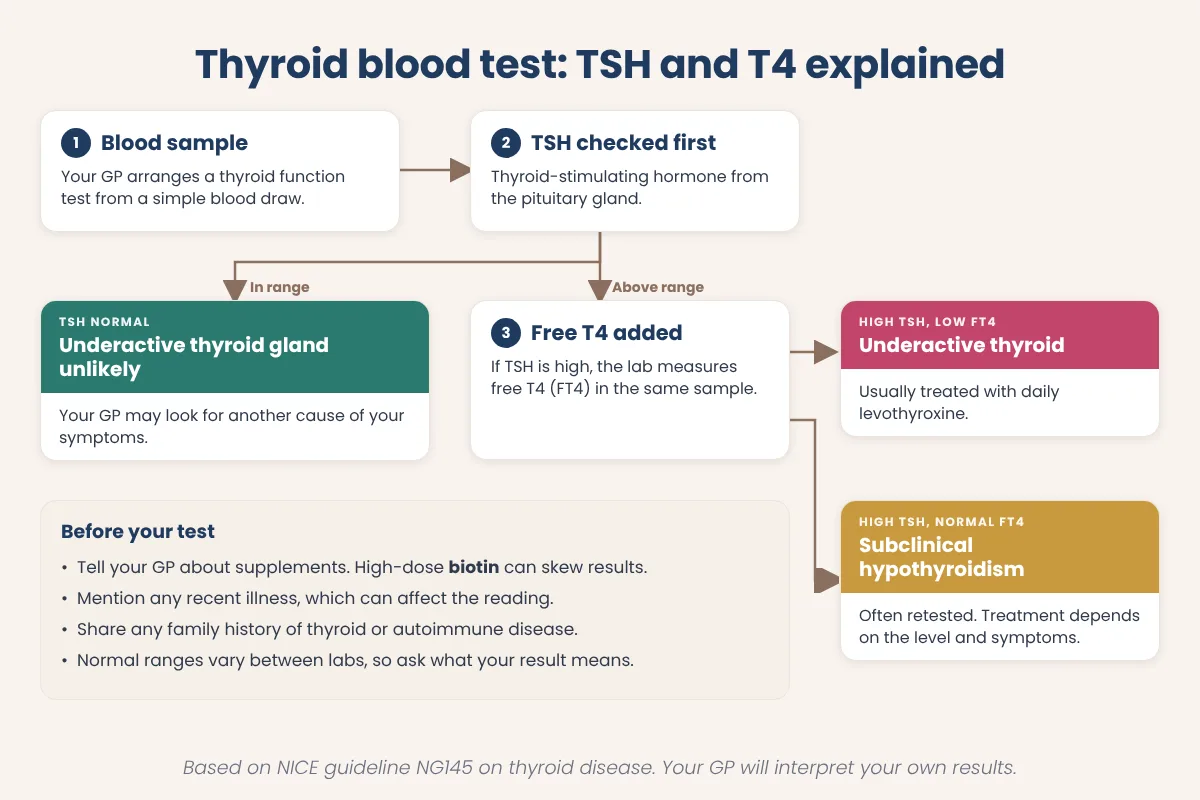
The test measures thyroid-stimulating hormone (TSH) and thyroxine (T4). TSH comes from the pituitary gland in your brain. When your thyroid is underactive, the pituitary makes more TSH to try to push it into action.
Under the NICE guideline on thyroid disease, NG145, doctors may first measure TSH alone. If TSH is above the normal range, the lab then measures free T4 (FT4) in the same sample.
| Result | What it usually means |
|---|---|
| High TSH and low FT4 | Underactive thyroid (primary hypothyroidism) |
| High TSH and normal FT4 | Subclinical, or mild, hypothyroidism |
| TSH within the normal range | An underactive thyroid gland is unlikely |
Normal ranges vary slightly between labs. Your GP will explain what your own result means.
Tips Before Your Test
- Tell your GP about any supplements. NICE notes that high doses of biotin can give falsely high or low results.
- Mention any recent illness. NICE advises against testing during an acute illness, unless that illness may be thyroid related.
What About Subclinical Hypothyroidism?
Subclinical hypothyroidism means TSH is slightly raised while T4 is still normal. Often, there are no clear symptoms. NICE suggests considering levothyroxine if TSH is 10 mU/L or higher on two tests taken 3 months apart.
For adults under 65 with symptoms and a lower raised TSH, a 6-month trial of treatment may be considered.
Levothyroxine Treatment and What to Expect for Your Weight
An underactive thyroid is usually treated with levothyroxine. This daily tablet replaces the hormone your thyroid cannot make. Most people need it for life, and the NHS says you should be able to live a normal life.
How Treatment Usually Works
NICE suggests a starting dose based on body weight for most adults under 65 without heart disease. For people aged 65 and over, or those with heart disease, doctors start lower and increase slowly.
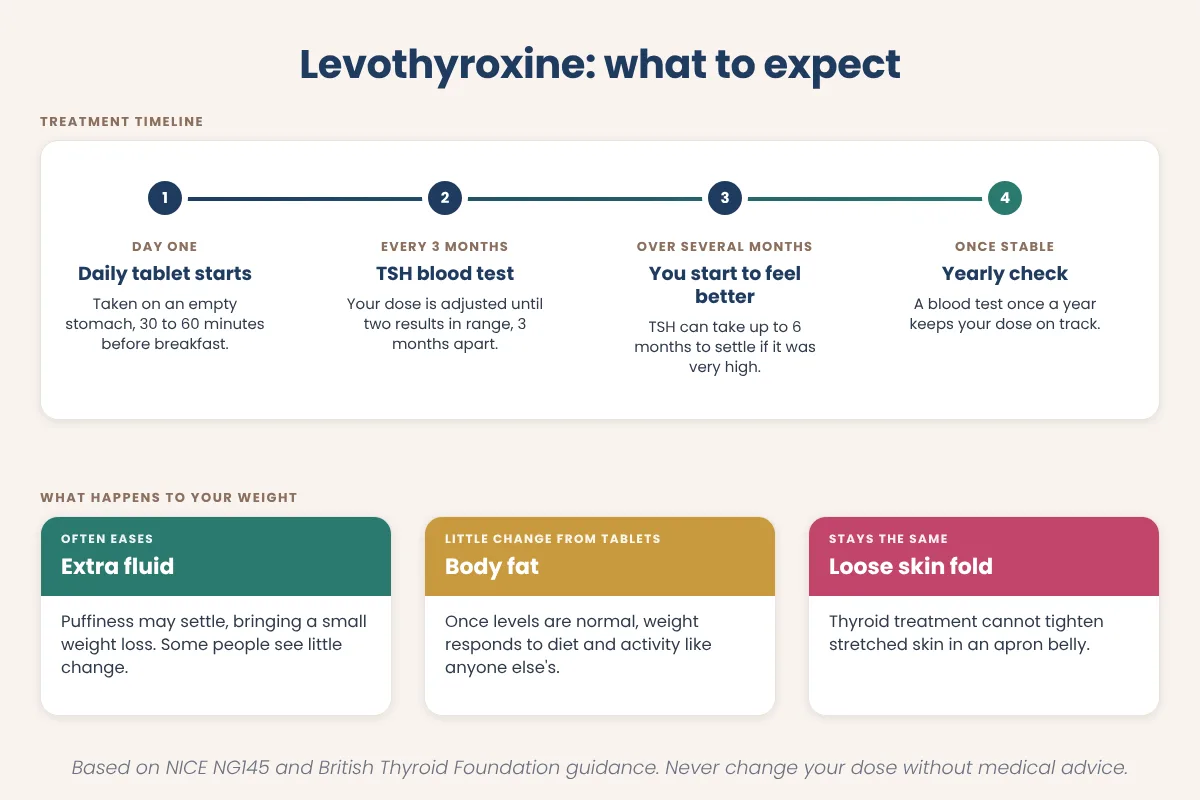
After that, TSH is usually checked every 3 months until it settles, and then once a year. If your TSH was very high before treatment, NICE notes it can take up to 6 months to return to range. The British Thyroid Foundation says it can take several months before you feel better.
How to Take It
The NHS advises taking levothyroxine on an empty stomach, 30 to 60 minutes before breakfast, caffeine or other medicines. The British Thyroid Foundation also suggests leaving at least four hours between levothyroxine and calcium, iron or multivitamin tablets. These can reduce how well it is absorbed.
What Happens to Your Weight
Because much of the gain is fluid, treatment often brings a small weight loss. The British Thyroid Foundation guidance says this is usually less than 10% of body weight. However, it also says it is fairly common to see no clear weight loss at all, because hypothyroidism tends to develop slowly.
A small Danish study, published in 2011 in the Journal of Clinical Endocrinology and Metabolism, followed 12 newly diagnosed adults for a year on treatment. Their average weight fell from 83.7 kg to 79.4 kg. Yet their fat mass barely changed, and the researchers linked the loss to the body clearing excess water.
In short, levothyroxine may ease puffiness and fluid. It will not shrink the fat in a fold or tighten stretched skin. Once your levels are back in range, the guidance says you can gain or lose weight just like someone without a thyroid problem.
Never Take Extra Thyroid Tablets to Lose Weight
A higher dose will not melt away belly fat. The British Thyroid Foundation guidance explains that excess thyroid hormone can cause muscle loss as well as fat loss. Any weight lost is usually regained once the extra dose stops.
Too much levothyroxine also causes symptoms of an overactive thyroid. For this reason, only change your dose on your doctor’s advice.

Other Causes of Belly Changes to Consider
If your thyroid test is normal, something else is likely behind the change in your tummy.
Menopause
The NHS says weight gain during perimenopause and menopause is common and often happens around the stomach and upper body. Our guide to menopause belly vs apron belly explains how to tell the two apart.
The British Thyroid Foundation also notes that some women need a lower levothyroxine dose around the menopause.
Polycystic Ovary Syndrome (PCOS)
The NHS lists weight gain, or difficulty losing weight, as a common PCOS symptom. PCOS is also linked to insulin resistance, which can affect where fat is stored. Our guide to the PCOS apron belly looks at this hormone link in detail.
Bloating
Sometimes a swollen tummy is not fat or skin at all. Constipation, which is common with hypothyroidism, can cause bloating too. Our quick guide to apron belly vs bloating helps you tell the difference.
Managing an Apron Belly When You Have a Thyroid Condition
Getting your thyroid levels right comes first. After that, the usual apron belly approaches apply.
- Take levothyroxine consistently, at the same time each day, and keep your blood test appointments.
- Build activity back gently as your energy returns. Walking is a good place to start.
- Look after the skin under your fold. Keep it clean and dry, and use a gentle moisturiser on the rest of your body, since hypothyroidism can make skin dry.
- Support the fold with well-fitting underwear or a support garment if it feels heavy.
If a fold of loose skin remains once your weight is stable, surgery may be an option. Tell any surgeon about your thyroid condition and your medicines. Our guide to getting an apronectomy on the NHS sets out the usual criteria.
When to See a GP
The NHS advises seeing a GP if you think you might have an underactive thyroid. In particular, book an appointment if:
- You have several symptoms together, such as tiredness, unexplained weight gain, feeling cold and dry skin.
- You feel exhausted, low or unwell in the months after giving birth.
- You take levothyroxine but still feel unwell, or you have new symptoms.
- You notice new swelling in your face, hands, feet or tummy.
- The skin under your fold becomes red, hot, painful or keeps breaking down.
If you are pregnant or planning a pregnancy and take levothyroxine, tell your GP or midwife promptly. Your dose often needs adjusting.
Call 999 or go to A&E if someone becomes very drowsy, confused or hard to wake. This needs urgent help, whatever the cause.
Frequently Asked Questions
Can an underactive thyroid cause an apron belly?
Not directly. An underactive thyroid can add a modest amount of weight, mostly from salt and water. An apron belly is a fold of loose skin and fat that usually develops from weight changes, pregnancy and ageing.
How much weight can an underactive thyroid cause?
Guidance shared by the British Thyroid Foundation suggests around 5 to 10 pounds may be due to the thyroid, depending on severity. Most of it is fluid rather than fat. Massive weight gain is rarely caused by hypothyroidism.
Does hypothyroidism cause belly fat specifically?
There is no clear evidence that hypothyroidism targets belly fat. Its fluid tends to show as puffiness in the face, hands and feet. Fat around the tummy is more often linked to general weight gain, menopause or conditions such as PCOS.
Will levothyroxine get rid of my apron belly?
No. Levothyroxine often brings a small weight loss as extra fluid clears. However, it does not burn the fat in a fold or tighten stretched skin. A loose fold usually needs other approaches.
What blood test checks for an underactive thyroid?
A thyroid function test measures thyroid-stimulating hormone (TSH) and thyroxine (T4). A high TSH with a low T4 usually means an underactive thyroid. Your GP can arrange the test.
What is myxoedema?
Myxoedema is a skin change seen in more severe hypothyroidism. Substances build up in the skin and make it look puffy, but it does not dent when pressed. It usually improves with treatment.
Can I take extra thyroid tablets to lose weight?
No. Taking more levothyroxine than prescribed can cause symptoms of an overactive thyroid and muscle loss. Any weight lost is usually regained when the extra dose stops. Only change your dose on your doctor’s advice.
Should I ask my GP for a thyroid test if I have an apron belly?
An apron belly alone is not a reason for a thyroid test. However, ask your GP if you also have symptoms such as tiredness, feeling cold, dry skin or constipation. A blood test will give you a clear answer.
Final Thoughts
An underactive thyroid can add a few pounds, mostly fluid, but it is rarely the main reason for an apron belly. The fold itself is mainly stretched skin and fat, shaped by weight changes, pregnancy and time. Treatment with levothyroxine can ease puffiness and help you feel more like yourself, yet it will not tighten loose skin.
If you have several symptoms, ask your GP for a blood test rather than guessing. Once your levels are right, focus on what helps any apron belly: gentle activity, good skin care and, if needed, a talk about surgery.