Finding a new bulge on your tummy can feel scary, especially when you already live with an overhang. So, is it an apron belly or hernia? Most of the time, a soft fold that you can lift and hold is skin and fat. A lump that pushes out when you cough, though, needs a closer look.
This guide explains how the two differ, where hernias tend to appear and how diastasis recti fits in. It also sets out the NHS warning signs, so you know when to book a GP visit and when to call 999.

Apron Belly or Hernia: The Quick Answer
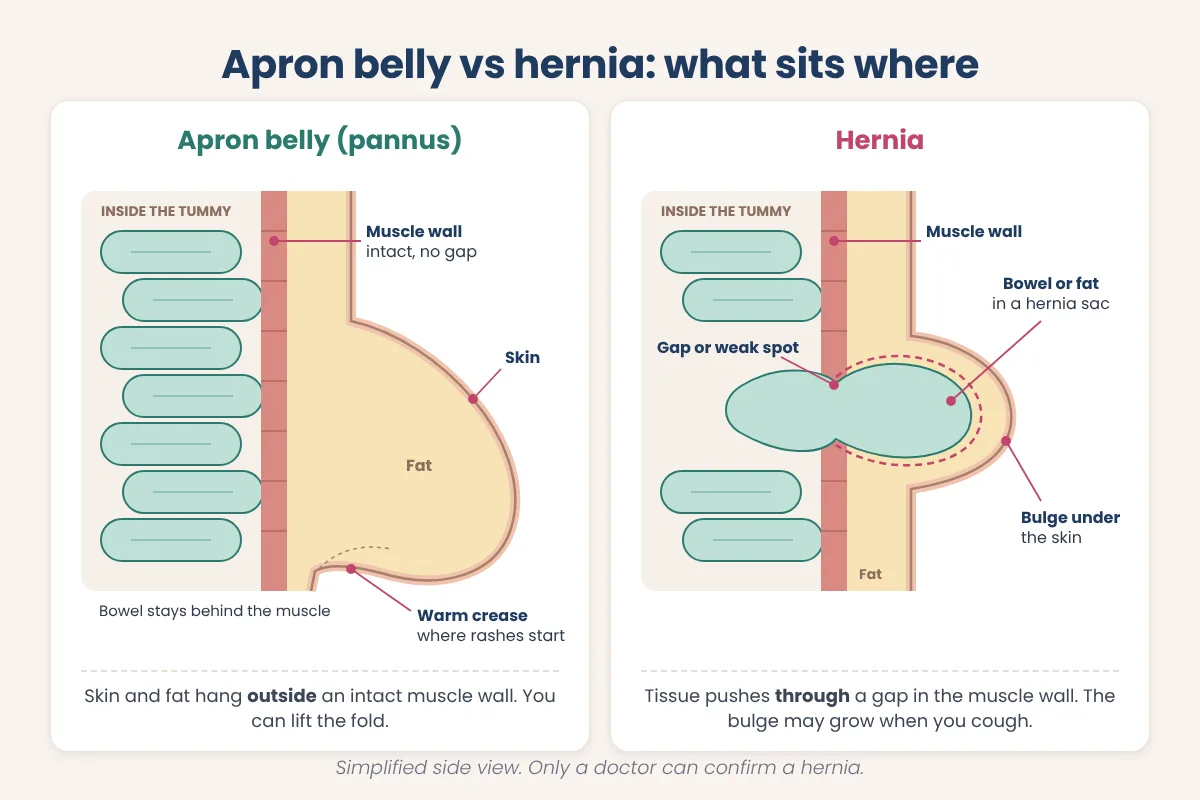
An apron belly is a fold of skin and fat that hangs in front of the tummy muscles. A hernia is tissue that pushes through a gap or weak spot in those muscles. In short, one sits outside the muscle wall, while the other breaks through it.
Here are the main clues at a glance:
- You can lift, hold and move an apron belly fold, and it feels soft all the way through.
- A hernia often shows as a rounded lump that gets bigger when you cough, sneeze or strain.
- A hernia lump may shrink or vanish when you lie down.
- Pain, a hard lump or a lump that will not go back in are warning signs, not normal fold changes.
Even so, you can have both at once. If you are unsure, a GP check is the safest next step.
What an Apron Belly (Pannus) Is
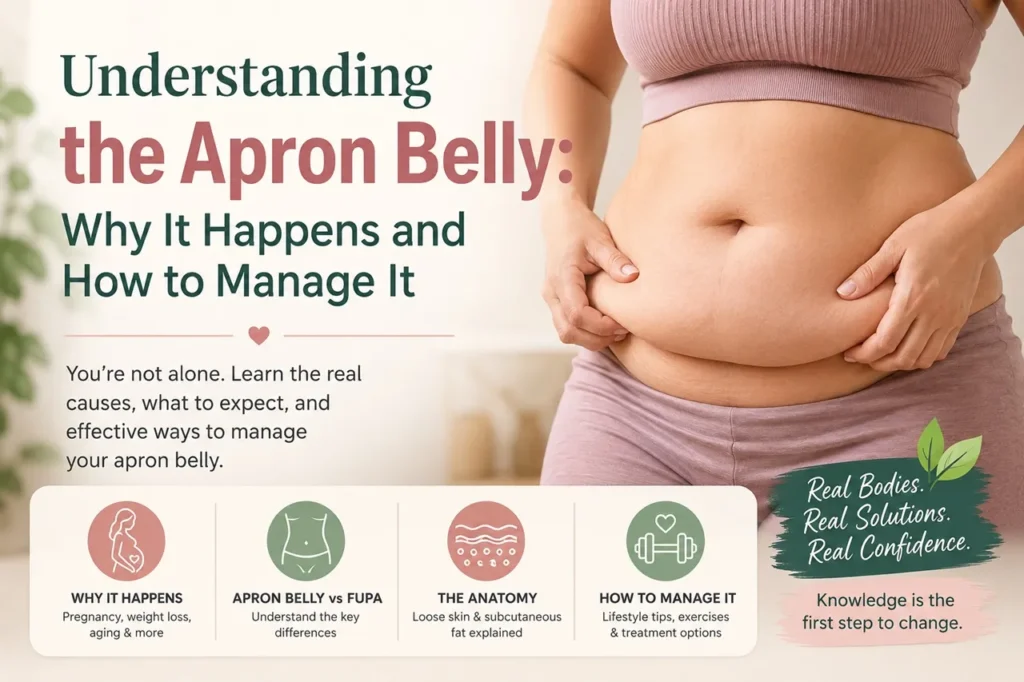
An apron belly is the everyday name for a pannus, also called a panniculus. It is a hanging fold of loose skin and fat on the lower tummy. Pregnancy, weight gain, large weight loss and ageing skin are common causes.
The fold sits entirely outside the abdominal wall. As a result, the muscles behind it are usually intact, and your bowel stays where it belongs. A pannus is not dangerous in itself, although it can cause rashes, back ache and trouble with hygiene.
Doctors grade the fold by size, and our guide to apron belly grades explains each level in plain English.
What a Hernia Is
The NHS hernia guide describes a hernia as part of an internal organ, such as your bowel, pushing through a gap or weak area in the muscle that keeps your organs in place. The bulge often contains bowel or fatty tissue inside a pouch called a hernia sac.
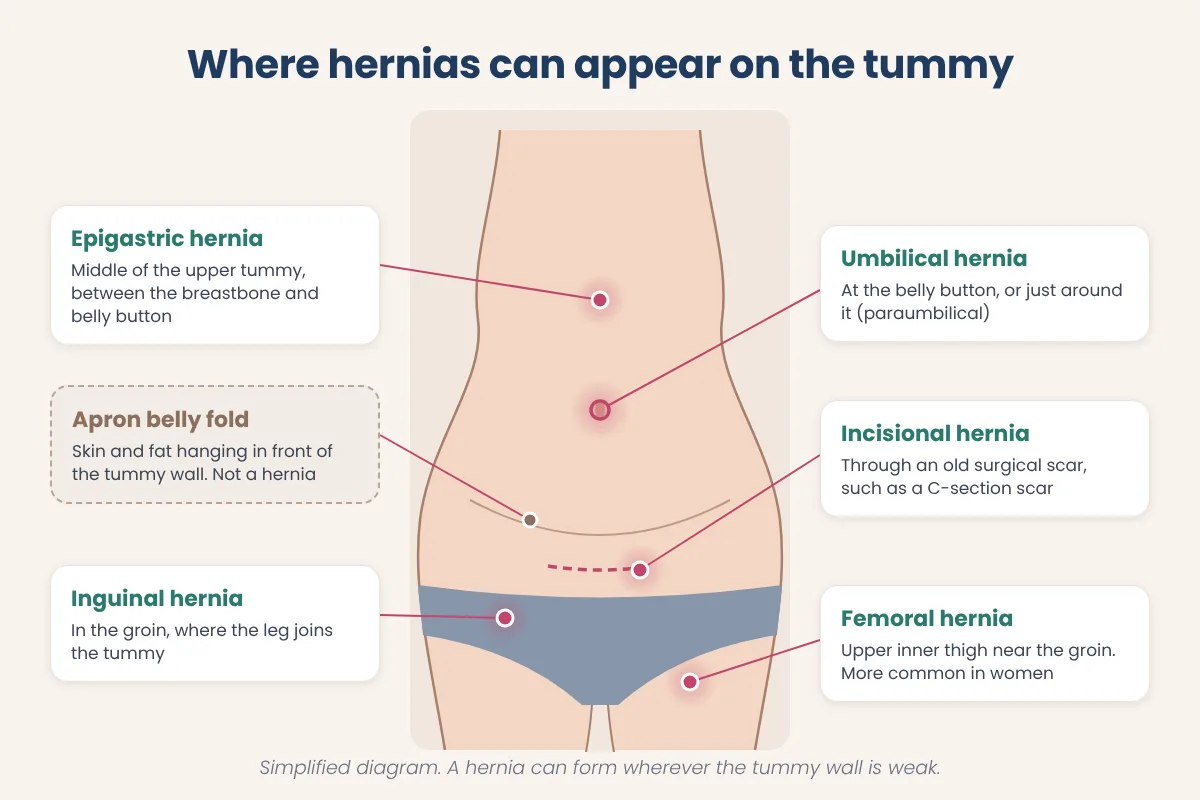
These are the types most often confused with an apron belly.
Umbilical and Paraumbilical Hernias
An umbilical hernia appears at the belly button. When it sits just above or beside it, doctors may call it a paraumbilical hernia. According to the NHS, adult umbilical hernias are linked to living with obesity, having multiple pregnancies and fluid build-up in the tummy from conditions such as liver disease.
The usual sign is a soft swelling at the belly button. In adults, they are often painless, although they can ache when you cough or strain.
Incisional Hernias After a C-Section or Surgery
An incisional hernia forms through an old surgical scar, where the tissue has healed with a weaker patch. It can follow a caesarean, a hysterectomy or any open operation on the tummy. Our article on an apron belly hanging over a C-section scar explains why that area changes after birth.
Ventral and Epigastric Hernias
A ventral hernia is a general term for any hernia through the front of the tummy wall. An epigastric hernia is one type. It appears in the middle of the upper tummy, between the breastbone and the belly button.
Inguinal and Femoral Hernias
An inguinal hernia forms in the groin, where the leg joins the tummy. A femoral hernia sits slightly lower, at the top of the inner thigh. The NHS notes that femoral hernias are far more common in women, particularly older women. In addition, treatment is almost always recommended straight away, because they carry a higher risk of complications.
How Each One Looks and Feels
The table below compares an apron belly, a hernia and diastasis recti side by side. Use it as a guide only, because none of these checks can replace a medical examination.
| Feature | Apron belly (pannus) | Hernia | Diastasis recti |
|---|---|---|---|
| What it is | A fold of loose skin and fat | Bowel or fat pushing through a gap in the muscle wall | Stretching and widening of the band between the 2 sides of the six-pack muscle |
| Where it sits | Outside the muscle wall, hanging over the pubic area | Belly button, old scars, upper midline, groin or upper thigh | Down the middle of the tummy, above and below the belly button |
| How it feels | Soft, squashy and easy to lift | A rounded lump, often with tight, stretched skin over it | A soft gap or dip between the muscles |
| When you cough or strain | Little or no change in shape | The lump may push out or grow | A ridge or dome may appear down the middle |
| When you lie down | The fold flattens and falls to the sides | The lump may shrink or disappear | The dip is easier to feel when you lift your head |
| Pain | Usually none, but rashes in the crease can be sore | Can ache, and new or severe pain is a warning sign | Usually painless, sometimes with back ache |
| Usual treatment | Skin care, support, and sometimes surgery | Assessment, and often surgical repair | Core rehab with a physiotherapist, rarely surgery |
The Lying-Down and Cough Check
The NHS explains that a hernia lump may get bigger when you cough, sneeze or cry, and smaller when you lie down. Doctors call this push a cough impulse. You can look for these changes gently at home:
- Stand in front of a mirror and note where the bulge sits.
- Place a flat hand lightly over it and give a small cough.
- Then lie on your back and see if the lump softens or disappears.
- Lift your apron fold gently, so you can also see the skin underneath.
Never press hard or try to force a lump back in. If the check causes pain, stop and speak to your GP.
Reducible vs Stuck Hernias
A reducible hernia slips back inside when you lie down or press gently. An incarcerated hernia, on the other hand, stays stuck outside. If the trapped tissue then loses its blood supply, it becomes a strangulated hernia. The NHS calls this a medical emergency, because it can lead to sepsis and gangrene.
Diastasis Recti: The Third Possibility
Many mums notice a ridge or dome down the middle of the tummy after pregnancy. This is often diastasis recti, where the band of tissue between the 2 sides of the six-pack muscle, the linea alba, stretches and widens.
Unlike a hernia, there is usually no hole in the muscle wall. That said, a small hernia at the belly button can sometimes sit within a wide gap, so a firm or painful lump still needs checking.
Diastasis recti and an apron belly also often appear together after pregnancy. To check your own gap at home, read our guide on how to tell a mum pooch from diastasis recti. A women’s health physiotherapist can then measure it properly.
Can a Hernia Hide Under an Apron Belly?
Yes, it can. A heavy fold can cover the belly button, a low scar and the groin. This makes a bulge harder to see and feel.
A few signs suggest that something sits beneath the fold:
- A firm or tender spot under the fold that feels different from the soft tissue around it.
- A dragging ache in one place, especially when you lift, cough or stand for long periods.
- A new lump near your belly button or an old caesarean scar.
- Skin over one area that looks tight, shiny or stretched.
Meanwhile, the crease itself can get sore, red and raw. That is usually a rash called intertrigo, not a hernia. Our guide on caring for a sore apron belly fold covers simple daily steps. Still, mention any lump you find when you see your GP about the skin.
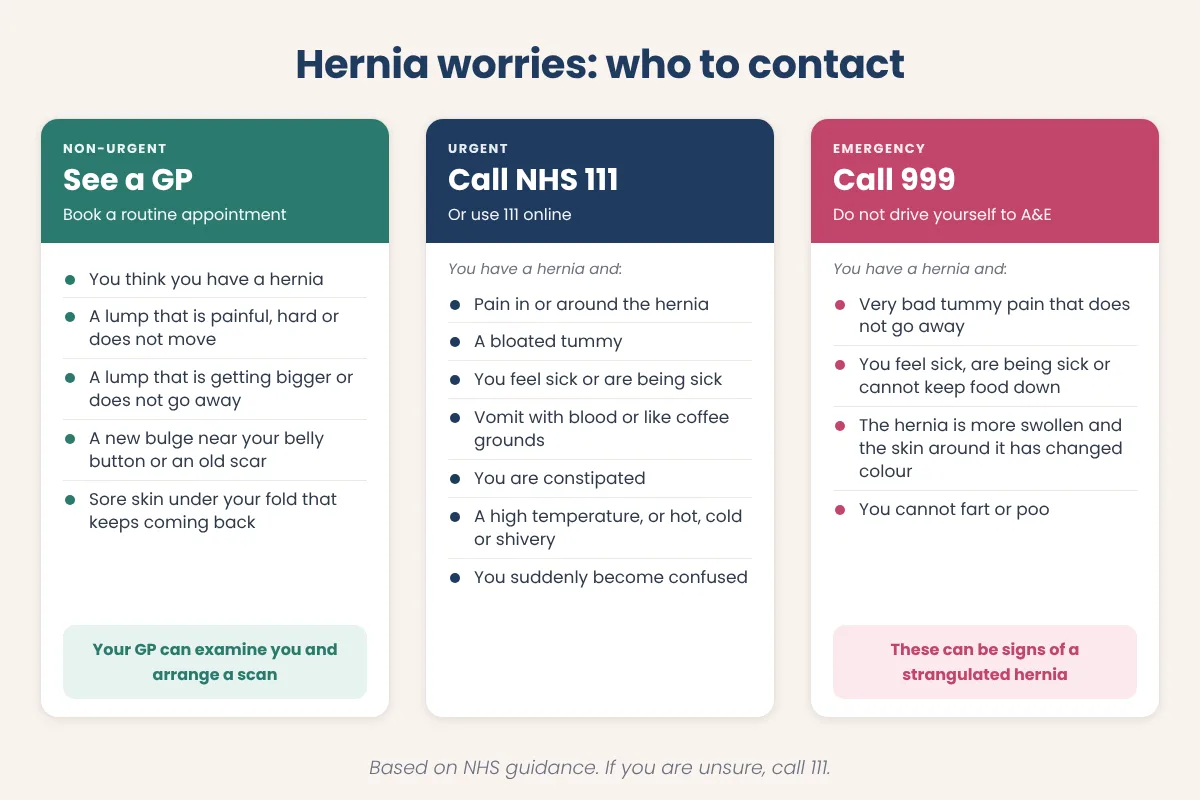
Red Flags: When to Call 999 or Go to A&E
A hernia that becomes trapped can cut off the blood supply to the bowel. For this reason, the NHS umbilical hernia page advises calling 999 if you have a hernia and:
- You get very bad tummy pain that does not go away.
- You feel sick, are being sick, or are unable to keep any food down.
- Your hernia is more swollen than usual and the skin around it has changed colour.
- You are unable to fart or poo.
Do not drive yourself to A&E. The person you speak to at 999 will tell you what to do next. Likewise, a painful lump in the groin or upper thigh with sickness needs urgent care, since femoral hernias can trap the bowel.
When to See a GP or Call NHS 111
Most hernias are not emergencies. However, the NHS says you should get help from NHS 111 if you have a hernia and any of these:
- Pain in or around the hernia.
- A bloated tummy.
- You feel sick or you are being sick.
- You are vomiting blood, or your vomit looks like coffee grounds.
- You are constipated.
- You have a high temperature, or you feel hot, cold or shivery.
- You have suddenly become confused.
Book a routine GP appointment if you think you have a hernia, or if you have a lump that is painful, hard or does not move. The same applies to a lump that is getting bigger or does not go away. A GP visit is also worthwhile if your fold keeps getting infected or makes daily life hard.
How a Hernia Is Diagnosed
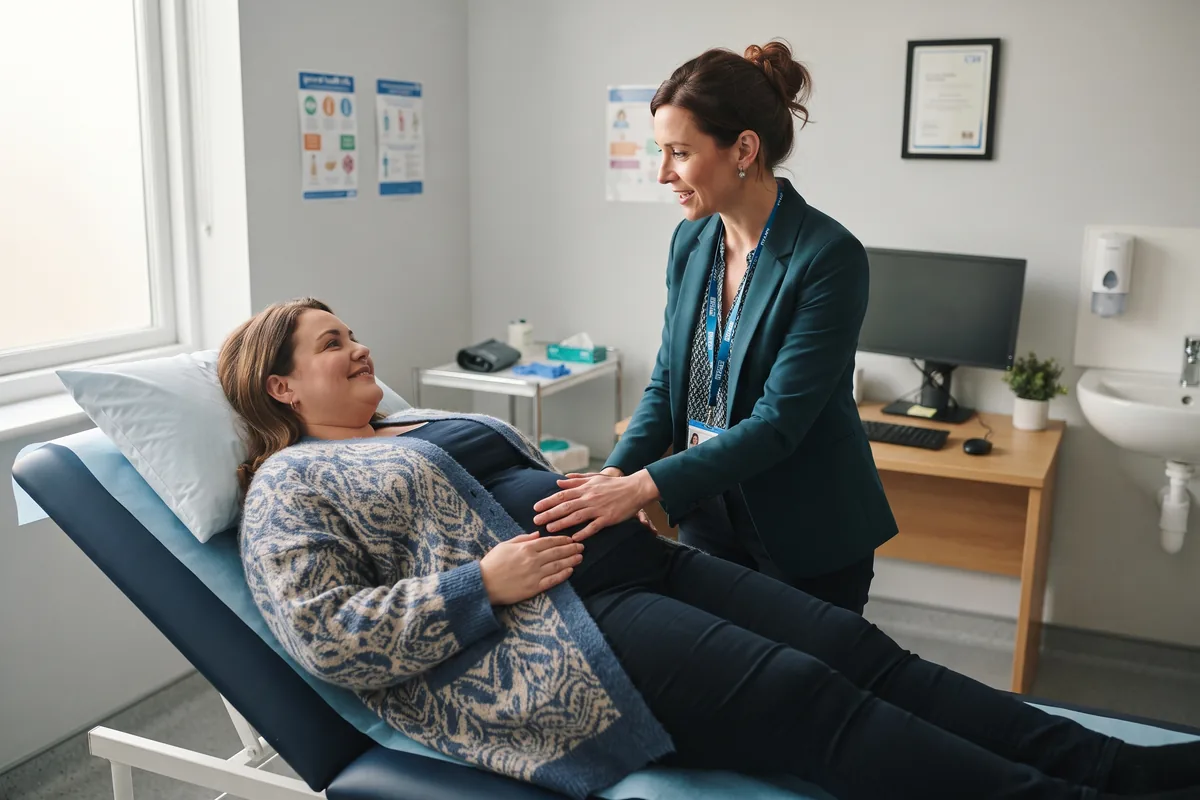
Most of the time, a GP can diagnose a hernia by examining you. They may check you standing and lying down, and ask you to cough.
When a hernia is harder to find, scans can help. Hernia guidance from University Hospitals Bristol, an NHS trust, describes three options:
- Ultrasound scan: a simple, widely available test that does not involve radiation.
- CT scan: sometimes needed, particularly for incisional hernias or in an emergency.
- MRI scan: another way to look closely at muscles and soft tissue.
A deep apron fold can make the examination harder. So, if your GP cannot feel a clear lump, ask whether a scan would help.
Treatment Options on the NHS
Treatment depends on the type of hernia, its size and your general health. Not every hernia needs an operation straight away. However, the NHS says surgery is usually recommended for adults with an umbilical hernia, as it is unlikely to get better by itself.
Hernia Repair Surgery
During a repair, the surgeon pushes the bulge back into place and closes the gap with stitches. For larger hernias, a thin sheet of mesh may be added to strengthen the wall. The NHS says recovery from an umbilical hernia repair usually takes up to 4 to 6 weeks.
Hernia Repair With Apron Belly Surgery
Some women need both a hernia repair and a panniculectomy, also called an apronectomy. In some cases, surgeons carry out both in one operation. In others, they stage them months apart. Combining the two can raise the risk of wound problems, so your surgical team will weigh this carefully.
A tummy tuck, or abdominoplasty, can also tighten the muscles at the same time. Our comparison of panniculectomy vs tummy tuck sets out how the two operations differ.
BMI and Weight Criteria
Weight matters for both operations. The NHS lists losing weight, if you are overweight, as one way to manage a hernia. Higher BMI is also linked to more wound problems after skin removal surgery.
NHS funding for an apronectomy depends on your local Integrated Care Board. For example, the Cheshire and Merseyside policy asks for a current BMI under 30, stable for at least 12 months. It also asks you to be a non-smoker with skin fold infections that persist despite treatment. Our guide to getting an apronectomy on the NHS explains the referral steps.
If your fold developed after weight loss surgery, your bariatric team can also help. Our article on an apron belly after gastric sleeve or bypass covers the usual timeline.
Frequently Asked Questions
Can an apron belly turn into a hernia?
No, an apron belly cannot turn into a hernia, because the fold sits outside the muscle wall. However, the same factors can lead to both. The NHS links adult umbilical hernias to living with obesity and having multiple pregnancies.
How can I tell if my lump is a hernia at home?
Look for a lump that pushes out when you cough and shrinks when you lie down. An apron belly fold feels soft and lifts easily instead. A home check cannot rule out a hernia, so see your GP about any new lump.
Does a hernia go away on its own?
Some hernias in babies close by themselves, but most adult hernias do not. The NHS says surgery is usually recommended for adults with an umbilical hernia, because it is unlikely to get better by itself. Your GP can advise on your own type.
When is a hernia an emergency?
Call 999 if you have a hernia with very bad tummy pain that does not go away, or if you are being sick. The same applies if the hernia is more swollen and has changed colour, or you cannot fart or poo. Do not drive yourself to A&E.
Can a hernia be repaired during an apronectomy?
Sometimes. Some surgeons repair a hernia during the same operation, while others stage the procedures. Combining them can raise the risk of wound problems, so your surgical team will decide what is safest for you.
Can diastasis recti be mistaken for a hernia?
Yes, because both can cause a bulge down the middle of the tummy. Diastasis recti is a widening of the tissue between the six-pack muscles, usually without a hole. A firm or painful lump still needs a GP check.
Which scan shows a hernia?
Many hernias need no scan, because a doctor can see and feel them. When one is harder to find, an ultrasound scan is usually the first test. A CT scan is sometimes used, particularly for incisional hernias or in an emergency.
Final Thoughts
A soft fold that lifts easily is most likely an apron belly, while a lump that pushes out when you cough may be a hernia. Diastasis recti adds a third possibility, especially after pregnancy. Because they can overlap, a GP check is the simplest way to know for sure.
Above all, trust your instincts. Severe pain, sickness or a stuck, discoloured lump needs 999 straight away. For anything else, book a calm, unhurried GP appointment, because you deserve clear answers about your own body.