
Quick Answer
The best wedding dresses for an apron belly have a waist seam above or below the fold, a boned and lined bodice, a fabric with enough body to skim and a fitting plan that checks the gown seated too.
- A-line, empire and structured ballgowns work most easily
- Choose the silhouette first, then fabric and structure
- Book fittings early so the last one is calm
Choosing wedding dresses for an apron belly is a different task from choosing a dress for any other day. The gown is worn for ten hours, photographed from every angle, sat in, danced in and hugged in. A fold of skin over the lower tummy, also called a pannus, does not stop any of that. It simply means the dress needs the right silhouette, the right inner structure and a fitting plan that leaves nothing to the last week.
This guide walks through the shapes that work, how corsetry and boning hold a soft torso comfortably, which fabrics skim and which cling, what to wear underneath, and how to run alterations so the final fitting is calm. There is a section for plus-size and postpartum brides, a list of questions for your seamstress, and practical posture tips for the photographs.
You do not need to change your body before you try on a gown. You need a gown cut for the body you have.
Key takeaways
- A-line, empire and ballgown silhouettes skim the fold; the waist seam should sit clearly above or below it, never on it.
- Boning and a lined bodice carry the weight of the dress so the lower tummy is not squeezed.
- Crepe, mikado and duchess satin hold their shape; chiffon and charmeuse need a slip or lining under them.
- Order in the size that fits your largest measurement and allow eight to twelve weeks for alterations.
- Bring your wedding-day shapewear and shoes to every fitting from the first one.
Why Wedding Dresses for an Apron Belly Need a Different Approach
Most sample gowns are cut on a smooth, gently rounded front. An apron belly changes three things: where the waist seam lands, how much fabric is needed across the lower front, and how the dress behaves when you sit.
The fold changes where a waist seam lands
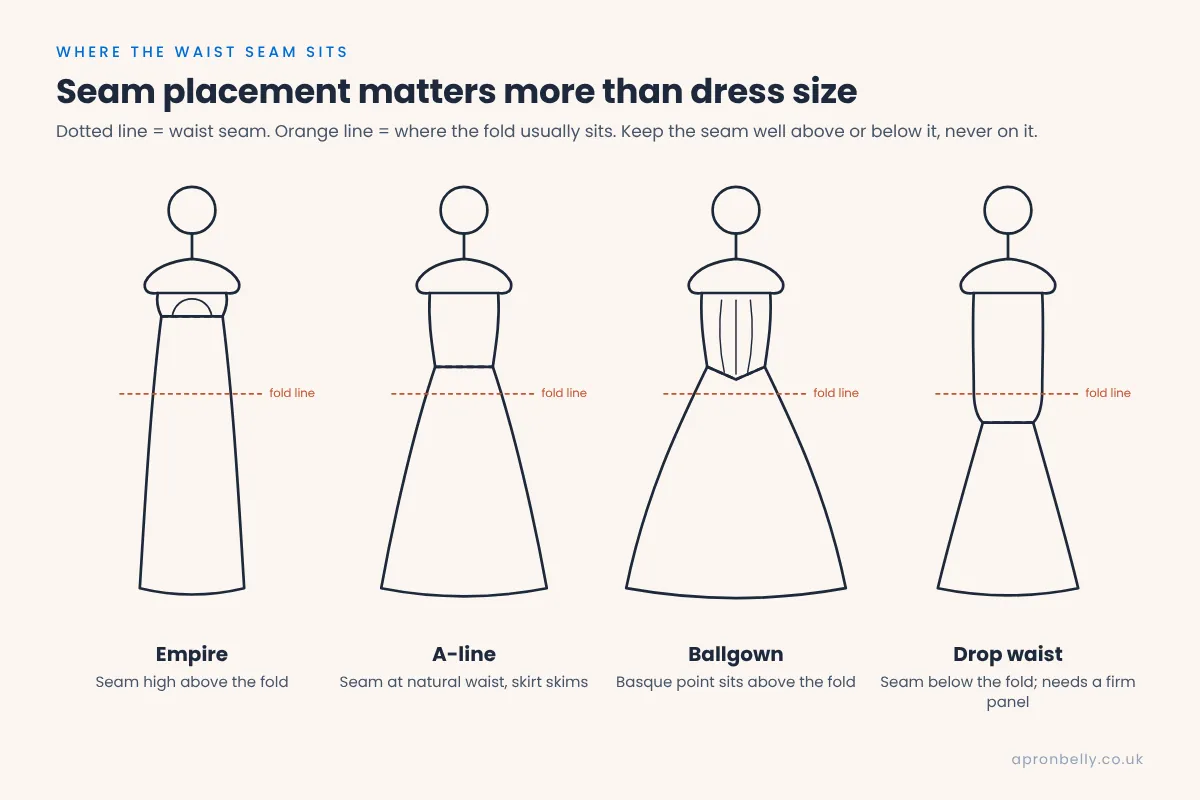
Dressmakers place the waist seam at the narrowest point of the torso. With an apron belly, that point is often higher than a standard pattern assumes, so a seam cut to sit at the waist can land on the fold itself. A seam on the fold creases, pulls and shows through fabric, which is why so many brides feel a dress is wrong without knowing why. The fix is a seam clearly above the fold, as in an empire line, or a bodice that extends below it, as in a drop waist with a firm panel.
Why sample sizes mislead
Boutique samples are commonly a UK 10 to 14, clipped at the back or held open with a modesty panel. That shows neckline and fabric and almost nothing about how the skirt will fall over your tummy. Ask whether the shop stocks samples in a UK 18 to 26, and if not, find a boutique that does. The best dresses for an apron belly follow the same rules whatever the occasion, so the shapes you already trust in day wear are a useful starting point.
The Best Silhouettes: A-line, Empire, Ballgown and Drop Waist
Four silhouettes work reliably with a fold, and each solves the problem differently.
A-line: the safest all-rounder
An A-line gown fits through the bust and natural waist, then flares in a straight line to the hem. The skirt starts above the fold and skims past it with a few centimetres of air, so nothing clings. It suits most heights, works in heavy or light fabrics, and is the easiest shape to alter.
Empire: the seam sits high above the fold
An empire line seams directly under the bust and falls from there. The fold is covered by a column of fabric that never touches a seam. This is the kindest shape for a tummy that is tender, for a bride who dislikes pressure on the waist, and for anyone who is early postpartum. Choose a fabric with a little weight, such as crepe or georgette over a lining, so the column drapes rather than floats.
Ballgown with a structured bodice
A ballgown pairs a boned, fitted bodice with a full skirt. The bodice, often with a dipped basque point at the front, holds the upper body firmly, and the skirt flares immediately so the fold is enclosed by volume rather than fabric tension. The structure means the dress carries its own weight, which many brides with a heavier lower tummy find more comfortable than a soft gown.
Drop waist: works with the right panel
A drop waist extends the bodice over the hips before the skirt begins. On an apron belly this only works if the bodice is lined with a firm power-mesh or coutil panel through the lower front and the seam sits below the fold, not across it. Done well, it gives a long, smooth line. Done badly, it rides up. Ask for a toile or a long fitting before committing. Sheath, column and mermaid lines, which place the tightest fabric over the fold, are the hardest to fit and are best left to a fully corseted gown.
Corsetry, Boning and Inner Structure
Much of the comfort in a wedding dress lives on the inside, where the guest never looks.
What boning actually does
Boning is a set of flexible strips, usually spiral steel or plastic, sewn into channels inside the bodice. It stops the fabric collapsing into folds and distributes the weight of the skirt across the whole torso. On a softer body, spiral steel is better than plastic because it bends in every direction and does not kink when you sit. A good bridal bodice for an apron belly has boning at the side seams, princess seams and centre front, plus a waist stay: a grosgrain ribbon fastened at the natural waist that stops the dress drifting down onto the fold.
Corset back versus zip
A lace-up corset back gives several centimetres of adjustment on the day and spreads pressure across the whole back rather than along one zip line. The trade-off is time: lacing takes ten minutes and a helper. A zip is quicker but must be sized precisely at the final fitting. Many seamstresses offer a hidden inner corselette with an outer zip, which combines both.
The lower front panel
Ask specifically about the lower front of the bodice. A double layer of coutil or firm power mesh from the underbust to the top of the skirt holds the fold gently and stops the outer fabric creasing. It should feel like a firm hug, not a squeeze. If you can take a full breath and sit down without the panel digging in, it is right.
Fabrics: What Skims and What Clings
Fabric decides whether the silhouette on the hanger survives contact with a real body.
| Fabric | Weight and drape | Over an apron belly | Best silhouettes | Watch out for |
|---|---|---|---|---|
| Crepe | Medium weight, matt, fluid | Excellent; skims and does not cling when lined | A-line, empire, soft ballgown | Shows shapewear lines if unlined |
| Mikado | Heavy silk blend with a soft sheen | Excellent; holds its own shape away from the body | A-line, ballgown, drop waist | Creases when sat in for long periods |
| Duchess satin | Heavy, high sheen, structured | Very good; the stiffness hides contours | Ballgown, structured A-line | Sheen highlights any pull or tight seam |
| Charmeuse satin | Light, slippery, very shiny | Poor on its own; clings and shows every line | Only as a lining or a loose slip | Static, visible shapewear |
| Chiffon and georgette | Light, sheer, floaty | Good as an overlay on a firm lining | Empire, A-line overlay | Needs an opaque, weighted underlayer |
| Lace | Varies; usually over a base layer | Good when the base is crepe or satin, not stretch mesh | A-line, ballgown bodices | Stretch lace over the tummy magnifies the fold |
| Tulle | Light, airy, used in layers | Very good for full skirts | Ballgown, A-line | Thin single layers are transparent |
Reading the table
Fabrics with body, such as crepe, mikado and duchess satin, sit away from the tummy and keep the silhouette you chose. Light fabrics are lovely, but they need a firm lining to do the structural work. When a gown is described as satin, ask which satin, because charmeuse and duchess behave like different materials.
Lining, sheen and colour
A matt finish reads as smooth in photographs, while a high sheen reflects light from every curve, including the fold. If your heart is set on satin, choose duchess with a full lining and a firm front panel. Ivory and warm white are slightly more forgiving than stark white because they soften the contrast between fabric and shadow.
Shapewear Under the Dress
Shapewear is optional. Some brides want a firmer line for the photographs; others want nothing extra on a long, warm day. Either is fine, but decide early, because the gown is fitted around whatever you wear underneath.
Choosing a piece that stays put
For an apron belly the reliable options are a high-waist smoothing short that reaches the underbust, a mid-thigh bodysuit with a snap gusset, or a built-in corselette inside the gown. Each avoids a waistband in the crease, which is where rolling and chafing start. Our guide to shapewear for an apron belly explains compression levels, and the best shapewear for apron belly round-up compares specific styles. If a gown already has a boned, lined bodice, light shapewear is usually enough; firm compression under a firm bodice makes it hard to breathe and eat.
What to wear beneath the shapewear
Wear a cotton-gusset brief or nothing under a bodysuit, and choose seamless edges so nothing prints through crepe. Our best underwear for an apron belly guide covers rise and waistband width, and the lingerie for an apron belly guide helps with bras and sets for the evening.
Skin care for a long day
The skin under the fold will be warm for many hours. Dry the area well in the morning, apply a light barrier cream or anti-chafe balm, and tuck a soft cotton liner inside the shapewear if the skin is prone to rubbing. Our advice on apron belly skin care when it gets sore applies doubly on a wedding day.
Bridal Fittings and the Alterations Timeline
Alterations are where a good gown becomes your gown. Most UK boutiques plan three fittings, and a structured bodice needs more time than a soft one.

A working timeline
- Twelve to nine months before: try on silhouettes and order the gown in the size that fits your largest measurement, usually the hip including the fold. Made-to-order gowns take four to six months to arrive.
- Four to three months before: the gown arrives. Buy the shapewear and shoes you will wear on the day and keep them for fittings.
- Eight to six weeks before: first fitting. The bodice is pinned, boning positions checked, the hem marked and the bustle planned.
- Three to two weeks before: second fitting. Sit, climb a step, lift your arms and hug someone. Anything that pulls gets adjusted now.
- One week to three days before: final fitting and collection. Only minor tweaks. Avoid a new diet, new shapewear or a new bra at this stage.
What a good fitting checks
A seamstress who understands a fold will check the dress sitting down, not only standing: whether the waist stay holds, whether the lower front panel creases when you lean forward, whether the skirt lining clings when you walk, and whether the bustle lifts the train without pulling the bodice down. If a fitting is over in five minutes and you never sat down, ask for another.
Questions to ask your seamstress
- Where will the waist seam sit on me, and can it be raised above the fold?
- Is the bodice boned with spiral steel, and does it have a waist stay?
- Can you add or firm up a lower front panel in coutil or power mesh?
- Which lining will go under the skirt, and will it cling in warm weather?
- If my weight changes by a dress size either way, what is the plan?
- Can the back be converted to a corset lace-up for adjustability?
- How will the bustle be attached so it does not pull the bodice down?
- What is the latest date you can take in or let out this fabric?
Plus-Size and Postpartum Brides
The silhouettes above work for every size, but two groups have extra points to consider.
Plus-size brides and UK size ranges
Many bridal designers now cut to a UK 30 or beyond, and specialist plus-size boutiques stock samples you can actually try. Ask for gowns cut on a curve block rather than graded up from a size 10, because a curve block allows for the fuller lower front. Check that the bodice length matches your torso; a long bodice on a short torso pushes the seam down onto the tummy. If a gown feels nearly right, the fix is often a seam moved by two centimetres, not a different dress. Our guide to styling that skims an apron belly covers the same principles for the rest of the wedding wardrobe.
Postpartum brides
If you are marrying within a year of giving birth, the body at ordering time may not be the body on the day. The abdomen keeps changing for months, especially after a caesarean, and a lower belly pooch after pregnancy often softens as the uterus returns to size and swelling settles. Choose an empire or A-line gown with a corset back so there is room to adjust, and book the final fitting as late as the boutique allows. If you have a caesarean scar, ask for a smooth lining with no seam or hook over the scar line. Our article on an apron belly after a C-section explains what is normal in the months after delivery. Breastfeeding brides should also allow for cup changes during the day and choose a bodice with a built-in bra and adjustable cups.
Where your grade matters
Clinicians describe the size of a pannus in grades, and the grade changes what the dress needs to do. A Grade 1 or 2 fold is covered by almost any A-line. From Grade 3, where the fold reaches the upper thigh, a firm lower panel and a waist stay become important, and a drop waist is best avoided. Our explainer on apron belly grades describes each stage in plain terms.
Posture, Photographs and the Day Itself
Once the dress fits, the remaining confidence comes from how you stand and move in it.
Simple posture habits
Stand with weight through both feet, soften the knees, lengthen through the back of the neck and let the shoulders drop. Avoid pulling the tummy in for photographs; it tightens the bodice, shortens your breath and shows on your face. A relaxed torso in a structured dress photographs better than a tense one.
Angles your photographer can use
A slight turn of the hips, around thirty degrees from the camera, with the front foot pointed towards the lens, narrows the silhouette. Holding the bouquet at hip height draws the eye down the centre of the dress. Ask for a few photographs from slightly above eye level, and for the skirt to be fluffed out before full-length shots so the fabric falls away from the tummy.
Sitting, eating and dancing
Sit on the edge of the chair with the skirt lifted slightly at the back so the bodice does not ride up. Eat; a well-fitted dress allows it. For dancing, a bustle that lifts the train and a waist stay that holds the bodice keep everything in place. If you want more reassurance about feeling seen in the gown, our piece on body confidence with an apron belly is worth reading in the weeks before.
Frequently Asked Questions
What is the best wedding dress style for an apron belly?
An A-line gown with a boned, lined bodice is the most reliable choice, because the skirt flares from the natural waist and skims the fold without touching it. Empire lines suit brides who want nothing on the waist, and a ballgown with a structured bodice suits those who like a firm, held feeling. All three keep the waist seam off the fold.
Can I wear a fitted or mermaid wedding dress with an apron belly?
You can, but it is the hardest silhouette to fit well. A mermaid or trumpet line places the tightest fabric over the fold and shows any change in weight. It needs heavy crepe or mikado, a fully corseted bodice with a firm lower panel, and a seamstress experienced with curve fits. If you love the shape, ask for a toile and a long sitting-down fitting before you commit.
Do I need shapewear under a wedding dress?
No. A gown with a boned, lined bodice provides structure on its own, and many brides are more comfortable without extra compression on a long day. If you want a smoother line, choose a high-waist smoothing short or a bodysuit with a snap gusset, and wear it to every fitting so the dress is altered around it.
How far in advance should I order a wedding dress?
Order nine to twelve months before the wedding. Made-to-order gowns typically take four to six months to arrive, and you then need eight to twelve weeks for three fittings. A structured bodice with boning and a corset back takes longer to alter than a soft gown, so build in extra time if you choose one.
Which fabric hides an apron belly best?
Crepe and mikado are the most forgiving because they have enough body to sit away from the tummy and a matt or soft finish that does not reflect light from the fold. Duchess satin works in a structured gown. Charmeuse satin and unlined chiffon cling and show shapewear lines, so use them only over a firm lining.
Will my apron belly show in wedding photographs?
In a well-cut gown, the fold is covered by fabric that falls away from the body, so the photographs show the silhouette of the dress rather than the shape beneath it. Matt fabrics, a slight hip turn, the bouquet held at hip height and a relaxed posture all help. A good photographer will also fluff the skirt before full-length shots.
What should I tell the bridal boutique before my first appointment?
Give them your measurements, including the hip measured over the fold, and say that you want silhouettes where the waist seam sits above the tummy. Ask whether they have samples in your size and whether their seamstress has experience with corsetry and firm lower panels. Clear answers at this stage save disappointing appointments later.
The Bottom Line
The best wedding dresses for an apron belly share four things: a silhouette whose waist seam sits above or below the fold, a boned and lined bodice that carries the weight of the dress, a fabric with enough body to skim, and a fitting plan that checks the gown sitting as well as standing. A-line, empire and structured ballgowns meet all four most easily.
One decision at a time
Choose the silhouette first, then the fabric, then the inner structure, then the shapewear. Each choice narrows the next. A gown fitted this way lets you forget the dress and enjoy the day, which is the whole point.