

Quick Answer
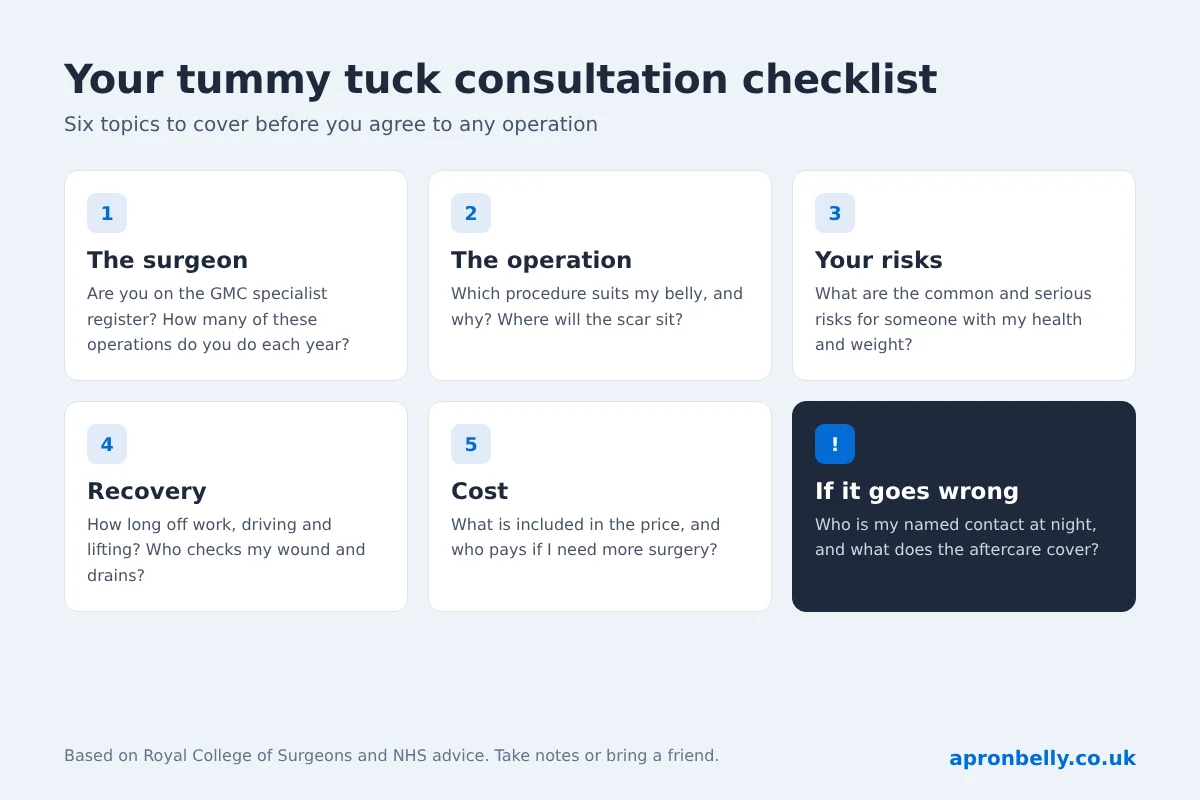
The best questions to ask at a tummy tuck consultation cover six areas: the surgeon’s training and experience, which operation suits your belly, your personal risks, recovery and aftercare, the full cost, and what happens if something goes wrong. Write them down, bring a friend, and take at least two weeks to think before you agree.
- Meet and question the surgeon who will actually operate
- Ask for risks, costs and aftercare in writing
- For an NHS panniculectomy, ask how your local criteria apply to you
A consultation is often short, and it is easy to come away realising you forgot to ask the one thing that worried you most. Going in with a written list of questions to ask at a tummy tuck consultation helps you stay in control, compare surgeons fairly and spot warning signs early. This checklist works for a private tummy tuck (abdominoplasty) and for an NHS or private panniculectomy, the operation that removes a hanging apron belly.
This article is part of our apron belly surgery hub. If you have not picked a surgeon yet, start with our guide to choosing a surgeon for apron belly surgery, then bring this list to each appointment.
Before the Consultation: Get Ready
Write down what bothers you most
Surgeons need to know what you want to change and why. Note whether your main problem is the look of the fold, rashes and soreness underneath, back pain, difficulty walking or trouble finding clothes. This shapes which operation is offered and, on the NHS, whether you may qualify at all.
Bring the right information
- A list of all your medicines, including supplements and weight loss injections
- Your weight history: your highest weight, current weight and how long it has been stable
- Details of past operations, especially on the tummy, and any hernia
- Records of skin infections or GP visits caused by the fold, with dates
- Your smoking or vaping status, as nicotine affects healing
Take someone with you
A partner, friend or relative can take notes while you listen. Ask the clinic whether you can record the conversation on your phone so you can replay the answers at home.
Questions to Ask at a Tummy Tuck Consultation About the Surgeon
Training and registration
- Are you on the GMC specialist register, and in which specialty?
- Are you certified by the Royal College of Surgeons for cosmetic surgery of the abdomen?
- Are you a member of BAPRAS or BAAPS?
- Is the hospital where you operate registered with the right regulator, such as the CQC in England?
Experience with apron bellies
- How many tummy tucks or panniculectomies do you carry out each year?
- Do you often operate on people after large weight loss or with a large pannus?
- Can I see before and after photos of patients you have operated on yourself?
- What are your own complication and revision rates?
The Royal College of Surgeons advises asking to see before and after photos only of procedures the surgeon has carried out personally. Photos from a brochure or another surgeon tell you nothing about the person in front of you.
Who you will be dealing with
Ask whether the person you are meeting is the surgeon who will operate. GMC guidance says the doctor carrying out a cosmetic procedure must discuss it with you and seek your consent personally, and cannot hand that job to someone else. If you only ever meet a sales adviser or a nurse, treat it as a warning sign.
Questions About the Operation Itself
Which procedure is right for me?
- Do I need a panniculectomy, a full tummy tuck or a mini tummy tuck, and why?
- Will you repair the tummy muscles, and do I need that?
- Would liposuction or a different scar pattern, such as a fleur de lis, be considered for my shape?
- Are there non surgical options I should try first?
Our guide to panniculectomy vs tummy tuck explains the difference, and our page on apron belly tummy tucks covers what the full operation involves.
The practical details
- Will I have a general anaesthetic, and who is the anaesthetist?
- How long will the operation take, and how many nights will I stay in hospital?
- Will I have drains, and for how long?
- Where will the scar sit, how long will it be, and will my belly button be moved?
Scars are permanent, so ask to see where yours will go. Our article on apron belly surgery scars shows what to expect as they heal.
Realistic results
Ask what a good result would look like for you, not for an ideal patient. A reasonable improvement is a more helpful aim than perfection. Ask whether a later weight change or pregnancy would affect the result, and whether you might need further surgery in the future.
Questions About Your Risks and Health
What could go wrong
- What are the common risks, such as seroma, wound healing problems and numbness?
- What are the rarer serious risks, such as blood clots or infection?
- How likely is each risk for someone with my weight, age and health?
- How would each problem be treated, and by whom?
What raises my personal risk
Smoking, a higher BMI, diabetes and some medicines all affect healing. Ask whether you need to stop smoking or nicotine products, lose weight, adjust any medicines or have tests before a date is booked. Our tummy tuck preparation checklist covers the steps most surgeons ask for.
Your mental wellbeing
The NHS points out that a disappointing result can affect your mental health, and suggests asking yourself why you want the change. A good surgeon will ask about this too, and may suggest talking to your GP before you decide.
Questions About Recovery and Aftercare
Getting back to normal life
- How much pain should I expect, and what pain relief will I have?
- How long before I can drive, return to work and lift children or shopping?
- How long will I wear a support garment?
- When can I start exercising again?
For a week by week picture, see our guide to apron belly removal recovery.
Follow up and contacts
- How many follow up appointments are included, and who will see me?
- Who changes dressings and removes stitches or drains, and where?
- Who do I contact at night or at the weekend if something feels wrong?
- Can you send a summary of the operation to my GP?
The Royal College of Surgeons says your contact for problems should be a named doctor who can deal with complications, not an NHS helpline. If a clinic expects your GP or A&E to handle problems after private surgery, ask why.
Questions About Cost for Private Patients
What the price includes
- Can I have a written, itemised quote?
- Does the price include the anaesthetist, hospital stay, garments, follow up and medicines?
- Who pays if I need a return to theatre or a revision operation?
- Is the deposit refundable if I change my mind or am not fit for surgery?
Compare quotes line by line rather than by the headline figure. Our guide to apron belly surgery cost shows typical price ranges in the UK.
Insurance and complaints
Ask what insurance the surgeon and hospital hold, and what the complaints procedure is. You may never need either, but a clinic that cannot answer clearly is not one to trust with an operation.
Extra Questions for an NHS Panniculectomy Consultation
Eligibility
- Do I meet the local criteria for a panniculectomy, and if not, which part do I fall short on?
- What BMI and how long a period of stable weight do you need?
- What evidence of skin problems or other symptoms would help my case?
- If I am turned down, can my GP apply through an individual funding request?
Rules differ between areas. Our guides to panniculectomy NHS criteria and asking your GP for a referral explain how decisions are usually made.
What the NHS operation covers
A panniculectomy removes the hanging fold to ease physical problems. Ask whether muscle repair or belly button changes are included, as these are often treated as cosmetic. Ask about the likely waiting time and what to do if your symptoms get worse while you wait.
How to Judge the Answers
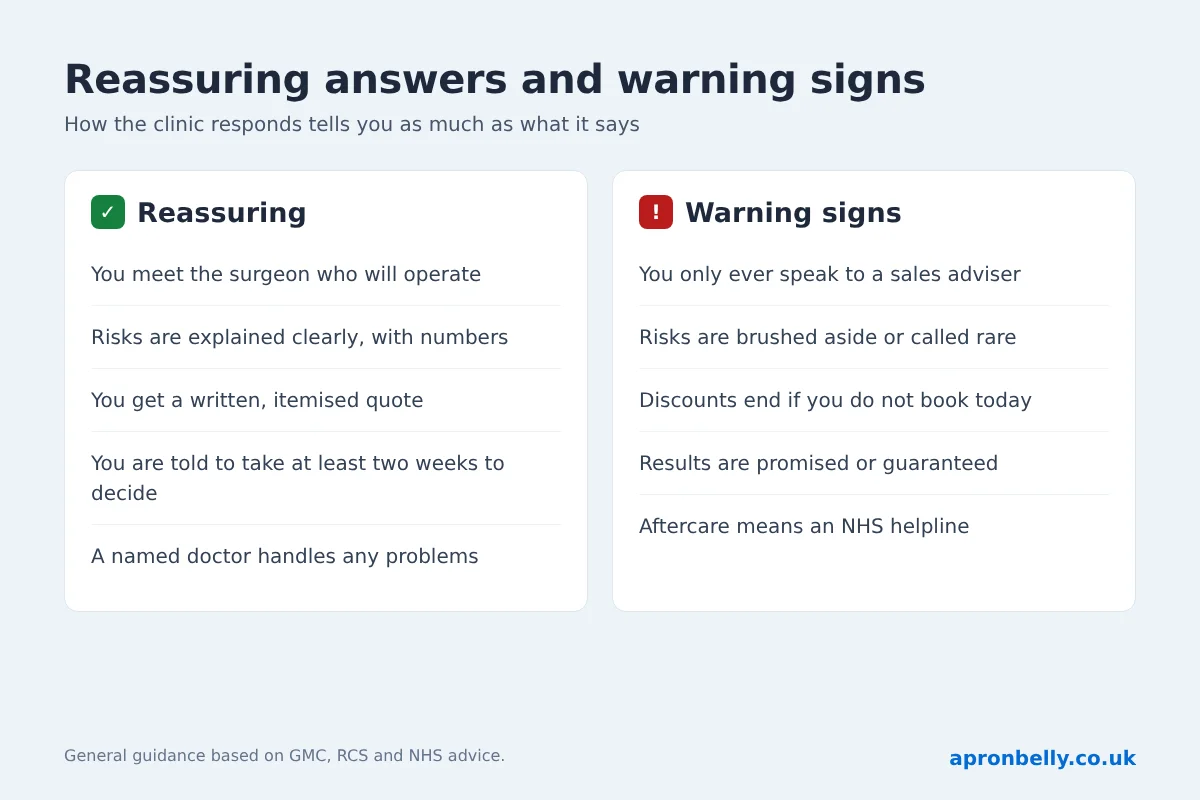
| Topic | Reassuring answer | Warning sign |
|---|---|---|
| Who you meet | The operating surgeon leads the consultation | You only ever see a sales adviser |
| Risks | Explained clearly, with figures for you | Brushed off as rare or nothing to worry about |
| Cost | Written, itemised quote | A verbal price or a discount that ends today |
| Results | Realistic aims and limits discussed | Results promised or guaranteed |
| Aftercare | A named doctor and a clear plan | Told to use NHS 111 or A&E |
| Time to decide | Encouraged to wait at least two weeks | Pressure to pay a deposit now |
After the Consultation
Take time to think
The Royal College of Surgeons strongly advises taking at least two weeks after meeting the operating surgeon before you go ahead. The NHS also says you should be offered a cooling off period after any consultation. You can change your mind at any point.
Get a second opinion
You can ask another surgeon for their view at any time. Hearing two opinions is especially useful if you were offered a different operation from the one you expected.
Talk it through
Read back over your notes, share them with someone you trust and speak to your GP if you have health conditions. The final decision is yours alone.
Frequently Asked Questions
What should I ask at a tummy tuck consultation?
Ask about the surgeon’s registration and experience, which operation suits you and why, your personal risks, recovery time, follow up care, the full itemised cost and who to contact if something goes wrong. Write your questions down before you go.
Should I meet the surgeon who will operate?
Yes. GMC guidance says the doctor carrying out a cosmetic procedure must discuss it with you and seek your consent personally. Be wary of any clinic where you only meet a sales adviser.
How long should I wait after a consultation before booking surgery?
The Royal College of Surgeons strongly advises taking at least two weeks after your consultation with the operating surgeon before going ahead. You can take longer, and you can change your mind at any point.
What should I bring to a panniculectomy consultation?
Bring a list of your medicines, your weight history, details of past operations and records of skin infections or GP visits caused by the fold. On the NHS, ask how your local criteria apply to you.
Is it normal to have a second consultation?
Yes. Many people have a second appointment with the same surgeon or a second opinion from another surgeon before deciding. It is a sensible step, not a sign of being difficult.
The Bottom Line
A written list of questions to ask at a tummy tuck consultation turns a rushed appointment into a proper conversation. Check the surgeon, the operation, your risks, recovery, cost and aftercare, judge how openly the clinic answers, and give yourself at least two weeks before deciding. For more help, visit our apron belly surgery hub.
Your next step
Copy the questions that matter most to you into your phone or a notebook today, and add the date of your consultation so you can track answers from each surgeon side by side.
Featured image: notebook, pens and glasses by Shixart1985, Wikimedia Commons, CC BY 2.0, cropped. This article is for general information and is not medical advice. Speak to your GP about whether surgery is right for you.