
Quick Answer
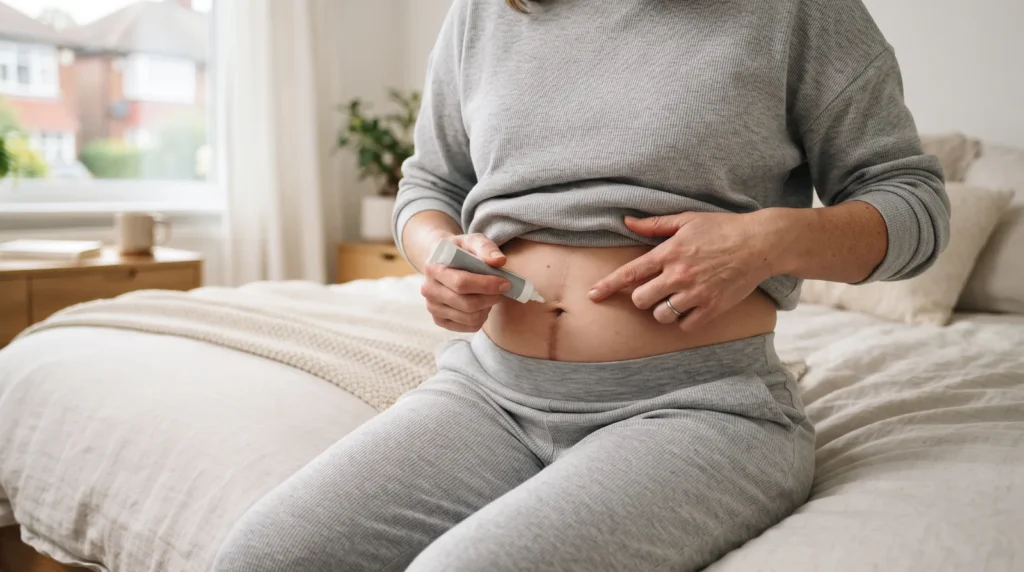
Apron belly surgery scars usually run low across the abdomen from hip to hip, and most fade into a flat, pale line within 12 to 18 months. The scar often looks its worst at around three months before it improves.
- Start silicone and gentle massage once the wound has fully closed
- Protect the scar from the sun
- See your surgeon or GP if a scar keeps growing
Apron belly surgery scars are the price most people pay for a lighter, more comfortable lower belly. Whether you have a panniculectomy or a full tummy tuck, the operation leaves a long scar low across the abdomen. For many people, that scar worries them more than the surgery itself.
The good news is that most scars settle well with time and simple care. This guide explains where the scar sits, what it looks like month by month, and which methods have the best evidence for helping it fade. It also covers when a scar needs a doctor’s opinion. Your surgeon’s instructions always come first, because every operation and every body heals differently.
Where Apron Belly Surgery Scars Sit
Most apron belly surgery leaves one long horizontal scar low on the abdomen, usually running from hip to hip. Surgeons try to place it low enough to sit under knickers or a swimsuit. The exact length depends on how much skin is removed.
The panniculectomy scar
A panniculectomy removes the hanging fold of skin and fat. The scar normally runs along the lower belly, close to where the fold used to sit. A larger apron needs a longer cut, so the scar may wrap round towards the sides. The belly button is usually left alone, so there is often no scar around it.
The tummy tuck scar
A full tummy tuck (abdominoplasty) also leaves a low horizontal scar. In addition, there is usually a small scar around the belly button, because the skin is pulled down and the navel is brought through a new opening. Our guide to panniculectomy vs tummy tuck explains how the two operations differ in more detail.
The fleur-de-lis scar
After very large weight loss, some people have loose skin running side to side as well as top to bottom. In that case, a surgeon may suggest a fleur-de-lis technique. This adds a vertical scar up the middle of the belly, joined to the horizontal one in an upside-down T shape. It removes more skin, but it leaves more scarring, so it is worth discussing the trade-off openly.

What Apron Belly Surgery Scars Look Like Over Time
A new scar changes a great deal over the first year. Knowing what is normal helps you stay calm when it looks worse before it looks better.
Weeks 1 to 6: the healing wound
At first, the wound is closed with stitches, glue or tape strips. It may look pink, slightly puckered and bruised. Swelling often makes the line look uneven. During this stage, the main job is keeping the wound clean and dry, as your surgical team advises. Do not put creams, oils or silicone on the wound until it has fully closed.
Months 2 to 3: the red, raised stage
Many people are surprised when the scar looks redder and thicker around two to three months. This is normal. The body is laying down new collagen to strengthen the wound, and blood flow to the area is high. The scar may also feel itchy, tight or firm. This is usually the busiest stage of healing, not a sign that something has gone wrong.
Months 4 to 12: flattening and fading
Over the following months, the scar usually softens and flattens. The colour slowly fades from red or purple to pink, then towards a paler line. The NHS guide to scars explains that many scars fade and become less noticeable over time, though they never disappear completely.
Months 12 to 18: the mature scar
Most surgical scars reach their final look somewhere between 12 and 18 months. A mature scar is usually flat, soft and paler than the surrounding skin. On darker skin, it may stay slightly darker or lighter than the skin around it. This is also the point at which surgeons judge whether any revision might help.

Why Some Scars Heal Better Than Others
Two people can have the same operation and end up with very different scars. Several things play a part, and some of them are in your control.
Things you cannot change
Genetics matter a great deal. Some people simply form thin, pale scars, while others tend to form thick ones. Skin tone also plays a part. People with Black, Asian or mixed heritage skin have a higher chance of raised scars and of colour changes in the scar. Age has an effect too, because older skin often heals more slowly but may form flatter scars.
Things you can influence
Smoking is the biggest one. Nicotine narrows small blood vessels, which slows healing and raises the risk of the wound opening. Most surgeons ask you to stop smoking and vaping nicotine for several weeks before and after surgery. Tension also matters. Lifting, stretching and bending too early pull on the scar, which can widen it. Finally, a wound infection or an area that breaks down tends to leave a wider, more visible scar.
Weight and wound healing
A higher BMI and diabetes both raise the chance of slow healing along the lower edge of the wound. That is one reason NHS policies and many private surgeons ask for a stable weight before surgery. Our guide to apron belly removal recovery covers wound care in the early weeks.
How to Fade Apron Belly Surgery Scars
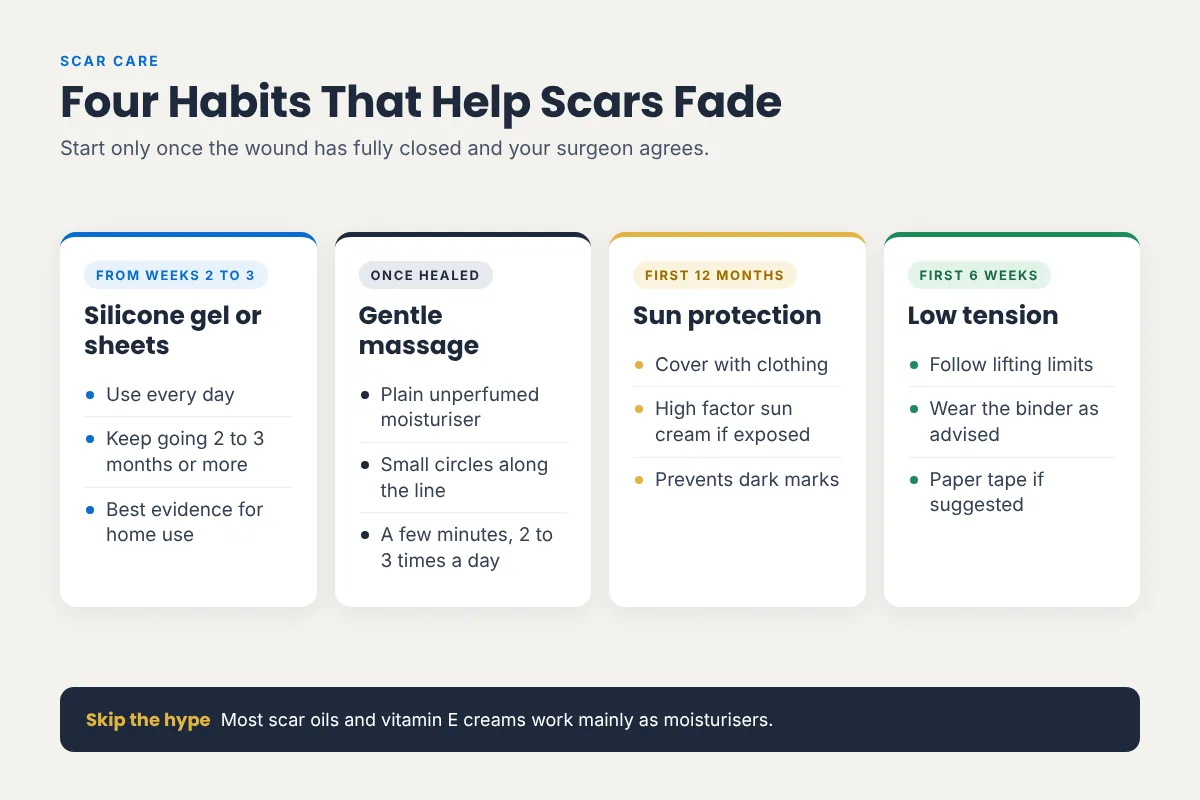
There is no cream that makes a scar vanish. However, a few simple steps have good evidence behind them, and they are cheap and easy to do at home. Always wait until the wound has fully closed, with no scabs or open areas, before you start.
Silicone gel and silicone sheets
Silicone is the most widely recommended home treatment for surgical scars. It comes as a clear gel or as soft, reusable sheets. It seems to work by keeping the scar hydrated and calming the overactive collagen response. Most surgeons suggest starting two to three weeks after surgery, once the wound has sealed. Use it daily for at least two to three months, and often longer. Sheets suit a long, low scar well because knickers help hold them in place.
Scar massage
Gentle massage can help a scar feel softer and less tight. Once your surgeon says the wound has healed, use a plain, unperfumed moisturiser. Press firmly with two fingers and move in small circles along the scar, then up and down across it. A few minutes, two or three times a day, is plenty. Stop if it hurts, bleeds or opens.
Sun protection
New scars burn easily and can darken permanently in strong sun. Keep the scar covered with clothing when you can. If it is exposed, for example on a beach holiday, use a high factor sun cream. Keep this up for at least the first year, while the scar is still pink.
Reduce tension on the scar
Follow your surgeon’s rules on lifting, bending and exercise. Wear your binder or support garment for as long as advised. Some surgeons also suggest paper tape along the scar for a few weeks, which supports the edges and may stop it spreading.
What About Creams, Oils and Vitamin E?
Shops sell many scar oils and creams. Most are pleasant moisturisers, and moisturising does help scars feel more comfortable. However, there is little good evidence that they fade scars better than silicone or plain massage.
Vitamin E and bio oils
Vitamin E is often recommended online, but studies have not shown a clear benefit for surgical scars. Some people also develop skin irritation from it. If you enjoy using an oil for massage, that is fine, but do not expect it to work miracles.
Onion extract and other gels
Some scar gels contain onion extract or similar plant ingredients. The evidence for them is mixed. If you choose one, check the label and do a patch test first. Silicone remains the better-supported first choice.
Problem Scars and Medical Treatments
Most apron belly surgery scars mature into a fine line. A smaller number need more help. Your surgeon or GP can tell you which type you have.
Hypertrophic scars
A hypertrophic scar is raised, red and firm, but it stays within the line of the original cut. These often improve slowly on their own over a year or two. Silicone, pressure and steroid injections can all help.
Keloid scars
A keloid grows beyond the edges of the original wound. It can be itchy, painful and keep growing. Keloids are more common in people with darker skin and in people who have had them before. If you know you form keloids, tell your surgeon before the operation, because they may plan preventive treatment.
Steroid injections, laser and microneedling
For stubborn raised scars, doctors may inject a steroid into the scar to flatten it. Some clinics use lasers to reduce redness or improve texture. Microneedling is also used for some flat scars. These treatments work best when done by a doctor or nurse with experience in scars, and results vary.
Scar revision surgery
If a scar is very wide, puckered or tethered, a surgeon may suggest cutting it out and closing it again. Revision is usually only considered once the scar has fully matured, often after 12 months. It cannot remove the scar, but it may leave a neater one.
Dog Ears and Uneven Scar Ends
Some people notice small bulges of skin and fat at either end of the scar. Surgeons call these “dog ears”. They can settle as swelling goes down, so most surgeons wait several months before deciding on any treatment.
When a dog ear needs attention
If a bulge is still there after six to twelve months, a small revision under local anaesthetic can often trim it. Some people choose to leave it if it does not bother them. Ask your surgeon how they handle dog ears before you book, as it is a common question.
Living With Your Scar
For many people, the scar becomes a quiet reminder of a choice that made daily life easier. Even so, it can take time to feel at ease with it.
Clothing and comfort
A healing scar can rub against seams and elastic. Soft, high-waisted cotton knickers that sit above the scar often feel best in the first months. Our guide to the best underwear for an apron belly covers fabrics and cuts that avoid digging in.
Skin camouflage
If the scar’s colour bothers you once it has healed, specialist camouflage creams can blend it with the surrounding skin. The charity Changing Faces runs a skin camouflage service in the UK. A GP can also help if you feel very low about how the scar looks.
Feelings about the scar
It is normal to have mixed feelings. Some people feel proud of the scar, while others feel self-conscious. Our guide to building body confidence has practical ideas that may help as you adjust.
When to Contact Your Surgeon or GP
Contact your surgical team, your GP or NHS 111 if you notice any of the following.
Signs of a wound problem
Redness that spreads, warmth, pus, a bad smell, a gap in the wound or a temperature of 38°C or higher can all be signs of infection. A soft swelling above the scar may be a seroma, which is a pocket of fluid. Report these early, because early treatment usually means a better scar.
Signs of a problem scar
See your GP or surgeon if a scar keeps growing, spreads beyond the cut, becomes very painful or itchy, or limits movement. These may be signs of a keloid or a tight scar that could benefit from treatment.
Frequently Asked Questions
How long does an apron belly surgery scar take to fade?
Most scars look red and raised for the first three months, then slowly flatten and fade. They usually reach their final appearance between 12 and 18 months after surgery. A scar never disappears completely, but most become a pale, flat line.
When can I start using silicone on my scar?
You can usually start silicone gel or sheets once the wound has fully closed, often two to three weeks after surgery. Never use it on an open wound or over stitches. Check with your surgeon first, then use it daily for at least two to three months.
Where is the scar after a panniculectomy?
The scar usually runs horizontally across the lower belly, often from hip to hip. Its length depends on how much skin is removed. Unlike a tummy tuck, a panniculectomy does not normally leave a scar around the belly button.
Why does my scar look worse at three months?
Many scars look redder and thicker around two to three months because the body is laying down new collagen. This is a normal stage of healing. Most scars then soften and fade over the following months.
Can a bad tummy tuck scar be fixed?
Often, yes. Raised scars may respond to silicone, steroid injections or laser treatment. Wide or uneven scars can sometimes be improved with scar revision surgery once the scar has matured, usually after 12 months.
Do scar creams really work?
Most scar creams work mainly as moisturisers. Silicone gel or sheets have the best evidence for home use. Massage and sun protection also help, while products like vitamin E have little proof of benefit.
The Bottom Line
Apron belly surgery scars are long, but most heal into a flat, pale line within 12 to 18 months. Expect the scar to look its worst at around three months before it improves. Silicone, gentle massage, sun protection and avoiding strain on the wound give it the best chance. If a scar keeps growing or causes pain, ask your surgeon or GP about treatment.
Your next step
If you are still deciding on surgery, ask your surgeon to show you where your scar will sit and how long it is likely to be. Our guide to apron belly surgery cost in the UK can help you plan the wider decision.