Quick Answer
A dunlap belly is slang for a stomach that has “done lapped” over the belt or waistband. It usually describes a rounded belly of fat, often in men, that spills over the trousers. An apron belly, or pannus, is a separate fold of skin and fat that hangs down from the lower tummy and is graded 1 to 5. The two can overlap, and the same steps help both: steady weight loss, activity, skin care and a GP check if you are worried.
- Dunlap belly and curtain belly are informal words, not medical diagnoses
- A true apron belly lifts away from the body and has a skin crease underneath
- See a GP if the skin under any overhang is hot, sore, broken or smelly
A dunlap belly is one of those phrases people hear from a parent or a friend and then search for later. It is a jokey way of describing a stomach that hangs over the belt, and it is often used alongside other everyday words such as curtain belly, beer belly or muffin top. None of these are medical terms, which can make it hard to know what they really mean or whether they matter for your health.
This guide explains what a dunlap belly means, where the phrase is thought to come from, how it differs from an apron belly and what helps in the UK. For the wider picture of why a stomach overhangs, read our guide to the hanging belly, and for all of our core explainers, visit the belly guide hub.
What Is a Dunlap Belly?
A dunlap belly is an informal name for a belly that hangs over the top of the belt or waistband, so the stomach has “done lapped” over the trousers.
Where the phrase comes from
The phrase is usually explained as a play on words: the belly “done lap” over the belt. It is often heard in the southern United States and is sometimes called dunlap’s disease as a joke. Some people link it to the tyre brand Dunlop and the idea of a spare tyre, but there is no reliable record of where it first started. It is best treated as friendly slang rather than a description a clinician would use.
Who the term is used for
Dunlap belly is most often said about men with a rounded belly that sits forward and over the waistband. It can describe anyone, though, and the shape it points to is common in all adults who carry extra fat around the middle.

Curtain belly and other related words
A curtain belly is a similar slang term for a fold that drops down over the lower tummy like a curtain. People also say belly hangs over or stomach hanging over when they describe the same thing. Other everyday words you may see include:
- beer belly or pot belly: a round, firm belly that pushes forward, usually from fat deep inside the abdomen
- muffin top: fat that bulges over tight waistbands at the front and sides
- FUPA: a fatty pad over the pubic area, explained in our guide to apron belly vs FUPA
- B belly: a belly with a crease across the middle, so it looks like the letter B from the side
Dunlap Belly vs Apron Belly
The dunlap belly and the apron belly can look alike in clothes, but they are not quite the same shape. Knowing the difference helps you choose the right next step.
How each one is shaped
A dunlap belly is mainly about the belly spilling over the belt. The belly is often round and fairly firm, and much of the extra size may come from visceral fat, the fat stored deep around the organs. An apron belly is a separate fold of skin and fat, known as a pannus, that hangs down from the lower abdomen. You can usually lift it away from the body, and there is a crease underneath where skin rests on skin. Our guide to what an apron belly is covers the medical side in more detail.
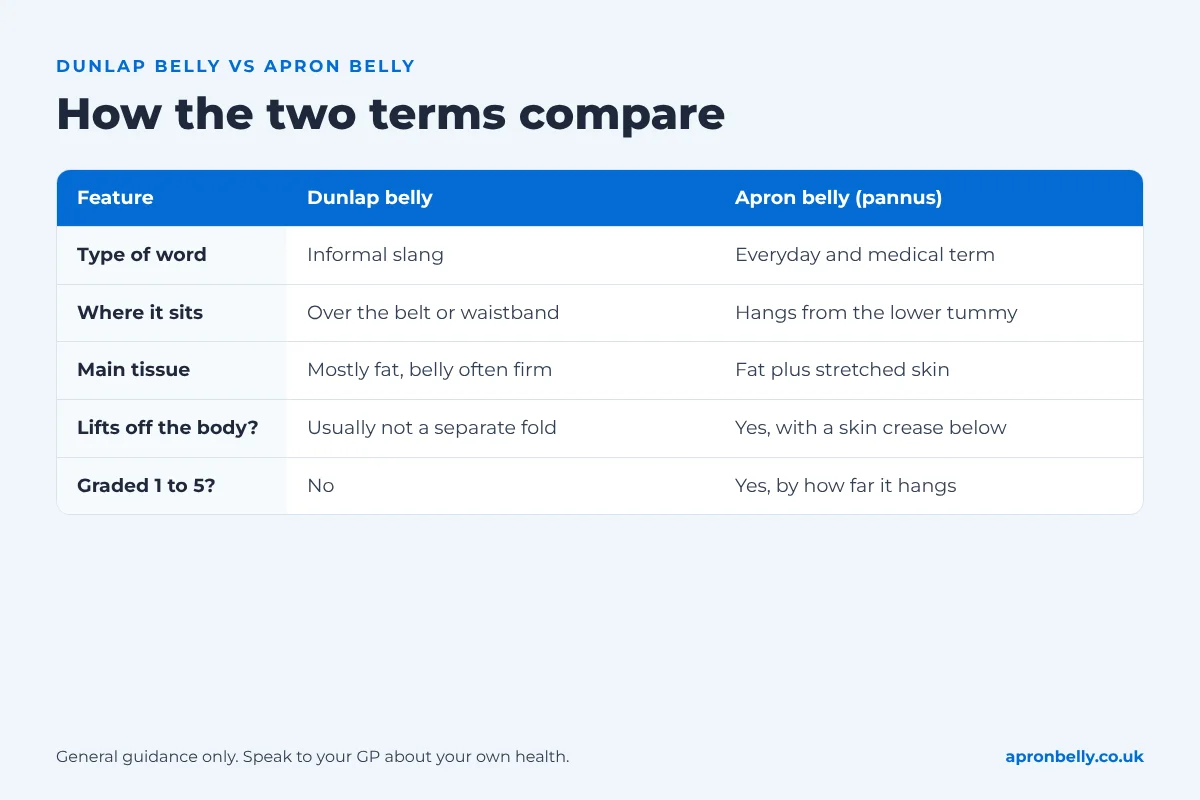
A quick comparison
| Feature | Dunlap belly | Apron belly |
|---|---|---|
| Type of word | Informal slang | Everyday and medical term |
| Where it sits | Over the belt or waistband | Hangs from the lower tummy |
| Main tissue | Mostly fat, often deep belly fat | Fat under the skin plus stretched skin |
| Skin crease underneath | Often none | Yes, where the fold rests |
| Graded by clinicians | No | Yes, grade 1 to grade 5 |
When a dunlap belly becomes an apron belly
The two shapes sit on a scale. A belly that starts by pushing over the belt can, with more weight gain, pregnancy or ageing skin, begin to fold over and hang lower. Once it forms a fold that covers the pubic hairline, a clinician would usually call it a grade 1 pannus. Our guide to apron belly vs belly fat explains how to tell a fold from general tummy fat.
How Slang Terms Map to Medical Grades
Clinicians describe a pannus by how far it hangs when you stand. Slang terms do not line up exactly with these grades, but the table below gives a rough guide.
The five pannus grades
| Grade | Where the fold reaches | Everyday words often used |
|---|---|---|
| Grade 1 | Covers the pubic hairline | Dunlap belly, belly hangs over, small apron belly |
| Grade 2 | Covers the genital area | Curtain belly, apron belly |
| Grade 3 | Reaches the upper thighs | Apron belly, hanging belly |
| Grade 4 | Reaches the middle of the thighs | Large apron belly |
| Grade 5 | Reaches the knees or below | Very large pannus |
Our full guide to apron belly grades explains each stage with care tips.
A simple mirror check
- Stand side on to a full length mirror in your underwear, with your back straight.
- Notice whether your belly simply pushes forward, or whether it folds down over the skin below.
- Gently lift the lower belly. If there is a crease underneath, you have a fold rather than only a forward belly.
- Note where the lowest edge of the fold sits compared with the pubic hairline.
- Check the crease for redness, damp skin or soreness.
What Causes a Dunlap Belly?
A dunlap belly forms when fat builds up around the middle faster than the tummy wall and skin can hold it flat. Several things usually work together.
Common causes
- gaining weight over time, especially if you tend to store fat around the middle
- eating more calories than you use, including calories from alcohol
- moving less, for example after a change of job, an injury or retirement
- ageing, as muscle mass falls and skin loses some of its stretch
- genes, which affect where your body stores fat
- pregnancy, which stretches the tummy muscles and skin
Why the belly pushes over the belt
Belts and waistbands tend to sit at the narrowest point below the belly. As the belly grows, the waistband slips lower and the belly rolls forward and over it. Wearing trousers lower than your natural waist can make the overhang look larger than it really is. Our guide to a stomach hanging over trousers explains the causes and the waistband and fit changes that help.
Is a Dunlap Belly a Health Problem?
The word itself is a joke, but the shape it describes can be worth taking seriously.
Belly fat and your health
Fat stored around the waist, particularly the deep visceral fat that makes a belly firm and round, is linked with type 2 diabetes, high blood pressure and heart disease. The NHS suggests a simple check: try to keep your waist size to less than half your height. For example, someone who is 180cm tall should aim for a waist under 90cm.
Skin problems under an overhang
If your belly folds over the skin below, the crease can trap sweat and heat. This can cause soreness and a red rash called intertrigo. Washing the area daily and drying it fully helps protect the skin.
Comfort and confidence
A belly that hangs over the belt can make trousers dig in and shirts ride up, and it can affect how you feel about your body. These are fair reasons to want a change, even when there are no medical problems.
How to Reduce a Dunlap Belly
You cannot burn fat from one spot, but the belly is often one of the first places to change when you lose weight overall.
Lose weight steadily
If you are above a healthy weight, the NHS advises aiming to lose 0.5kg to 1kg a week by eating fewer calories than you use and being more active. Cutting down on alcohol and sugary drinks is a simple first step for many people. A belly made mainly of fat usually shrinks well with weight loss.
Move more every day
The UK guidelines suggest at least 150 minutes of moderate activity a week, such as brisk walking, plus strength exercises on 2 or more days. Strength work helps you keep muscle as you lose fat, and core exercises improve posture so the belly is held better.
Choose clothes that sit well
- wear trousers at your natural waist rather than below the belly
- try a wider, softer waistband instead of a narrow, tight belt
- use braces if belts keep slipping under the belly
When loose skin is left
If your belly has become a true fold of stretched skin, for example after large weight loss, some skin may remain. Surgery to remove it, called a panniculectomy or apronectomy, is only offered on the NHS in limited cases, so a GP is the best person to talk to first. If the loose skin has settled into two stacked folds, our guide to the double apron belly explains why surgery is planned differently.
When to See a GP
Book a GP appointment, or contact NHS 111 if you are worried and cannot get one, if you notice any of these.
Warning signs
- skin under the overhang that is hot, swollen, painful or spreading red
- broken, weeping or smelly skin that does not heal
- a lump or bulge near the belly button or a scar
- a belly that grows quickly without weight gain, or swelling with pain
- you would like help with weight loss, including NHS weight management services
Frequently Asked Questions
What does dunlap belly mean?
Dunlap belly is slang for a stomach that has “done lapped” over the belt or waistband. It usually describes a rounded belly of fat that spills over the top of trousers. It is an informal phrase and not a medical diagnosis.
Is a dunlap belly the same as an apron belly?
Not quite. A dunlap belly usually means a belly that pushes forward and over the belt. An apron belly is a fold of skin and fat that hangs down from the lower tummy with a skin crease underneath. A dunlap belly can turn into an apron belly over time.
What is a curtain belly?
Curtain belly is another slang term for a fold of belly that drops down over the lower tummy like a curtain. It usually describes an apron belly, often grade 2 or more, where the fold covers the pubic area.
Can you get rid of a dunlap belly?
A dunlap belly made mainly of fat often gets much smaller with steady weight loss of 0.5kg to 1kg a week and regular activity. You cannot spot reduce belly fat, but the belly usually changes as you lose weight overall.
Is a dunlap belly dangerous?
The belly itself is not a disease, but carrying a lot of fat around the waist is linked with type 2 diabetes and heart disease. The NHS suggests keeping your waist to less than half your height. A GP can check your health and offer support.
The Bottom Line
A dunlap belly is friendly slang for a stomach that hangs over the belt. It usually describes a round belly of fat rather than a true fold, while an apron belly is a hanging fold of skin and fat that clinicians grade from 1 to 5. The two shapes can overlap, and the same steps help both: steady weight loss, regular activity, good skin care and a GP check if anything changes.
Your next step
Do the mirror check this week and measure your waist against half your height. If your belly is above that line, or the skin under it is sore, speak to your GP about support.
Featured image: leather belt and buckle by Joeyramoney, Wikimedia Commons, public domain, cropped.