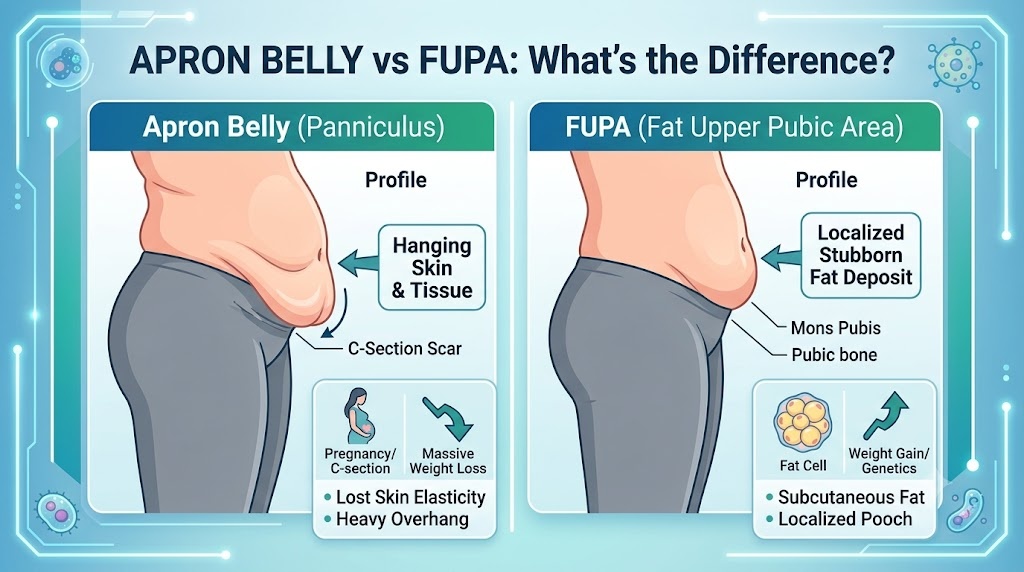


Telling apart a structural apron belly from a temporary bloated stomach matters because the two problems call for completely different responses. One is about tissue and fat distribution that builds over months or years; the other is about digestion, water retention, or gas that can appear and disappear within hours. This guide compares apron belly and bloating side by side so you can make a quick, confident read of your own body, understand what is an apron belly, see how fupa vs pooch confusion adds to the mix, and know when exercise helps bowel movement rather than reshapes structural tissue.
Quick answer: apron belly or bloating?
An apron belly is a structural lower-abdominal overhang made of skin, fat, and sometimes loose connective tissue that hangs over the lower body. It tends to stay present regardless of the time of day, though its visual severity can shift slightly with posture, clothing, or recent weight change. Bloating is a temporary swelling of the abdomen caused by gas, fluid retention, or digestive slowdown, and it typically rises and falls within a single day.
The clearest way to compare the two is by criteria that do not depend on guessing at cause: timing, feel and texture, visual shape, and response to simple interventions. What is an apron belly comes down to persistent tissue overhang, while bloating is a transient distension pattern. The fupa vs pooch distinction is also relevant here, since both sit lower on the abdomen and can be mistaken for either condition. Where digestion is involved, noting whether exercise helps bowel movement and reduces the swelling is one of the fastest practical checks available.
Apron belly vs bloating at a glance
| Criteria | Apron belly | Bloating |
|---|---|---|
| Best fit for identifying | Consistent lower-belly overhang present daily | Abdominal swelling that changes across a single day |
| Ideal use case for the distinction | Deciding on longer-term fat-loss, skin, or clothing strategies | Deciding whether a meal, cycle, or digestive pattern is the trigger |
| Main strength as a signal | Reliable, does not disappear with rest or fasting | Responds quickly to diet changes, movement, or time |
| Key tradeoff | Requires structural approaches like exercise, diet, or medical options | Can mimic apron belly appearance, leading to wrong assumptions |
This table is meant as a qualitative orientation, not a diagnostic tool. If your abdomen check does not clearly match one column, it is worth tracking your symptoms over a few days rather than relying on a single observation.
Apron belly vs bloating: the criteria that matter
Fit and use case

An apron belly is the better explanation when the overhang is present first thing in the morning, before food or fluids have been consumed, and remains largely unchanged throughout the day. This is one of the most useful timing checks: bloating almost always eases overnight, while a structural apron belly does not. Understanding what is an apron belly matters here because it shapes whether someone pursues clothing adjustments, targeted exercise, or a conversation with a healthcare provider, rather than adjusting a meal.
Bloating fits better when the belly looks and feels different depending on the time of day, what was recently eaten, or where someone is in a monthly cycle. It commonly appears higher and more centrally than a typical apron belly, though the fupa vs pooch overlap can blur this for anyone unfamiliar with the terms. If swelling reduces noticeably after a bowel movement or a short walk, that is a meaningful clue pointing toward digestion rather than fat distribution.
Value and tradeoffs

Framing an apron belly as a long-term structural feature means the realistic path forward involves consistent effort over weeks or months, whether through strength and core-focused exercise routines, dietary changes, or supportive clothing while other progress is made. The tradeoff is patience: there is no quick fix for tissue that has developed gradually, and expecting rapid change from a single week of effort tends to lead to disappointment.
Bloating has the opposite value proposition. It often resolves with same-day interventions, which makes it tempting to treat every lower-belly change as a passing digestive issue. The tradeoff there is complacency, since dismissing a persistent overhang as bloating can delay addressing a structural concern that would benefit from earlier attention, including exploring how exercise helps bowel movement regularity as a supporting habit rather than a cure.
Limitations and deal-breakers
The biggest limitation in self-assessment is relying on a single day’s observation. Apron belly and bloating can coexist, meaning someone with a structural overhang can also experience additional bloating on top of it, which temporarily exaggerates the appearance. This is a common source of confusion in the fupa vs pooch conversation, where people assume the entire visual change is fat-related when part of it is digestive.
A deal-breaker for self-diagnosis is any bloating accompanied by pain, sudden severe swelling, or changes in bowel habits that do not resolve with normal dietary adjustments. These signs point toward a digestive or medical issue rather than either apron belly or ordinary bloating, and they fall outside what this comparison can responsibly address. In that case, a conversation with a healthcare provider is the appropriate next step rather than continuing to compare visual criteria at home.
A simple decision rule

Use timing as the first filter: check the belly first thing in the morning on an empty stomach. If the overhang is still visible and feels like consistent, dense-to-soft tissue rather than tight or gassy distension, that points toward a structural apron belly. If the belly is flatter in the morning and swells later in the day, especially after certain meals, that points toward bloating.
Use feel as the second filter. Apron belly tissue typically feels like skin and fat you can grasp, sometimes with looser or overhanging skin depending on individual history. Bloating tends to feel tighter, sometimes accompanied by gas or a drum-like tautness, and it often eases with a bowel movement or passing time.
If the two seem to overlap, track it for three to five days rather than deciding from one observation. Note what you ate, whether exercise helps bowel movement on the days you moved more, and whether the lower-belly shape changed independent of digestion. This pattern-based approach avoids the common mistake of treating a structural concern as a short-term issue, or vice versa. For a deeper look at underlying drivers, see this overview of apron belly causes.
FAQ about apron belly and bloating
Is it possible to get rid of apron belly?
Reducing an apron belly is possible for many people through sustained fat loss, targeted strength work, and time, though results vary based on skin elasticity and individual history. Complete resolution is not guaranteed for everyone through non-surgical means alone.
What tightens the apron belly?
Core-focused strength training, gradual fat loss, and improved posture can tighten the surrounding muscles and reduce the visual prominence of an apron belly over time. Skin laxity itself responds more slowly and inconsistently than muscle tone does.
What is the difference between an apron belly and a fupa?
An apron belly is a fold that starts on the lower abdomen and hangs down, sometimes over the pubic area, while a FUPA is a smaller mound of fat sitting on the pubic area itself. The fupa vs pooch and apron belly distinctions mostly come down to location and the amount of overhang involved.
What causes an apron belly in females?
Common contributors include pregnancy-related changes, weight fluctuations, hormonal shifts, and reduced skin elasticity with age. Genetics and prior abdominal surgery can also play a role in how the lower belly holds and distributes tissue.
Which belly fat is hardest to lose?
Lower-abdominal and visceral fat around the midsection is often reported as more stubborn than fat in other areas, partly due to hormonal and metabolic factors. Consistency with diet and exercise over time remains the most reliable non-surgical approach.
How can you check whether it is an apron belly or bloating?
The most important first step is distinguishing a persistent structural overhang from temporary bloating, since what is an apron belly and what is short-term swelling call for very different responses. Morning checks are a simple, reliable starting point.
Should you treat it as a structural or a digestive problem?
Base the choice on how consistently the overhang appears, whether exercise helps bowel movement and reduces swelling on active days, and how much the shape changes with diet alone. Structural concerns call for structural strategies, while digestive patterns call for dietary and lifestyle review.
What are the common mistakes when comparing apron belly and bloating?
Avoid judging the belly from a single time of day, assuming all lower-belly change is fat-related, and ignoring persistent overhang as ordinary bloating. Both the fupa vs pooch mix-up and the apron belly-bloating mix-up usually stem from skipping the timing and feel checks.
Recommended next steps
If your morning check consistently shows a lower-belly overhang that does not change with digestion, the next useful step is exploring structural options such as targeted exercise, dietary adjustments, or supportive clothing choices while progress builds. If your symptoms point more toward bloating, especially when they ease after a bowel movement or a short walk, focus on dietary triggers and simple movement habits first.
For readers still uncertain after a few days of tracking, it is worth reviewing a broader guide to understanding apron belly as a starting reference point, and pairing that with attention to any persistent digestive symptoms that warrant a conversation with a healthcare provider rather than further self-comparison.
Rachel has spent over a decade writing about women’s health, body composition, and post-pregnancy recovery for UK-based digital publications and NHS-adjacent health platforms. She holds a postgraduate certificate in science communication and has worked closely with physiotherapists and dietitians to translate clinical research into plain, usable advice. Her approach is straightforward: lead with what the evidence actually says, flag the limitations honestly, and skip the language that makes readers feel like a problem to be solved. She writes for people who have already Googled the optimistic version and want someone to level with them.