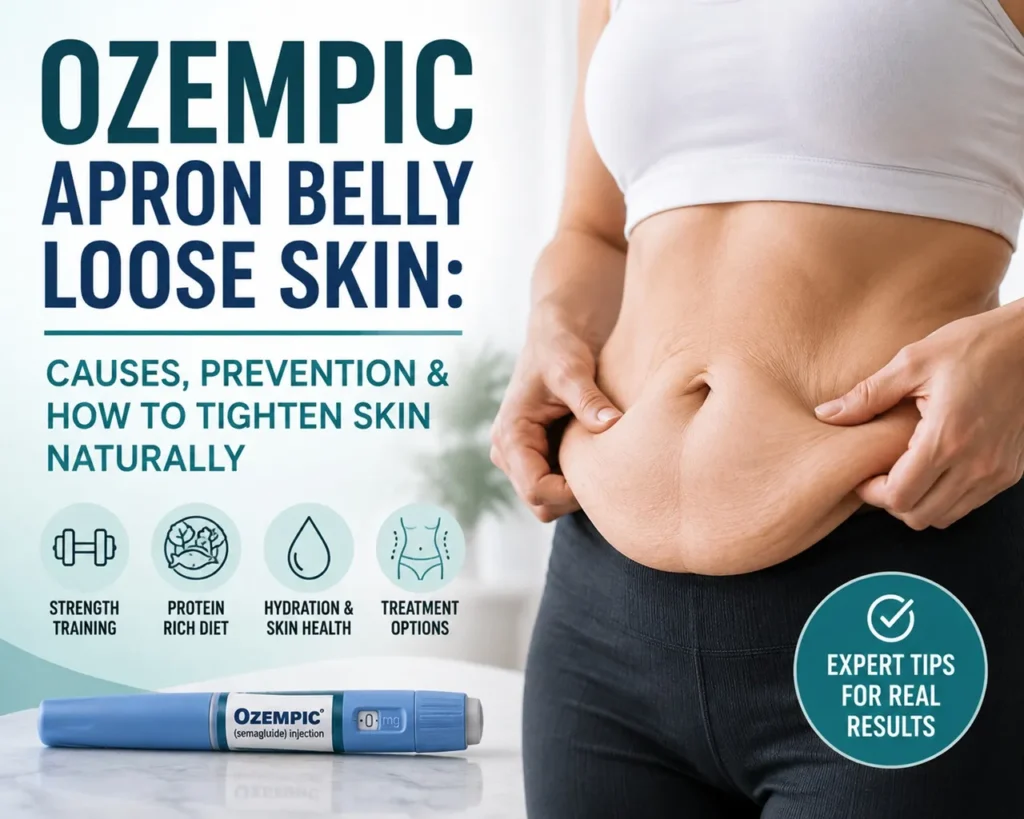
Ozempic (semaglutide) doesn’t directly cause loose skin. Rapid fat loss from this GLP-1 receptor agonist reduces skin elasticity faster than the skin can adapt, leading to an apron belly or excess abdominal skin. A combination of strength training, adequate protein intake, hydration, and, in severe cases, medical treatment can help address Ozempic-related loose skin.
Key takeaways
- Ozempic does not directly cause loose skin. Rapid fat loss is the main cause.
- Age, large weight loss, genetics, pregnancy and smoking raise the risk.
- Most natural skin tightening happens within 12 to 24 months of reaching a stable weight.
- Strength training, enough protein and good hydration can improve how loose skin looks.
- For large amounts of excess skin, a panniculectomy or tummy tuck may be an option.
Losing a large amount of weight with Ozempic is a real achievement. But for many people, rapid weight loss brings an unexpected challenge: loose skin, particularly around the abdomen. If you’ve noticed an overhanging fold of skin below your belly button, you may be dealing with what’s commonly called an apron belly.
This guide covers everything you need to know about Ozempic-related apron belly and loose skin, from why it develops and who is most at risk to practical strategies for tightening skin naturally, non-surgical treatments, and when surgery may be the right option.
You’ll also find a myth-busting section, comparison tables, a recovery timeline, and answers to the most common questions people ask after losing weight on semaglutide.
What Is Ozempic Apron Belly Loose Skin?
What is an apron belly?
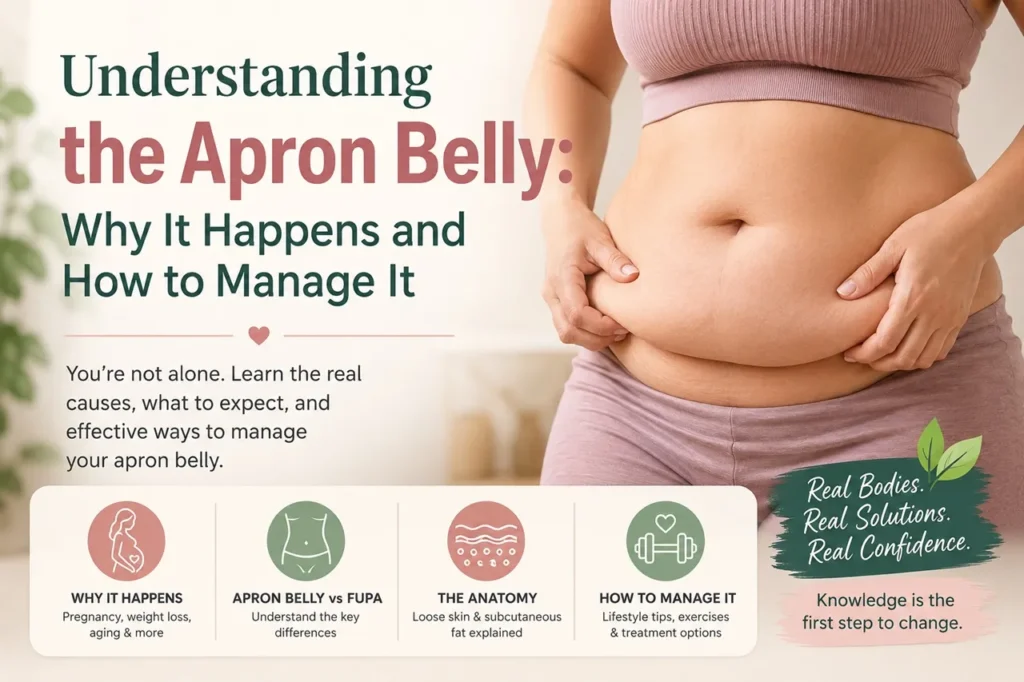
An apron belly, also called a panniculus or abdominal pannus, is a flap of excess skin and adipose tissue that hangs down from the lower abdomen. It develops when the skin stretches over time due to obesity, pregnancy, or major weight changes, then loses the ability to spring back once that volume is reduced.
The medical term for this condition is an overhanging abdomen or abdominal skin folds. In severe cases, the panniculus can hang past the groin or thighs, causing discomfort, skin irritation, and hygiene difficulties.
What is loose skin?
Loose skin forms when the connective tissue beneath the skin, primarily collagen and elastin fibres, has been stretched beyond its capacity to recoil. When the underlying fat or volume is removed (whether through surgery or weight loss), the outer layer of skin doesn’t automatically shrink to match the change.
Is it fat or skin?
This is a common source of confusion. Excess abdominal skin and subcutaneous fat can look and feel similar, but they require very different treatment approaches. Understanding which one you’re dealing with is an important first step; more on this in the comparison section below.
Does Ozempic Cause Loose Skin?

Ozempic (semaglutide) does not directly cause loose skin. The medication doesn’t alter skin structure or collagen production. What Ozempic does is facilitate rapid fat loss, often at a pace the skin cannot keep up with.
Ozempic is a GLP-1 receptor agonist originally developed for the management of type 2 diabetes. In the UK, Ozempic is licensed for type 2 diabetes. For weight loss, semaglutide is prescribed under the brand name Wegovy. Mounjaro (tirzepatide) is another weight-loss medicine used in the UK. In the STEP 1 trial, people taking weight-loss semaglutide lost about 15% of their body weight on average over 68 weeks (New England Journal of Medicine, 2021).
Skin laxity develops when fat volume decreases faster than the skin can remodel itself. Slow, gradual weight loss gives the skin more time to adapt. Rapid weight loss, common with semaglutide due to reduced appetite and a calorie deficit, leaves the skin insufficient time to tighten.
The result: excess abdominal skin and, in some people, a pronounced apron belly. This is why understanding the causes of Ozempic-related loose skin and treatment options early can make a meaningful difference in outcomes.
Why Does an Apron Belly Develop After Ozempic Weight Loss?
Several factors explain why some people develop more skin laxity than others after losing weight on Ozempic:
- Previous obesity: People who have carried a high BMI for years often have skin that has been stretched for a long time. The longer the stretch, the less likely the skin is to retract fully.
- Pregnancy: Repeated pregnancies stretch the abdominal wall and surrounding skin. Collagen and elastin fibres can sustain lasting damage, making post-weight-loss skin harder to tighten.
- Ageing: Collagen production naturally declines with age. By the time most people reach their 40s and 50s, their skin has already lost much of its elasticity, making it far less responsive to weight changes.
- Genetics: Skin elasticity is partly hereditary. Some people naturally produce more robust collagen and elastin fibres, while others are genetically predisposed to looser skin after weight loss.
- Muscle loss: Rapid weight loss often includes a loss of lean muscle alongside fat. Muscle provides structural support beneath the skin. When muscle mass decreases, the skin has less underlying tissue to conform to, which contributes to a sagging appearance.
Loose Skin vs. Belly Fat: How to Tell the Difference
Knowing whether you’re dealing with loose skin or residual fat determines which treatment approach is most appropriate.
| Feature | Loose Skin | Belly Fat |
|---|---|---|
| Texture | Thin, soft, wrinkled | Thicker, doughy, or firm |
| Appearance | Deflated or saggy | Rounded or protruding |
| Pinch test | You can pinch a thin layer between fingers | Difficult to pinch; feels dense |
| Firmness | Very little resistance | Feels solid or heavy |
| Movement | Moves and hangs freely | Less mobile, especially visceral fat |
| Response to exercise | Minimal change in appearance | May reduce with cardio and diet |
Subcutaneous fat sits just beneath the skin and is relatively soft. Visceral fat sits deeper around the organs and is firmer. Loose skin, by contrast, contains very little adipose tissue, it’s primarily stretched skin with a thin underlying layer.
If you’re unsure which you’re dealing with, a GP or dermatologist can help you distinguish between the two.
Who Is Most Likely to Get Loose Skin on Ozempic?

Not everyone who loses weight on Ozempic will develop noticeable loose skin. The following factors increase the likelihood:
- Older adults: Declining collagen production slows skin remodelling and reduces its effectiveness after age 40.
- Those with a large amount of weight lost: Losing more than about 23 kg (roughly 3.5 stone) greatly increases the risk of excess skin.
- People with a history of long-term obesity: A higher body fat percentage maintained over many years stretches the skin for longer, reducing its ability to retract.
- Smokers: Smoking impairs collagen synthesis and blood flow, both of which are essential for skin regeneration.
- Those with poor nutrition during weight loss: Inadequate protein intake can accelerate muscle loss and slow skin repair processes.
Can Loose Skin Tighten Naturally After Ozempic?
Yes, to a degree. Skin does have a natural capacity to remodel itself, but the extent of natural tightening varies widely from person to person.
Natural skin recovery timeline after Ozempic weight loss
| Timeframe | What to Expect |
|---|---|
| 0 to 3 months | Skin adjusting to new weight; little visible tightening |
| 3 to 6 months | Early improvements possible with consistent exercise and nutrition |
| 6 to 12 months | Continued collagen production; moderate improvement in skin tone |
| 12 to 24 months | Maximum natural improvement; results depend on age, genetics, and lifestyle |
The skin’s ability to tighten naturally depends primarily on:
- Age: Younger people tend to see better results because their collagen production is more active.
- Amount of weight lost: Modest weight loss allows for more skin rebound than extreme weight loss.
- Genetics: Some people’s skin bounces back better than others.
- Time: Natural skin elasticity recovery is a slow process. Most improvement occurs within the first two years after reaching a stable weight.
Best Exercises for Ozempic Apron Belly Loose Skin
Exercise won’t eliminate loose skin outright, but it can greatly improve overall appearance by building lean muscle beneath the skin.
Strength Training

Strength training is the most effective exercise strategy for body recomposition after major weight loss. By building muscle mass, you fill out the space left by lost fat, reducing the visible appearance of loose skin.
Key compound movements include:
- Squats: Target the legs, glutes, and core. Barbell or goblet squats are particularly effective.
- Deadlifts: Work the posterior chain and core, helping rebuild muscle throughout the trunk.
Aim for three to four sessions per week, progressively increasing resistance over time.
Resistance Training
Resistance training, whether using free weights, machines, or resistance bands, stimulates collagen production and supports improvements in overall body composition. This training is particularly useful for those new to exercise or managing joint concerns.
Core Exercises
Core-specific work helps strengthen the abdominal wall beneath loose skin:
- Planks: Build deep core stability without excessive spinal loading.
- Bird Dog: Improves core coordination and lower back strength.
- Glute Bridge: Activates the posterior chain and helps stabilise the pelvis.
Best Diet to Improve Skin Elasticity After Ozempic Weight Loss
What you eat during and after Ozempic-assisted weight loss directly affects how well your skin recovers. The following nutrients specifically support collagen synthesis and skin repair:
- Protein: The foundation of skin repair. Collagen synthesis depends on amino acids derived from dietary protein. Aim for at least 1.2 to 1.6g of protein per kilogram of body weight daily. Good sources include chicken, fish, eggs, Greek yoghurt, and legumes.
- Vitamin C: Essential for collagen production. Found in citrus fruits, strawberries, kiwi, and bell peppers.
- Vitamin E: Supports skin health and acts as an antioxidant. Found in nuts, seeds, and vegetable oils.
- Zinc: Plays a key role in wound healing and skin repair. Sources include red meat, shellfish, and pumpkin seeds.
- Copper: Needed for cross-linking collagen and elastin fibres. Found in organ meats, shellfish, and nuts.
- Omega-3 fatty acids: Reduce inflammation and support skin membrane integrity. Found in oily fish, flaxseeds, and walnuts.
- Hydration: Adequate water intake maintains skin plumpness and elasticity. Aim for 2 to 2.5 litres of water daily, more if physically active.
A nutrient-rich diet won’t reverse severe skin laxity on its own, but it provides the raw materials your body needs for ongoing skin repair and collagen remodelling.
Can Collagen Supplements Help With Loose Skin After Ozempic?

This is one of the most common questions from people managing loose skin after weight loss.
What does the evidence say?
Collagen peptides (hydrolysed collagen) are broken down into smaller amino acids that the body can absorb. According to a review published in the Journal of Drugs in Dermatology (2019), several randomised controlled trials suggest that supplementing with 2.5 to 10g of collagen peptides daily may improve skin elasticity and hydration over 8 to 12 weeks.
Types of collagen
- Type I: The most abundant in skin. Most oral supplements contain Type I, often sourced from bovine or marine collagen.
- Type III: Found alongside Type I in skin, blood vessels, and internal organs.
Realistic expectations
Collagen supplements may support skin health and improve skin elasticity, but they’re not a standalone solution for loose skin after Ozempic. Think of collagen supplementation as one piece of a broader strategy alongside resistance training, protein intake, and hydration rather than a cure.
Skincare, Sleep and Stress: The Habits That Support Skin Recovery
Exercise and nutrition do most of the work, but a few supporting habits decide how well your skin can use them. None of these will remove an apron belly on their own. Together, they give collagen repair the best possible conditions.
Topical skincare
Creams cannot rebuild the deeper dermis, but they do support the outer skin barrier. Retinol, a vitamin A derivative, encourages collagen production and cell turnover; start with a low strength two or three times a week to avoid irritation. Products containing hyaluronic acid, peptides or niacinamide can improve hydration and texture in the short term. Daily moisturising keeps the barrier intact, which matters more on thin, stretched skin.
Sleep
Much of the body’s tissue repair happens during deep sleep, when growth hormone release peaks. Regularly short or broken sleep interrupts that cycle. Seven to nine hours a night, a consistent bedtime and a dark, cool bedroom are simple ways to protect it.
Stress
Chronically raised cortisol is associated with faster collagen breakdown. Daily walks, a few minutes of slow breathing or any hobby that properly switches you off can help keep stress hormones lower while your skin adapts.
Avoid weight cycling
Repeatedly losing and regaining weight stretches the skin again each time, which makes it harder for elastin fibres to recover. If you are taking a GLP-1 medication, plan any dose changes or tapering with your prescriber so that your weight settles at a stable point rather than rebounding.
Loose skin or excess skin?
It helps to separate the two. Loose skin still has some elasticity and can improve over the first year or two at a stable weight. Excess skin hangs with little elasticity left and rarely changes with lifestyle measures. If your weight has been steady for more than a year and the fold has not improved, a consultation with a GP, dermatologist or plastic surgeon is the sensible next step.
Non-Surgical Treatments for Loose Skin After Ozempic
For those seeking greater improvement without surgery, several non-invasive and minimally invasive treatments show promising results:
| Treatment | Estimated Cost | Downtime | Expected Results |
|---|---|---|---|
| Radiofrequency skin tightening | £800 to £3,000 per course | None to minimal | Moderate skin tightening over 3 to 6 months |
| Microneedling | £200 to £600 per session | 1 to 2 days | Improved texture; 3 to 6 sessions recommended |
| Laser skin tightening | £500 to £2,500 per course | Minimal | Moderate improvement; best for mild laxity |
| Ultrasound therapy (e.g., Ultherapy) | £1,000 to £3,500 | None | Gradual tightening over 3 to 6 months |
| Morpheus8 | £800 to £2,000 per session | 2 to 5 days | Marked tightening; combines RF and microneedling |
Prices are approximate and vary widely by provider and location.
These treatments stimulate collagen production in the deeper layers of the skin and tend to produce the best results for mild to moderate skin laxity. They are generally not sufficient for large amounts of excess abdominal skin.
When Is Surgery the Best Option for Ozempic Apron Belly?
For people with large amounts of excess skin or a pronounced abdominal pannus that causes physical discomfort, recurrent infections, or hygiene difficulties, surgical intervention may be the most effective solution.
| Feature | Panniculectomy | Tummy Tuck (Abdominoplasty) |
|---|---|---|
| Purpose | Removes excess skin and fat below the belly button | Removes skin, fat, and tightens abdominal muscles |
| Recovery | 4 to 8 weeks | 6 to 8 weeks |
| Private cost (approx.) | From about £6,000 | £6,500 to £9,500 (average about £8,000) |
| NHS or insurance | NHS funding is rare and has strict criteria. Ask your GP. | Rarely funded on the NHS. Private medical insurance usually excludes cosmetic surgery. |
| Results | Functional improvement; cosmetic secondary | Functional and cosmetic improvement |
Panniculectomy is better suited for patients whose primary concern is the physical complications of a large abdominal pannus, while a tummy tuck (abdominoplasty) works best when both functional relief and cosmetic improvement are desired.
Both are major surgeries and require careful consideration, a stable body weight, and consultation with a consultant plastic surgeon on the GMC Specialist Register. For a full UK price breakdown, see our guide to apron belly surgery costs.
Common Mistakes That Make Loose Skin Worse

Avoiding these errors can meaningfully improve your outcome after Ozempic weight loss:
- Losing weight too quickly: Rapid weight loss gives skin no time to adapt. Slower, steady fat loss generally produces better skin outcomes.
- Low protein diet: Inadequate protein during weight loss accelerates muscle loss and slows skin repair.
- Skipping resistance training: Without building lean muscle, there is nothing to fill the space left by lost fat.
- Smoking: Nicotine constricts blood vessels, reduces collagen synthesis, and seriously impairs skin repair.
- Poor hydration: Chronically dehydrated skin loses elasticity faster and recovers more slowly.
Prevention Tips Before Starting Ozempic
If you’re about to begin Ozempic or a similar GLP-1 medication, these strategies can help reduce loose skin risk from the outset:
- Aim for gradual weight loss: Where possible, target 0.5 to 1 kg per week rather than rapid drops.
- Prioritise protein: A high protein intake from the start helps preserve muscle and supports skin repair.
- Begin resistance training early: Starting before major weight loss begins helps maintain muscle mass throughout the process.
- Stay hydrated: Make hydration a daily habit, not an afterthought.
- Protect your skin: Regular moisturising, sun protection, and avoiding smoking all support long-term skin health.
Myths vs. Facts: Ozempic Loose Skin
| Myth | Fact |
|---|---|
| Ozempic directly causes loose skin | Rapid weight loss causes skin laxity, not the medication itself |
| Exercise removes loose skin | Exercise builds muscle and improves appearance; it doesn’t eliminate excess skin |
| Collagen supplements completely reverse loose skin | Collagen peptides may support skin health but are not a cure for severe laxity |
| Loose skin always requires surgery | Mild to moderate loose skin can improve naturally with time, exercise, and nutrition |
| Young people never get loose skin after weight loss | Age reduces risk but doesn’t eliminate it; large, rapid weight loss can cause laxity at any age |
Frequently Asked Questions
No. Not everyone who loses weight on Ozempic develops noticeable loose skin. Factors such as age, the amount of weight lost, genetics, and baseline skin elasticity all influence individual outcomes. Gradual weight loss and proactive lifestyle measures reduce the risk considerably.
Mild loose skin can improve greatly with time, strength training, and good nutrition. However, complete resolution without surgery is unlikely for people with large amounts of excess skin or pronounced abdominal pannus.
Not necessarily. Skin continues to remodel for up to two years after major weight loss. Many people see meaningful improvement over this period. However, severe skin laxity, particularly after very large weight loss, is unlikely to resolve fully without medical intervention.
Research suggests that collagen peptides may modestly improve skin elasticity and hydration when taken consistently over 8 to 12 weeks. Collagen supplements are unlikely to eliminate loose skin on their own but may complement other strategies as part of a broader approach.
Most natural skin tightening occurs within 12 to 24 months of reaching a stable weight. Results depend on age, skin condition, amount of weight lost, and lifestyle habits. Consistency with resistance training, protein intake, and hydration all support the process.
Final Thoughts
Ozempic and other GLP-1 receptor agonists are remarkably effective weight loss tools. Rapid, large weight loss can transform overall health. However, it can also leave many people managing an unexpected challenge: Ozempic apron belly loose skin.
The key takeaways are clear. Ozempic doesn’t directly cause loose skin. Rapid fat loss and reduced skin elasticity are the real culprits. A combination of progressive strength training, adequate protein intake, proper hydration, and patience can meaningfully improve the appearance of excess abdominal skin for many people.
For those dealing with a more severe abdominal pannus, non-surgical treatments such as radiofrequency skin tightening or Morpheus8 offer targeted improvement without the recovery time of surgery. And for cases where excess skin causes physical discomfort or recurring skin infections, a panniculectomy or tummy tuck may be the most appropriate solution after consulting a qualified healthcare professional.
Managing loose skin after major weight loss is a long game. Results don’t happen overnight. But with the right approach, realistic expectations, and professional guidance where needed, meaningful improvement is well within reach.