

 23 Aug 2026
 9 min read
Apron belly before and after is one of the most searched phrases in this space, and it is easy to understand why. People want to know whether effort actually produces visible results, and if so, what those results honestly look like. The answer is more nuanced than most transformation photos suggest. Real progress is measurable and meaningful, but it rarely follows the dramatic arc of a social media reveal. Understanding what genuinely changes — and what may not — is the most useful thing you can do before you begin.
What apron belly before and after means in practice
When most people search for apron belly before and after pictures, they are looking for reassurance that change is possible. That is a reasonable thing to want. But the phrase covers a wide range of outcomes, and conflating them leads to frustration.
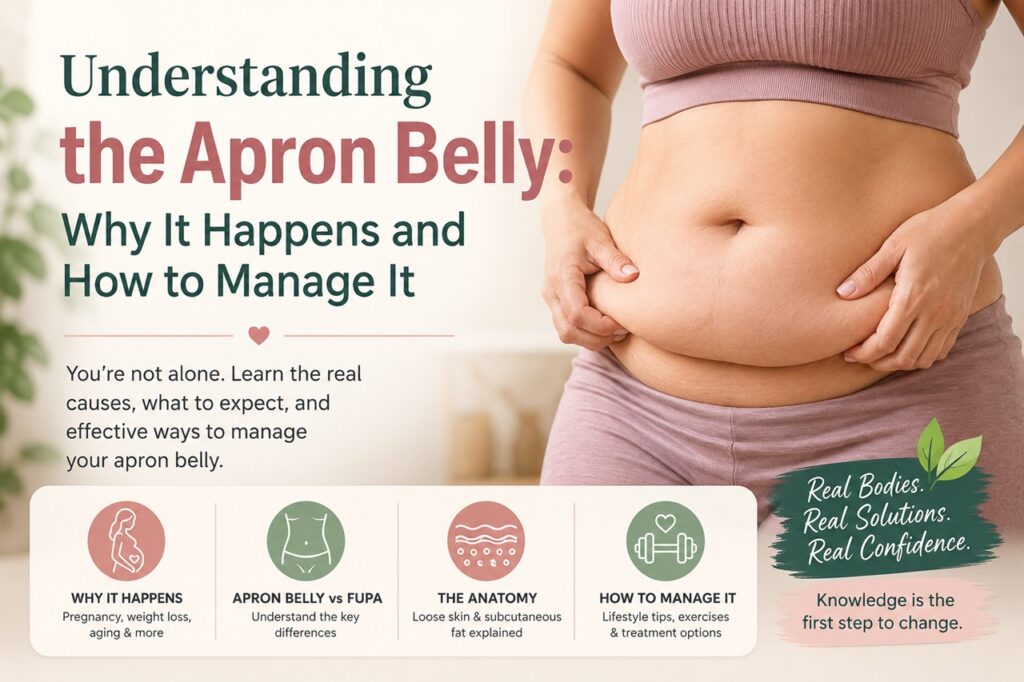
An apron belly — the fold of skin and fat that hangs below the navel, sometimes called a pannus — is shaped by two distinct components: subcutaneous fat and, in many cases, excess or stretched skin. These two components respond very differently to lifestyle changes. Fat tissue reduces with a sustained calorie deficit and consistent movement. Skin, particularly skin that has been stretched over years or through pregnancy, has limited capacity to retract, especially in adults over forty or those who have experienced significant weight fluctuation.
This distinction matters enormously when you are trying to interpret what apron belly before and after exercise or dietary change actually looks like. A person who loses a meaningful amount of body fat may find that the fold becomes smaller, lighter, and less pronounced. Posture often improves. Clothes fit differently. The fold may sit higher or feel less heavy. These are real, significant changes that improve daily comfort and confidence. But in many cases, some degree of fold remains, because the skin itself has not changed.
Good apron belly management starts with accepting this distinction rather than fighting it. The goal is not always elimination — it is improvement, and improvement is genuinely achievable for most people.
How to think about apron belly before and after
Framing your expectations correctly from the start changes how you measure success. If you expect a flat stomach and get a smaller, more manageable fold, you may feel like you have failed when you have actually made substantial progress. The way to avoid that trap is to understand the mechanics before you begin.
The core problem to understand

The apron belly sits at the intersection of fat loss and skin elasticity, and these two things do not move at the same pace or respond to the same interventions. To understand what an apron belly is in structural terms is to understand why the before and after story is always more complex than a single photograph implies.
Fat in the apron area is predominantly subcutaneous — it sits beneath the skin but above the abdominal muscles. This fat responds to a calorie deficit over time, just as fat elsewhere in the body does. There is no way to target it specifically through exercise, but consistent cardiovascular activity combined with a moderate dietary deficit will reduce it. The timeline varies considerably depending on starting point, age, hormonal factors, and consistency, but measurable fat reduction is achievable for most people within three to six months of sustained effort.
Skin is a different matter. Skin that has been stretched — through pregnancy, significant weight gain, or both — loses some of its elasticity. Collagen and elastin fibres that give skin its ability to snap back degrade over time and under sustained tension. Younger people and those who lose weight gradually tend to see better skin retraction than older adults or those who lose weight rapidly. But for many people, particularly those who have carried an apron belly for several years or who have had multiple pregnancies, some degree of skin fold will remain even after substantial fat loss.
This is not a failure of effort. It is a biological reality, and understanding it is the foundation of honest progress tracking.
The practical decision criteria

When you are deciding how to approach the question of how to get rid of apron belly, it helps to think in terms of what you are actually trying to change and what tools are available to you.
If the fold is primarily fat, consistent exercise and dietary changes will produce visible results. Apron belly before and after exercise comparisons from people in this category often show a noticeably smaller fold, improved posture, and a flatter overall abdominal profile. The fold may still be present, but it is lighter, less pendulous, and less likely to cause skin irritation or discomfort.
If the fold contains a significant proportion of loose skin, the realistic outcome of lifestyle change is a smaller, lighter fold — not a flat abdomen. In this scenario, the most meaningful changes are often functional rather than purely visual: less chafing, better clothing fit, improved mobility, and reduced discomfort during physical activity. These outcomes are worth pursuing even if the visual transformation is less dramatic than you hoped.
There is also a middle category that many people overlook: posture and core strength. An apron belly is not just a surface-level concern. Weak deep abdominal muscles and poor posture can cause the fold to appear more pronounced than it actually is. Strengthening the transverse abdominis and improving standing posture can produce a visible change in how the fold sits and presents, without any change in fat or skin volume. This is one of the most underappreciated aspects of apron belly before and after exercise results.
Clothing choices also play a role in how progress is perceived day to day. High-waisted trousers, supportive underwear, and well-fitted waistbands can change how the fold feels and looks in ways that matter practically, even if they do not alter the underlying tissue.
Common mistakes to avoid

The most common mistake people make when tracking apron belly before and after progress is using the wrong metrics. Weighing yourself daily and expecting the scale to reflect what is happening in the fold specifically is unreliable. Body weight fluctuates for many reasons, and fat loss in the abdominal area may not be proportional to overall weight loss at any given point.
Relying solely on apron belly before and after pictures is also problematic without standardisation. Lighting, angle, clothing, posture, and time of day all affect how a fold appears in a photograph. A photo taken in harsh overhead lighting will show more shadow and definition than one taken in soft side lighting. A photo taken after a large meal will look different from one taken first thing in the morning. Without consistent conditions, photographic comparisons are difficult to interpret honestly.
Another mistake is expecting linear progress. Fat loss is not a straight line. There will be weeks where measurements do not change, where the fold seems more prominent due to bloating or hormonal shifts, and where motivation dips. This is normal and does not indicate that the approach is failing.
Finally, many people underestimate the timeline. Meaningful changes to the apron belly — particularly in cases involving both fat and loose skin — take months, not weeks. Setting a realistic timeline of three to six months for initial visible change, and twelve months or more for substantial transformation, helps prevent early abandonment of an approach that is actually working.
How to apply this to apron belly before and after
Translating this understanding into a practical approach means choosing the right measures of progress from the start.
Take circumference measurements at the widest point of the fold and at the natural waist, using a tape measure, at the same time of day and under the same conditions. Do this monthly rather than weekly to smooth out short-term fluctuations. Take photographs in consistent conditions — same lighting, same clothing, same posture, same time of day — monthly rather than daily.
Track functional changes alongside visual ones. Can you walk further without discomfort? Has skin irritation under the fold reduced? Do certain clothes fit differently? These are legitimate markers of progress that photographs may not capture.
When reviewing apron belly before and after pictures — whether your own or others’ — apply the same critical lens. Understanding how to interpret these images accurately is a skill in itself. The guide on reading before and after pictures correctly covers the specific variables that make photographic comparisons misleading and how to account for them.
For exercise, prioritise approaches that combine cardiovascular activity with core strengthening. Walking, swimming, and low-impact aerobic exercise support fat reduction without placing excessive strain on joints. Core work — particularly exercises that engage the deep abdominal muscles rather than surface crunches — improves posture and the way the fold sits. Neither will eliminate loose skin, but both contribute to a meaningful before and after difference in most cases.
Diet matters more than exercise for fat reduction in absolute terms. A moderate, sustained calorie deficit — achieved through whole foods, adequate protein, and reduced ultra-processed food intake — is the most reliable driver of fat loss over time. Crash diets are counterproductive: rapid weight loss increases the likelihood of loose skin and is difficult to sustain.
FAQ about apron belly before and after
Will an apron belly ever go away?
It depends on the cause. If the fold is primarily fat, sustained weight loss can reduce it significantly. If loose skin is a major component, some fold is likely to remain without surgical intervention.
What is the main cause of apron belly?
The primary cause is accumulation of subcutaneous abdominal fat, often combined with skin that has been stretched by pregnancy or significant weight gain and has not fully retracted.
Is it possible to flatten an apron belly?
Partial flattening is achievable for most people through fat loss and improved posture. Complete flattening is less likely when loose skin is involved, and may require surgical options such as panniculectomy in those cases.
Is it possible to exercise away an apron belly?
Exercise can reduce the fat component of an apron belly and improve how it sits through better core strength and posture. It cannot remove excess skin, so the outcome depends on how much of the fold is fat versus skin.
Can you fully flatten an apron belly?
Full flattening through lifestyle change alone is uncommon when loose skin is present. Significant reduction is realistic for most people, but complete elimination typically requires surgical intervention in cases where skin laxity is the dominant factor.
What tightens the apron belly?
Fat loss reduces the volume of the fold. Core strengthening exercises improve posture and the way the fold presents. Neither tightens the skin itself, but both contribute to a visibly and functionally improved result over time.
What should readers know first about apron belly before and after?
The most important thing to understand is that the fold has two components — fat and skin — and they respond differently to intervention. Expecting fat-loss results when loose skin is the dominant issue leads to unnecessary disappointment.
How do you choose the right apron belly before and after approach?
Assess whether your fold is primarily fat, primarily loose skin, or a combination. Fat-dominant folds respond well to dietary change and exercise. Skin-dominant folds require realistic expectations and, in some cases, a conversation with a medical professional about surgical options.
Recommended next steps
If you are at the beginning of this process, the most useful thing you can do is establish an honest baseline. Measure, photograph under consistent conditions, and identify whether your fold is primarily fat, primarily skin, or a combination. That assessment shapes everything that follows.
From there, commit to a realistic timeline. Apron belly before and after exercise results do not appear in a fortnight. They emerge over months of consistent effort, and they look different for different people. Progress that includes a smaller fold, better posture, improved clothing fit, and reduced discomfort is genuine progress — even if a fold remains.
Avoid comparing your results to apron belly before and after pictures from people whose starting point, age, body composition, and history differ from yours. Use your own baseline as the reference point, and track the metrics that reflect what is actually changing in your body.
For a broader foundation on the subject, the resources on apron belly management cover the full range of approaches — from exercise and diet to clothing and practical daily strategies — in a way that supports realistic, sustainable improvement rather than quick fixes that rarely deliver.
Rachel has spent over a decade writing about women’s health, body composition, and post-pregnancy recovery for UK-based digital publications and NHS-adjacent health platforms. She holds a postgraduate certificate in science communication and has worked closely with physiotherapists and dietitians to translate clinical research into plain, usable advice. Her approach is straightforward: lead with what the evidence actually says, flag the limitations honestly, and skip the language that makes readers feel like a problem to be solved. She writes for people who have already Googled the optimistic version and want someone to level with them.