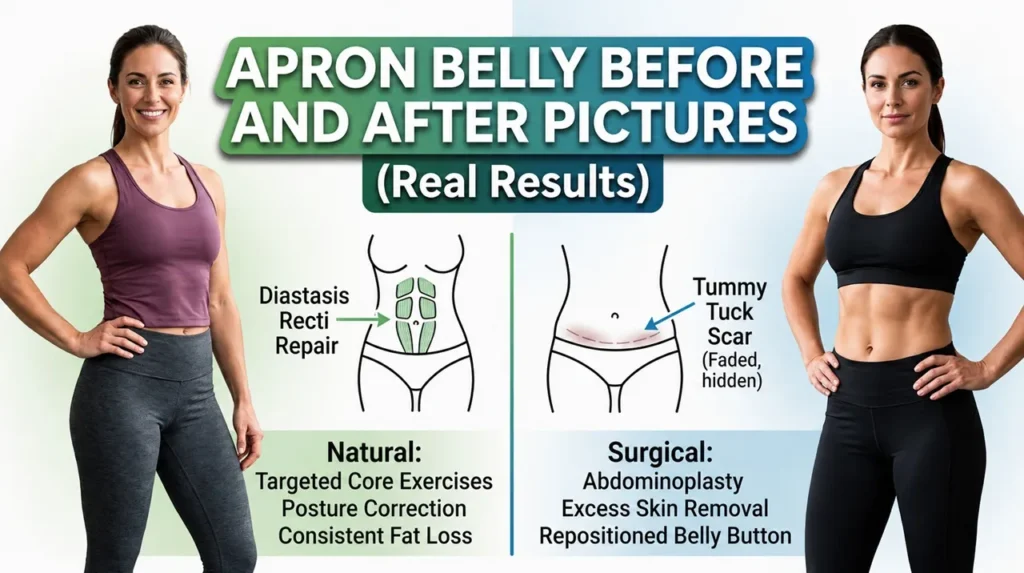
Apron belly before and after pictures usually show two kinds of change. Diet and exercise reduce the fat in the fold and improve core tone, but loose skin often remains. Surgery, such as a tummy tuck or panniculectomy, removes the excess skin and leaves a low hip-to-hip scar. Results depend on age, skin quality and weight stability.
Key takeaways
- Diet and exercise reduce fat in the fold, but cannot shrink heavily stretched skin.
- A tummy tuck removes excess skin and can repair diastasis recti.
- A panniculectomy removes the hanging apron but does not tighten the muscles.
- Tummy tuck scars usually fade to a faint white line over 12 to 18 months.
- Only compare photos taken with the same light, angle, posture and clothing.
Having a hanging stomach, or the medical term pannus or panniculus, can be physically uncomfortable and emotionally distressing. This additional amount of subcutaneous fat and loose skin can be the result of pregnancy and childbirth, a C-section, or massive weight loss, and it can leave individuals looking for genuine, authentic responses. To find inspiration, check out apron belly before and after pictures to get a realistic sense of how far you can go.
When looking for real life transformations, however, it’s important to look past heavily filtered, photoshopped images and focus on actual results. The time needed to achieve an apron belly reduction or elimination can vary greatly, depending on whether you choose a surgical or non-surgical approach. Although performing core strengthening exercises and adopting healthy lifestyle habits can make a world of difference for fat burning, in cases of severe skin laxity or stretched-out tummy muscles, medical intervention is necessary.
In this guide, the Apron Belly Team will explain what before and after results usually look like, compare weight reduction compared to surgical procedures such as an abdominoplasty (tummy tuck), and help you set realistic expectations for your own weight loss.
What Exactly is an Apron Belly (Pannus Abdomen)?
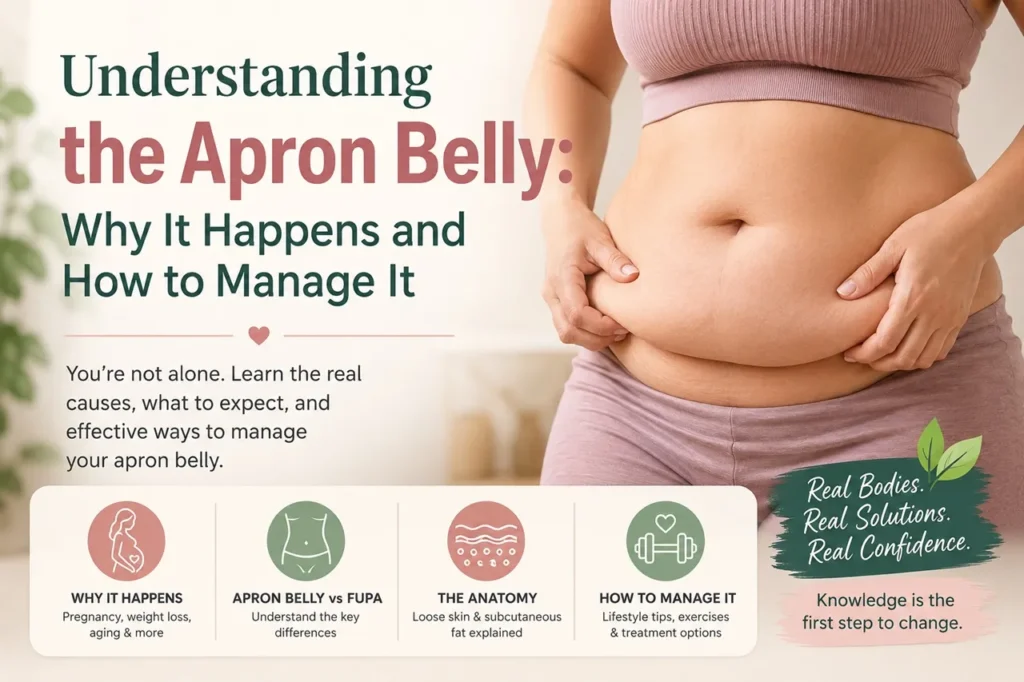
To appreciate the transformations, it is important to understand what initiates this particular condition. An apron belly is where the skin and fat in the lower abdomen hang over the pubic area like an apron. This isn’t because of weight gain; it’s because of less skin elasticity and floppy tummy muscles.
There are three main reasons for the formation of a hanging belly:
- Pregnancy & C-Sections: When you are pregnant, you are stretching the belly muscles. In many cases, it results in the separation of the left and right abdominal muscles, known as diastasis recti. The caesarean delivery scar may also develop a “shelf” effect, which results in the fat above the scar overhanging.
- Rapid weight loss: If you’ve lost a lot of weight in a short period of time, the fat cells shrivel, but the skin above may not come back into place because of the loss of skin elasticity.
- Visceral Fat vs Subcutaneous Fat: The visceral fat is the fat that surrounds the internal organs and deep within the abdomen, while the apron belly is primarily composed of subcutaneous fat, which is the type of fat that can be pinched and overstretched skin.
The first step to figuring out which transformation path (surgery or natural) is right for you is understanding the real cause of that apron belly.
Apron Belly Before and After: Natural Transformations (No Surgery)
Many individuals are wondering what they can do to get rid of a hanging tummy without having to see a surgeon. Yes, but with a big dollop of realism, when looking at the before and after pictures of the apron belly exercises. Natural transformations work really well for eliminating or toning down overall body fat and for tightening loose muscle, but they can only be used so much when it comes to completely stretched skin tissue.
1. Redefining the Core
Loss of fat from the bottom of the abdomen is impossible. But specific core strengthening exercises can help tighten the abdominal wall, thereby minimising the hang effect. In fact, the right (and only) way to get results is to focus on deep core stabilisation rather than traditional crunches, which place excessive pressure on the abdominal wall and can exacerbate diastasis recti.
- Deadbugs & Bird-Dogs: These exercises activate the transverse abdominis (TVA), the body’s natural corset.
- Pelvic Tilts: Great for recovery after childbirth, realigning the pelvis, and engaging the lower abdominal muscles.
- Planks and Side Planks: These strengthen the whole of the midsection in an isometric way, meaning that the spine is not strained.

2. Managing Subcutaneous Fat Loss
If you want to change your body composition, you need to focus on maintaining a caloric deficit, engaging in regular cardiovascular exercise, and doing strength training. As you lose weight, your body will start to use up the deep visceral fat and the softer subcutaneous fat.
The Reality Check: If your apron belly is mostly made of active fat cells, a natural transformation can be incredibly dramatic. However, if your apron is primarily empty, stretched-out skin left behind after drastic weight reduction, diet and exercise alone cannot shrink the excess tissue because the collagen fibres within the skin have completely broken down.

Apron Belly Before and After: Surgical Results
The real life transformations that surgical procedures can provide are the most radical, where there is extreme skin laxity, heavy tissue folds, or muscle separation following multiple pregnancies. Surgery before and after gallery images are usually from two completely different procedures.
1. Abdominoplasty (Tummy Tuck)
An abdominoplasty is the standard of a complete tummy makeover. This is the best procedure for those who wish to correct loose skin and separated muscles.
- The Process: The surgeon will make an incision through the lower abdomen, excise excess skin and subcutaneous fat, close the abdominal wall and repair the diastasis recti, and then redefine the umbilicus.
- The Results: Typical tummy tuck results show a smoother, flatter tummy. This helps to eliminate the shelf created by a C-section delivery and pulls the entire midsection in tight.

2. Panniculectomy
Unlike a tummy tuck, a panniculectomy is not a cosmetic procedure. It is functional.
- The Process: Only the excess “apron” or panniculus (fat and skin) dangling from under the pubic area is removed by the surgeon. It does not tighten the muscles beneath the abdomen or produce a very sculpted waistline.
- The Problem: This surgery is often performed after massive weight loss to relieve physical discomfort, chronic skin chafing, and hygiene problems caused by hanging skin that rubs against the lower body.

Real Apron Belly Stories: Four People, Four Different Outcomes
Photos only tell part of the story. These four people have spoken publicly about life with an apron belly or loose skin after weight loss. We have summarised each story in our own words and linked to the original source. Apron Belly has no connection to any of them.
Diet and exercise · Chesterfield, UK
Tara, 39: lost around 12 stone, then hit the loose skin wall
- Before: a hurtful comment from another parent in March 2024 made her decide to change.
- What she did: changed her diet from April 2024, joined a gym that September, swam, and added daily walking from January 2025.
- After: a much smaller body, but about 3 stone of loose skin on her stomach that hangs close to her knees. She wears control clothing every day and gets back pain.
- NHS: her funding request was turned down because her BMI was still above the local limit. She is fundraising for private surgery.
Source: Daily Mirror, via inkl
Weight-loss surgery · Cambridgeshire, UK
Wayne: lost 21 stone after a gastric sleeve
- Before: he weighed more than 35 stone and had a gastric sleeve on the NHS in June 2022.
- After: he reached about 14 stone, but was left with roughly 3 stone of loose skin that affected how he felt about his body.
- NHS: skin removal was refused because his case was not judged exceptional under local rules. He turned to crowdfunding for private surgery.
Source: Peterborough Today, August 2023
Diet, then panniculectomy · Arizona, USA
Richard: lost over 9 stone, then had the apron removed
- Before: after losing more than 130 lb (about 9 stone) through diet, his apron hung below his knees. It caused repeated rashes, and he wore oversized clothes to hide it.
- What he did: he raised it with a plastic surgeon during an unrelated hospital stay and had a panniculectomy once funding was approved on appeal.
- After: he described feeling lighter, moving more easily and no longer worrying about people staring.
Source: HonorHealth patient story
After pregnancy · First-person essay
Hannah: chose acceptance instead of a fix
- Before: she developed an apron belly after having and weaning her first child, and struggled with how her body had changed.
- What she did: rather than dieting or surgery, the artist drew her own body in her sketchbook.
- After: she now sees those drawings as a celebration of her body as it is.
What These Stories Show
- Weight loss shrinks the fat, not the skin. Tara, Wayne and Richard all lost a great deal of weight, and all three were left with loose skin.
- NHS funding is hard to get. BMI limits and “exceptional case” rules stopped both UK patients, even after huge weight loss. See our guide to apron belly surgery on the NHS.
- Surgery can change daily life. For Richard, removing the apron ended the rashes and made moving easier.
- Acceptance is a valid outcome too. Not everyone wants to change their body, and that is a choice worth respecting.
What to Look for in Real Transformation
If you’re looking for apron belly before and after photos, you might fall for dramatic before and afters. The key to setting realistic expectations is remembering these little details:
Scar Healing and Placement
The downside to surgical changes is an unsightly line from hip to hip. The scar will appear low in good results, so that it can be covered under underwear or swimwear. Examine the chronological progression of maturity for scar:
- Months 1 to 3: Deep pink/red, sometimes slightly raised.
- Months 6 to 12: The scar will begin to flatten and lighten.
- Months 12 to 18: It forms a light, faint white line which is easy to conceal.
The Belly Button Shape
One of the biggest clues to an unnatural surgical outcome is if the belly button is pulled or hooded. In a good result, the belly button fits naturally into the new tummy shape.
Posture and Lighting
In natural transformations, pay attention to how your lower belly immediately changes when you improve your posture (correct an anterior pelvic tilt). Make sure the lighting and angles are consistent in the before and after pictures so you can make an accurate comparison of improvement.

Illustration only. This image is an example, not a real patient result.
Apron Belly Before and After Weight Loss: What Usually Changes
Weight loss changes an apron belly in stages, and the order matters when you compare photos. Fat inside the fold shrinks first, so the overhang becomes lighter, softer and sits a little higher. Skin changes much more slowly. Once most of the fat has gone, whatever remains is largely stretched skin, and that part rarely shrinks back fully.
| Stage | What you may notice |
|---|---|
| First 4 to 8 weeks | Less bloating, looser waistbands, slightly lower weight on the scales |
| 2 to 6 months | A smaller waist measurement, a lighter fold and fewer rashes under it |
| 6 to 12 months | A visibly shallower overhang, better core strength and posture |
| Weight stable for 6 months or more | Remaining overhang is mostly loose skin; this is when surgery is usually discussed |
Rapid weight loss, including on GLP-1 medicines such as Wegovy or Mounjaro, often leaves more loose skin than slow loss, because the skin has less time to adapt. Age, sun damage, smoking and several pregnancies also reduce how much the skin can recover.
Slim people can see a different pattern. If your weight is already in a healthy range, your before and after photos may change more from posture work and deep core training than from further weight loss. Our guide to an apron belly on a skinny person explains why, and which fixes suit a small fold.
Signs of Progress Before the Photos Change
Many people give up because the mirror looks the same for weeks. However, real progress usually shows up in other ways first:
- Your waist measurement drops, even if the fold looks similar.
- Clothes fit differently, especially jeans and high-waisted knickers.
- The skin under the fold is calmer, with less sweating, chafing and redness.
- Your core feels stronger, so you can hold a plank or carry shopping more easily.
- Back ache and posture improve, which also lifts the lower belly visually.
- The fold feels lighter and softer when you lift it.
Track these every four weeks alongside your photos. Together they give a far more honest picture than a single dramatic image.
How to Judge Before and After Pictures Properly
Before and after pictures can motivate you, but they can also mislead. Use this checklist whenever you look at a transformation online or at a clinic:
- Same lighting and angle: harsh overhead light deepens shadows, while soft front light flattens the stomach.
- Same posture: slouching or tilting the pelvis forward makes an overhang look far larger than standing tall.
- Same clothing: high-waisted briefs or shapewear in the “after” photo can hide a great deal.
- Breathing in: check whether the stomach is relaxed in both photos.
- A stated time frame: results without dates are hard to trust.
- Side views as well as front views: the depth of the fold is easier to judge from the side.
- Signs of editing: warped backgrounds, unnaturally smooth skin or missing stretch marks suggest filters.
- Surgical results showing the scar: genuine tummy tuck photos usually show a scar and a reshaped belly button.
How to Take Your Own Progress Photos
Your own photos are only useful if they are consistent. Follow the same routine each time:
- Take them first thing in the morning, before eating or drinking.
- Stand in the same spot with the same light, ideally daylight from a window.
- Wear the same close-fitting underwear.
- Use a timer or tripod at waist height, rather than a mirror selfie.
- Take a front view, a side view and a relaxed seated view.
- Repeat every four weeks, not every day.
Keep your photos private and compare them only with your own earlier pictures. Other people’s results depend on genetics, age, the amount of loose skin and whether surgery was involved, so they are rarely a fair benchmark. For a practical plan to reduce the fold, see our guide on how to get rid of apron belly.
Comparing the Approaches: At a Glance
| Factor | Natural Transformation (Diet & Exercise) | Surgical Transformation (Tummy Tuck / Panniculectomy) |
| Primary Target | Subcutaneous and Visceral Fat Reduction | Excess Skin Removal and Muscle Repair |
| Muscle Correction | Strengthens and tones the deep core | Physically closes diastasis recti muscle gaps |
| Skin Elasticity Impact | Limited; cannot shrink heavily stretched tissue | Instantly removes loose hanging skin folds |
| Visible Scarring | None | Permanent hip-to-hip scar (hidden by underwear) |
| Recovery Time | None; gradual process over months/years | 4 to 8 weeks of physical downtime |
Frequently Asked Questions (FAQs)
Yes, when the apron is made up mainly of fat cells. Fat deposits can be reduced through a healthy diet and deep core exercises. If the apron skin is thin and low-elasticity, however, the only solution is to have the apron removed surgically.
A hanging or drooping belly button is usually caused by sagging skin right above it. While losing overall body fat can help, a surgical tummy tuck for a sagging stomach is the most effective way to tighten the skin and restore a youthful belly button shape.
An incision made in a caesarean section can form a tethered scar line. Fat stored above this scar will form a shelf or apron. This effect can be greatly diminished naturally through targeted massage therapy of the scar tissue, pelvic floor rehabilitation, and fat loss.
Conclusion
For those who prefer the natural route to losing fat and toning their stomach muscles, it will take some time, patience, and effort to get a flatter stomach. If you’re after a surgical tummy tuck (abdominoplasty), it will also take time, patience, and dedication. Well-documented before and after results show that clear improvement is possible. Evaluate your current body composition, seek expert advice, and select the route that best suits your health and lifestyle.
Disclaimer: The information in this article is for educational purposes only. The images are illustrations and examples, not real patient results. Always consult your GP or a consultant plastic surgeon on the GMC Specialist Register before starting a new exercise regimen or undergoing medical procedures.