
Quick Answer
Resistance band exercises for belly fat work by building muscle across your whole body, not by burning fat from the tummy itself. Aim for 2 to 3 sessions a week of moves such as band rows, chest presses and Pallof presses, doing 8 to 12 slow repetitions for 2 to 3 sets. Pair them with walking and a modest calorie deficit to shrink the fatty part of an apron belly.
- Bands are cheap, quiet and fit any living room
- Most moves can be done standing or seated
- Results come from overall fat loss, not spot reduction
Resistance band exercises for belly fat and core strength are one of the simplest ways to start strength training at home. A set of bands costs far less than a gym membership, takes up no space and lets you train standing or sitting, which matters if an apron belly makes floor work or bending uncomfortable. This guide explains what bands can and cannot do for an apron belly, how to choose one, eight beginner moves with clear steps, and a simple weekly plan.
This article is part of our belly exercises hub. If you are new to strength work, our strength training for apron belly guide explains why muscle matters, and this page shows how to do the same job with a band at home.
Can Resistance Band Exercises for Belly Fat Help an Apron Belly?
Yes, as part of a wider plan, but they will not remove belly fat on their own.
What bands can and cannot do
No exercise can burn fat from one chosen area. Our guide to apron belly myths explains why spot reduction does not work. What bands do well is build and keep muscle in your legs, back, chest, arms and core. A stronger trunk can make it easier to carry and support a heavy fold.
How bands fit the NHS guidelines
The NHS physical activity guidelines advise adults to do strengthening activities that work all the major muscle groups on at least 2 days a week, and they name working with resistance bands as one example. The same guidance recommends at least 150 minutes of moderate activity, such as brisk walking, each week. Band sessions cover the strength part, and walking covers the rest.
Where the fat and the skin come in
An apron belly is usually a mix of fat and loose, stretched skin. Exercise and a calorie deficit can shrink the fat, but they cannot tighten skin that has lost its stretch. Our guide to apron belly fat vs loose skin helps you work out which you have, so your expectations are realistic.
Choosing the Right Resistance Band
Bands come in several shapes.
Types of band
| Band type | What it looks like | Best for |
|---|---|---|
| Long flat band | A wide strip of latex, open at both ends | Rows, presses and stretches; can be looped or tied |
| Tube band with handles | A rubber tube with a handle at each end | Standing rows, presses and chops; easy to grip |
| Mini loop band | A small closed loop | Leg moves such as sit to stand and bridges |
Resistance levels and colours
Most brands use colours to show strength, from light to heavy, but there is no single standard, so the same colour can mean different things from different makers. Check the guide that comes with the set. Start with a band you can pull for 8 to 12 smooth repetitions without your form breaking down.
Safety checks before each session
- look along the band for nicks, tears or sticky patches, and replace it if you find any
- if you anchor the band to a door, use a proper door anchor and close the door towards you
- keep the band away from your face and pull it in a controlled line
- if you have a latex allergy, choose latex free or fabric bands
Before You Start: Reps, Sets and Form
Warm up first
Spend five minutes marching on the spot and rolling your shoulders before you pick up the band.
How many reps and sets
The NHS suggests doing 8 to 12 repetitions of each exercise, which counts as one set, and building to at least 2 sets, or 3 for more benefit. Each set should feel hard by the last couple of repetitions. Start gradually and build up over several weeks.
Breathing and posture with an apron belly
Breathe out as you pull or push the band, and breathe in as you return. Do not hold your breath, because straining raises pressure in the tummy. Stand tall with your ribs stacked over your hips. If the fold moves or rubs during exercise, high waisted leggings or a support garment can hold it steady. Our standing exercises for apron belly guide has more tips for training without floor work.
8 Resistance Band Exercises for Apron Belly
All eight moves can be done at home in a small space.

1. Standing band row
- Anchor the band at chest height in a closed door, or loop it around a sturdy post.
- Hold one end in each hand and step back until the band is slightly tight.
- Pull your elbows back past your ribs, squeezing your shoulder blades together.
- Return slowly, or do it seated with the band around your feet.
2. Chest press
- Wrap the band around your upper back, under your arms, holding an end in each hand.
- Start with your hands beside your chest.
- Push both hands forward until your arms are nearly straight, then return slowly.
3. Pallof press
This is one of the best band moves for the deep core, because your trunk has to resist the band pulling you sideways.
- Anchor the band at chest height and stand side on to the anchor.
- Hold the band with both hands at the centre of your chest.
- Press your hands straight out in front, hold for two seconds without letting your body twist, then bring them back.
- Do all your repetitions, then turn round and repeat on the other side.
4. Band pull apart
- Hold the band in front of your chest with your hands shoulder width apart.
- Keeping your arms long, pull the band apart until it touches your chest.
- Return slowly. Use a lighter band for this move.
5. Sit to stand with a loop band
- Place a mini loop band just above your knees and sit near the front of a firm chair.
- Keep your knees pushed gently out against the band.
- Stand up, using your hands on your thighs if you need to, then sit down slowly.
6. Glute bridge
- Lie on your back on a firm bed or mat with a loop band above your knees and your feet flat.
- Press through your heels and lift your hips until your body forms a straight line from shoulders to knees.
- Lower slowly. Skip this move if lying flat is uncomfortable, and do extra sit to stands instead.
7. Low to high chop
- Anchor the band low, near the bottom of a door, and stand side on to it.
- Hold the band with both hands near the outside of your knee on the anchor side.
- Pull it diagonally up and across your body to finish above the opposite shoulder, turning through your trunk and pivoting your back foot.
- Return slowly and repeat on the other side.
8. Overhead press
- Stand on the middle of the band with your feet hip width apart.
- Hold an end in each hand at shoulder height.
- Press up until your arms are nearly straight, keeping your ribs down, then lower slowly.
- Do this seated if you have shoulder problems, and stop if it causes pain.
A Simple Weekly Resistance Band Plan
Spread your band sessions across the week and add walking on the days between. If you already follow our apron belly workout plan, you can swap its strength days for these band circuits.
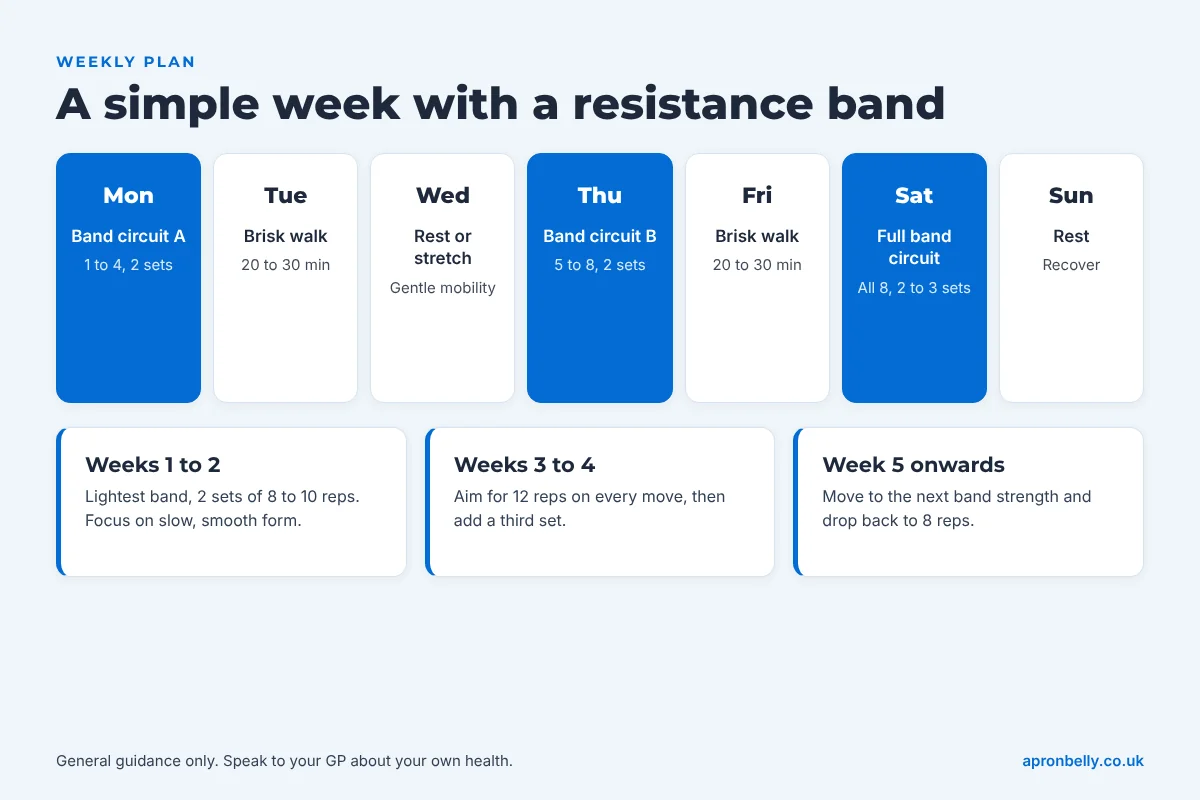
Circuit A and circuit B
| Day | Session | What to do |
|---|---|---|
| Monday | Band circuit A | Moves 1 to 4, 2 sets of 8 to 12 reps |
| Tuesday | Brisk walk | 20 to 30 minutes |
| Wednesday | Rest | Gentle stretching if you like |
| Thursday | Band circuit B | Moves 5 to 8, 2 sets of 8 to 12 reps |
| Friday | Brisk walk | 20 to 30 minutes |
| Saturday | Full circuit | All 8 moves, 2 to 3 sets |
| Sunday | Rest | Recover |
How to progress
For the first two weeks, use the lightest band and aim for 2 sets of 8 to 10 repetitions with slow, smooth form. Once you can manage 12 repetitions on every move, add a third set. When three sets of 12 feel easy, move up to the next band strength and drop back to 8 repetitions.
Pair it with your eating plan
Band work keeps your muscle, but fat loss comes from eating a little less energy than you use. Our guide to the calorie deficit for apron belly shows how to set a safe target, and our best way to get rid of apron belly guide puts diet, exercise and treatment together by grade.
A Worked Example
A 52 year old woman with a grade 2 apron belly finds floor exercises hard because the fold presses on her when she bends. She buys tube bands and a loop band. For the first fortnight she does circuit A on Mondays and circuit B on Thursdays with the lightest band, plus two 20 minute walks. By week four she manages three sets of 12 on most moves and moves up a band for rows and chest presses. Alongside a modest calorie deficit, she notices her trousers fit more loosely around the waist after a few months, and carrying shopping feels easier.
What she changed along the way
- she swapped the glute bridge for extra sit to stands on days when lying down felt uncomfortable
- she wore high waisted leggings to stop the fold moving during chops
Staying Safe and Knowing When to Stop
When to check with your GP first
Speak to your GP or practice nurse before starting if you have a heart or lung condition, high blood pressure that is not well controlled, a hernia, or you have had recent surgery or a recent birth. If you think you may have a bulge that comes and goes, our guide to apron belly or hernia explains the signs.
Stop and get help if
- you feel chest pain, tightness or unusual breathlessness
- you feel dizzy or faint
- you notice a new bulge or sharp pain in your tummy or groin
- a joint becomes painful rather than just tired
Frequently Asked Questions
Do resistance band exercises get rid of belly fat?
Not on their own. No exercise burns fat from one chosen spot. Resistance band exercises build muscle across your body, and together with a calorie deficit and regular walking they help you lose fat overall, which is what shrinks the fatty part of an apron belly.
How often should I do resistance band exercises?
The NHS advises strengthening activities that work all the major muscle groups on at least 2 days a week. Two or three band sessions a week, with a rest day between them, is a sensible target for most beginners.
What resistance band should a beginner buy?
A set of long flat bands or tube bands with handles in two or three strengths is the most flexible choice, plus a small loop band for leg moves. Start with the lightest band you can use for 8 to 12 smooth repetitions, and check the maker’s guide, because colours and strengths differ between brands.
Can I do resistance band exercises with a large apron belly?
Yes. Most band moves can be done standing or seated, so you do not need to get down on the floor or bend forward over the fold. Choose positions that feel comfortable, support the fold with high waisted leggings if it moves, and ask your GP first if you have a hernia or a heart condition.
How long before I see results from resistance band training?
Most people notice they feel stronger and that everyday tasks are easier within a few weeks of regular sessions. Visible change in an apron belly depends on overall fat loss, so it usually takes months, and loose skin may stay even after the fat reduces.
The Bottom Line
Resistance band exercises for belly fat work best as one part of a plan. They build muscle across your body cheaply and safely at home, and most moves can be done standing or seated, which suits an apron belly. Aim for at least 2 sessions a week, 8 to 12 slow repetitions per set, and combine them with walking and a modest calorie deficit. For more home routines, see our guide on how to get rid of apron belly without crunches.
Your next step
Pick up a light set of bands, try circuit A this week and write down how many repetitions you manage. Small, steady progress is what changes how you feel and, over time, how your belly looks.
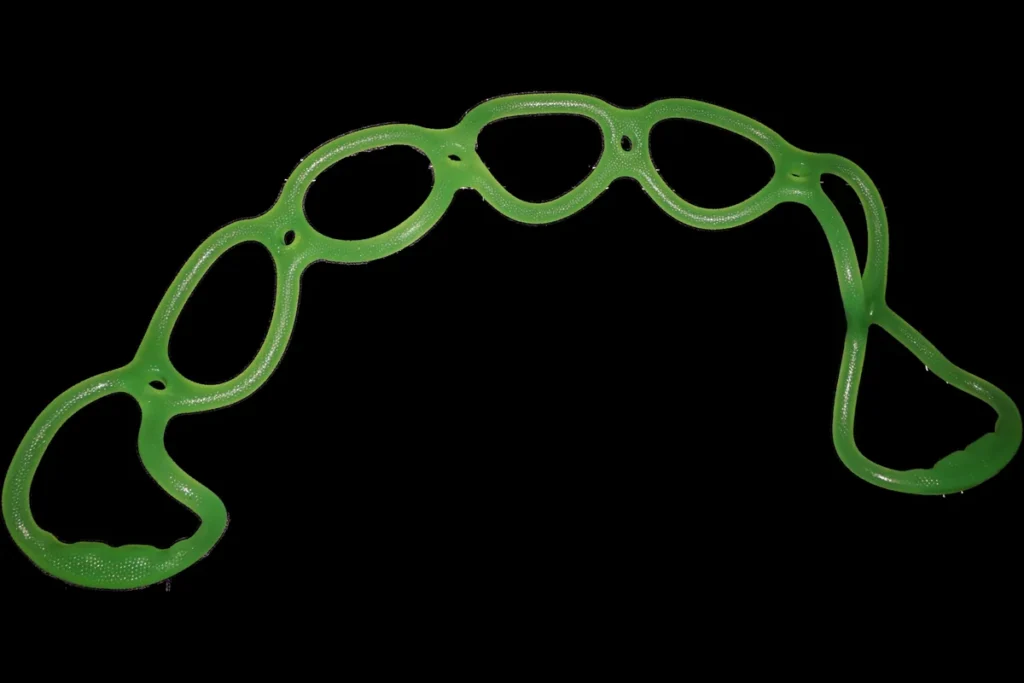
Featured image: strength band by Tiia Monto, Wikimedia Commons, CC BY-SA 4.0, padded.