
You carried two babies at once. Your body stretched further than most people ever realise, and it did the job without a rulebook. Now the newborn fog is slowly lifting, and you’re looking at a stomach that doesn’t match the one you remember. A soft fold hangs below your belly button. Your clothes sit differently. Maybe you avoid the mirror, or maybe you stare at it far too often.
If that sounds familiar, you’re far from alone, and nothing about it means you did something wrong. An apron belly after twins is one of the most common physical changes after a multiple pregnancy, yet very few people talk about it honestly. This guide explains why it happens, what you can realistically change, and when it makes sense to explore other options.
If you’re new to the topic, our apron belly overview is a good place to start. If your twins arrived by caesarean, which is common with multiple births, our guide on apron belly after a C-section covers the recovery side in more detail, because the two experiences often overlap.
Why Twins Change Your Stomach More Than a Single Pregnancy
A single pregnancy stretches your abdomen a lot. Twins stretch it further, faster, and often for longer. Your uterus grows larger to hold two babies, two placentas, and extra fluid. Your abdominal wall has to expand to make room, and your skin has to follow.
Three things usually happen at the same time.
First, your skin stretches past its limit. Skin copes well with gradual change. Rapid, large expansion can overwhelm its elastic fibres, and some of them never fully recover. That’s why the skin on your lower tummy may feel loose, crepey, or soft even after the babies arrive.
Second, your abdominal muscles separate. The two halves of your rectus abdominis muscle run down the front of your stomach, joined by a thin band of connective tissue. As your bump grows, that band stretches and thins. Doctors call this diastasis recti. MedlinePlus, the health information service of the US National Library of Medicine, says the risk is higher with multiple births or many pregnancies. It also notes that pregnancy-related diastasis recti often lasts long after birth.
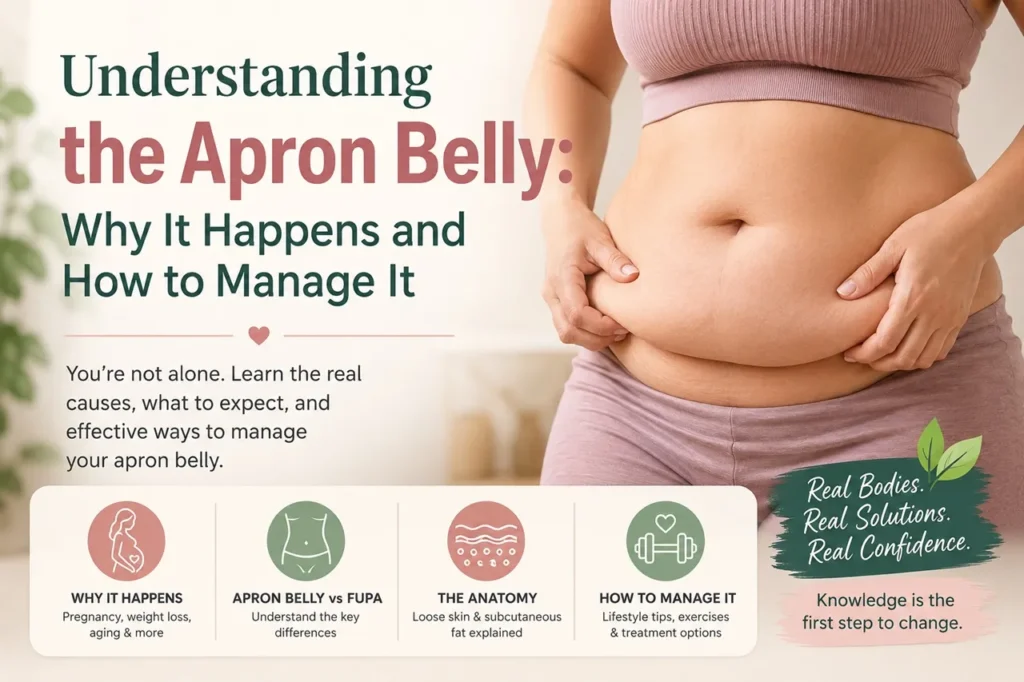
Third, your tissue sits differently. Weaker muscles give your organs and soft tissue less support, so your lower tummy can push forward and hang over. That fold is what people call an apron belly, and doctors call a panniculus.
What Is an Overhang After a Multiple Pregnancy?
An overhang after a multiple pregnancy is the fold of loose skin and soft tissue that droops over your lower abdomen. For some women it sits just below the belly button. For others it hangs lower and covers a caesarean scar.
Here’s something that surprises many mums: this has little to do with how much weight you gained. Two women can gain the same amount, and one ends up with a smooth stomach while the other has an overhang. Genetics, skin elasticity, the size of your babies, and how quickly your belly grew all play a part. Twin pregnancies tend to push several of those factors to the extreme at once.
So if you’re at a healthy weight and still have a stubborn fold, your body isn’t playing tricks on you. You’re dealing with stretched skin and separated muscles, which diet alone can’t solve.
Please Don’t Call It a Failure
Many twin mums tell the same story. People say, “At least you have two healthy babies.” That’s true, and it’s also not the whole picture. You can feel deeply grateful and still feel upset about your body. Both feelings belong together.
Think about what your body just did. It grew two people. Then it recovered from birth while you fed, soothed, and changed two newborns on very little sleep. You didn’t have time for workouts, and you shouldn’t have been rushing into them anyway.
A change in your stomach after twins isn’t a sign of laziness, poor discipline, or “letting yourself go”. It’s a normal physical result of an extraordinary pregnancy. Start from that point, and everything else gets easier.
How Long Should You Wait Before Judging Your Results?
Patience feels impossible when you’re exhausted and self-conscious. Still, your body needs real time. The first six to twelve weeks focus on healing. Your uterus shrinks, your hormones settle, and any incision knits together.
After that, change continues slowly. Many women notice their stomach tightening gradually over six to twelve months, particularly if they breastfeed, stay active, and sleep when they can. Some swelling and puffiness fades. Some muscle tone returns.
MedlinePlus notes that diastasis recti heals on its own in some cases, but often lasts long after birth. So give your body a fair chance before you decide what you’re dealing with. A good rule is to wait at least six months to a year after delivery before judging how much of your overhang is permanent.
How to Check for Diastasis Recti After Twins
Because twin pregnancies carry a higher risk of muscle separation, it’s worth checking your stomach once your doctor has cleared you for gentle movement. You can try this simple test at home.
Lie on your back with your knees bent and feet flat. Lift your head and shoulders slightly, as if starting a gentle crunch. Use your fingertips to feel along the midline above and below your belly button. Notice how many finger-widths fit into the gap, and whether the area bulges or domes upward.
A gap of one to two finger-widths is common in the early weeks. A wider gap, or doming that doesn’t improve, is worth mentioning to your GP or health visitor. Ask for a referral to a women’s health physiotherapist. They can assess your muscles properly and give you exercises tailored to your body. A self-check is useful, but a professional opinion is better.
What Helps: Rebuilding Your Core Gently
Once you have medical clearance, start with the deep core muscles instead of traditional ab exercises. Crunches and sit-ups can push a separated gap wider, so they’re best avoided for now.
Begin with diaphragmatic breathing. Lie down, place a hand on your belly, and breathe deeply so your stomach rises. This reconnects your deep core without any strain. Add gentle pelvic floor squeezes, which support your core and bladder together. Short, easy walks help too, especially when you push the pram.
After a few weeks, you can add pelvic tilts, heel slides, and bird-dogs. Move slowly and stop if you notice doming along your midline. Our belly exercises guide walks through a beginner-friendly routine that builds strength safely, without overloading a healing core.
Keep your expectations realistic, too. Exercise can strengthen your muscles, improve your posture, and reduce the fat sitting within the overhang. It can’t shrink stretched skin. Many twin mums find that their core feels far stronger and their stomach looks flatter, yet a fold of loose skin remains. That’s not a sign you’re doing it wrong. It’s simply the limit of what movement can change.
Looking After Your Skin
Stretched skin deserves kindness, even if it won’t snap back completely. A few habits support skin health and comfort.
Eat enough protein, since your skin and muscles both need it to repair. Drink water throughout the day. Protect your tummy from strong sun, because stretched skin and scars burn easily and can darken. Moisturise regularly, not because creams remove stretch marks, but because soft, well-cared-for skin feels more comfortable and less itchy.
Be wary of products that promise to erase stretch marks or tighten loose skin. No cream, wrap, or supplement reverses significant skin laxity. Our Belly Skin guide explains what genuinely supports skin elasticity and what’s just clever marketing.
If the fold rubs when you walk or sweats in warm weather, keep the area clean and completely dry, and choose breathable cotton. Irritation that doesn’t clear up deserves a visit to your GP.
Everyday Comfort Matters Too
Some women find a supportive high-waisted garment helpful for comfort and posture during the early months. Others hate anything tight. Neither choice is wrong. Just remember that a support garment holds your tummy in place temporarily. It doesn’t rebuild your muscles or change your skin.
Pay attention to your back, as well. A weaker core and a heavier front can strain your lower back, particularly when you lift two babies and two car seats every day. Bend your knees, keep loads close to your body, and ask for help when you can.
When Surgery Enters the Conversation
Some women do everything right and still live with a significant overhang. They rebuild their core, reach a stable weight, care for their skin, and wait a full year or more. If the fold still bothers them, or causes irritation, discomfort, or a loss of confidence, it’s reasonable to explore surgical options.
A tummy tuck removes excess skin and fat and can tighten separated muscles. A smaller procedure called a panniculectomy removes the hanging fold without tightening the muscles. Each suits different situations, and only a qualified surgeon can advise you.
Timing matters a great deal after twins. Most surgeons advise waiting until your weight has settled, you’ve finished having children, and your body has had a year or so to recover. Another pregnancy can undo surgical results, so it’s wise to hold off if you might have more children. Recovery also takes weeks, and with two little ones at home, you’ll need solid practical help.
Cost and funding deserve honesty, too. The NHS generally treats a tummy tuck as cosmetic surgery and doesn’t usually offer it. Some areas make exceptions for specific medical cases, so ask your GP what applies where you live. If you’d like a clearer picture of what the operation involves, our tummy tuck guide explains the procedure and what to consider before booking a consultation.
The Bottom Line
An apron belly after twins happens because your body stretched further than it was designed to stretch in a single pregnancy. Your skin lost elasticity, your muscles separated, and your tissue lost some of its support. None of that reflects your effort or your worth.
Give yourself time to heal. Check your core, rebuild gently, and look after your skin. If a fold remains after a year of patient effort, you have options, and you can explore them calmly when the time is right. Until then, be as kind to your body as you’d be to a friend who just grew twins.
Frequently Asked Questions
Is an apron belly after twins normal?
Yes. Twin pregnancies stretch the skin and abdominal muscles more than a single pregnancy, so loose skin and muscle separation are very common afterwards. It doesn’t mean you did anything wrong.
Will my apron belly go away on its own after a multiple pregnancy?
It may improve in the first year as swelling fades and muscles regain some tone. Stretched skin often stays loose, though, so many women keep some degree of overhang even after steady exercise and a healthy weight.
When can I start exercising after having twins?
Wait until your GP or midwife clears you, usually at your six to eight week check. After a caesarean, which is common with twins, you may need longer. Start with breathing, pelvic floor work, and gentle walking before anything more demanding.
Can exercise fix an overhang after a multiple pregnancy?
Exercise can rebuild your deep core, improve posture, and reduce the fat within the overhang. It can’t remove stretched skin, so a visible fold may remain even when your muscles feel strong.
When can I have a tummy tuck after twins?
Most surgeons recommend waiting until your weight is stable, you’ve finished having children, and your body has recovered for roughly a year. Book a consultation with a registered surgeon, and ask your GP about your options.