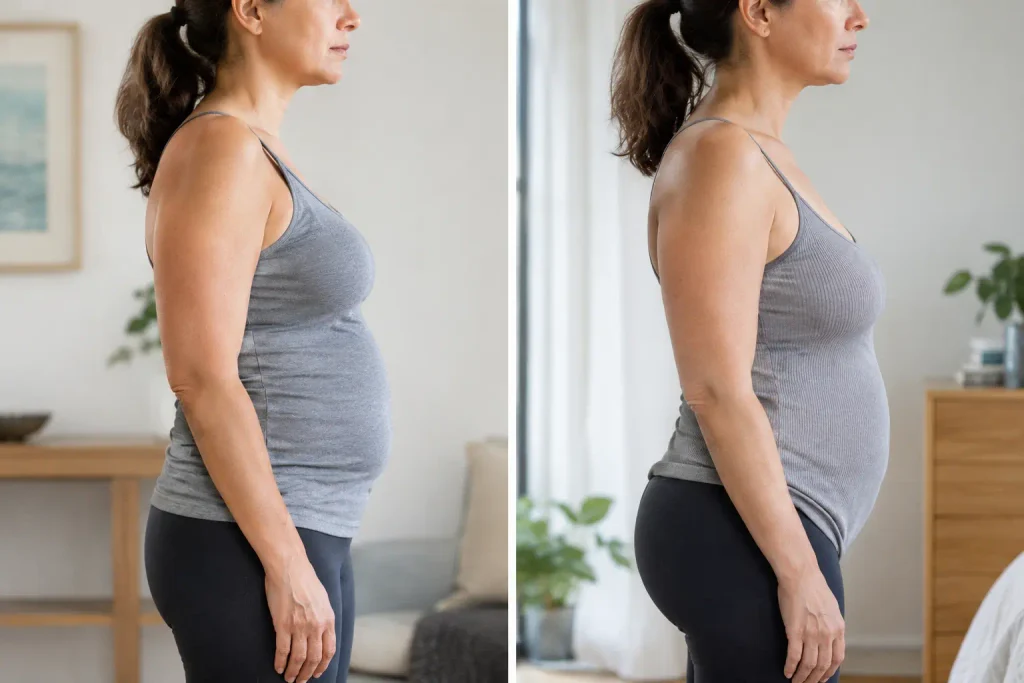
Something shifted, and you can’t quite explain it. Your weight hasn’t changed much, maybe not at all, yet your stomach looks different than it did five years ago. You eat the same way. You still move. So why does my stomach look different after menopause, and is what you’re seeing actually new, or is it an older issue that menopause has simply made more obvious?
This question comes up constantly for women in their 40s and 50s, and it deserves a straight answer. Menopause belly vs apron belly isn’t just two different names for the same thing. They’re genuinely different conditions, sometimes with overlapping causes, and the right approach depends on telling them apart. Our menopause apron belly guide covers the hormonal side of this change in more depth. This article focuses on how to tell that hormonal shift apart from a true apron belly, and what to do about each one.
What Is Menopause Belly?
Menopause belly describes the shift in fat storage that happens as oestrogen levels drop during perimenopause and menopause. Before this stage, oestrogen tends to direct fat toward your hips and thighs. As oestrogen falls, fat storage shifts toward your abdomen instead, even if your total body weight barely moves.
Mayo Clinic research confirms this shift happens at a cellular level. Falling oestrogen activates certain proteins that make fat cells more efficient at storing fat, and this effect concentrates specifically around the midsection rather than spreading evenly across the body. That’s why so many women notice a rounder stomach during their 40s and 50s, even when their clothes still fit everywhere else.
Menopause belly causes go beyond hormones alone. Muscle mass naturally declines with age, and since muscle burns more calories than fat, a slower metabolism makes abdominal fat easier to gain and harder to lose. Sleep disruption from night sweats and hot flashes raises cortisol, a stress hormone that further encourages fat storage around your middle. Genetics play a role too, influencing how much of this shift you personally experience.
What Is an Apron Belly?
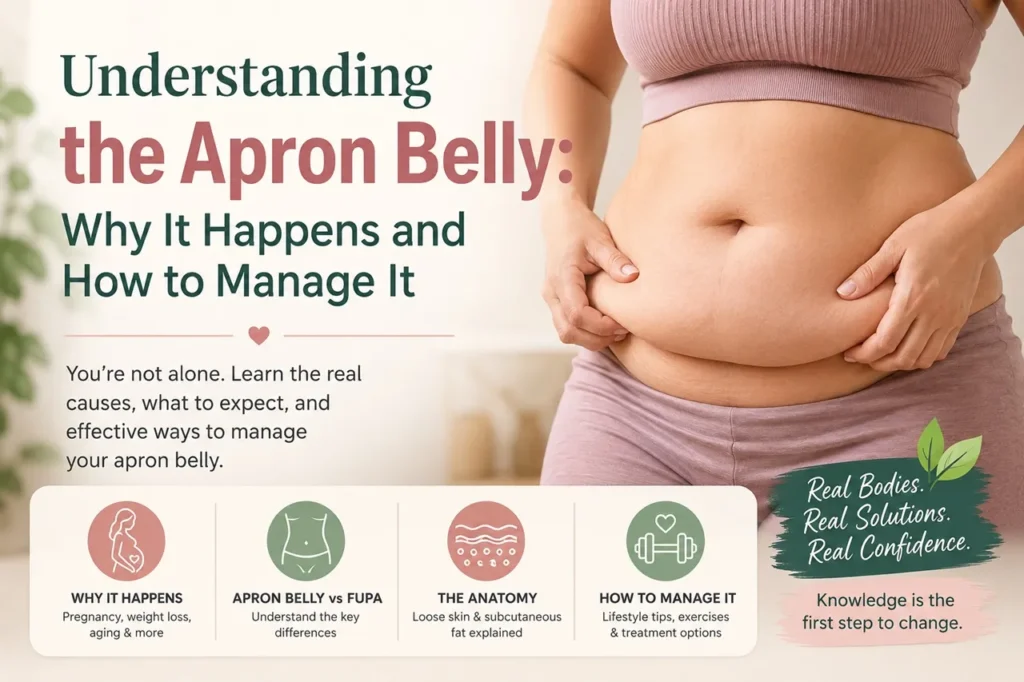
An apron belly, medically called a panniculus, is a different condition altogether. It’s a fold of loose skin and fatty tissue that hangs down over the lower abdomen, often linked to pregnancy, a caesarean section, or major weight loss earlier in life.
Unlike menopause belly, an apron belly usually involves structural changes beyond fat storage. Skin that has stretched during pregnancy or major weight changes can lose its elasticity permanently, and it doesn’t tighten again just because fat storage patterns change later in life. Many women with an apron belly also have diastasis recti, a separation of the abdominal muscles that weakens core support and makes the area look more pronounced.
Here’s where things get interesting after 40. Natural ageing also reduces skin elasticity, through declining collagen production. That means a woman who had a mild, barely noticeable apron belly in her 30s might find it looks considerably more obvious in her 50s, not because the underlying tissue changed, but because her skin’s ability to hold everything in has weakened with age. Our guide to tightening apron belly skin without surgery explains what supports skin elasticity and what does not.
How the Two Conditions Overlap After 40
This is the part most articles miss. Menopause belly and an apron belly aren’t mutually exclusive, and for many women past 40, both are happening simultaneously.
Picture a woman who had a C-section in her 30s and has carried a mild apron belly ever since. She barely noticed it for years. Then she enters perimenopause, and suddenly her midsection looks noticeably larger. What changed? Her apron belly didn’t necessarily get worse on its own. Instead, new hormonal fat storage added itself directly on top of an existing structural issue, while declining skin elasticity made the overall area look looser than before.
This overlap explains why so many women feel like their body changed overnight during midlife, when really, two separate processes converged at the same time.
Menopause Belly vs Apron Belly: How to Tell Them Apart
A few practical checks help clarify which condition, or combination, you’re dealing with.
Consider your timeline first. If your stomach changed gradually over the past few years without any major weight change, menopause belly is the likely driver. If you’ve had an apron belly since pregnancy or a major weight loss years ago, that structural element has probably been present all along, with menopause simply adding fat on top of it.
Check the shape and texture next. Menopause belly tends to feel like an even, soft layer across your midsection, similar to how fat accumulates anywhere else. An apron belly feels different: looser, foldable, sometimes hanging rather than sitting as one consistent layer.
Look for a midline gap as well. Press along the centre of your stomach above and below your belly button. A gap wider than two finger-widths suggests diastasis recti, which points toward an apron belly component rather than menopause-related fat alone.
Finally, think about your history honestly. Pregnancy, a C-section, or major weight loss earlier in life all raise the likelihood that structural factors are contributing, on top of whatever menopause is now adding.
What Actually Helps Menopause Belly
Because menopause belly is driven mainly by hormones and metabolism, the most effective strategies target those specific mechanisms. For a step-by-step plan, see our guide on how to lose a menopause apron belly.
Strength training matters more during this stage of life than almost any other intervention. Building and maintaining muscle mass counteracts the metabolic slowdown that comes with age, and more muscle means your body burns more calories even at rest.
Protein intake becomes more important too, since it supports the muscle you’re working to maintain and keeps you fuller for longer, which helps manage the calorie balance that influences fat storage.
Sleep deserves real attention, even though hot flashes make it harder to come by. Poor sleep raises cortisol and disrupts the hormones that regulate hunger, which can undo otherwise solid diet and exercise efforts.
Some women also discuss hormone replacement therapy with their doctor. Mayo Clinic notes that researchers are still studying whether hormone therapy meaningfully affects menopausal weight gain, so this is a conversation to have with a GP rather than a guaranteed fix.
What Actually Helps an Apron Belly
Because an apron belly often involves skin and sometimes muscle separation, it needs a different combination of strategies.
Deep core rehabilitation targets any diastasis recti directly, using gentle, staged exercises rather than traditional crunches, which can worsen a separation if attempted too early. Our apron belly exercises guide walks through a beginner-friendly routine suited to this.
General fat loss still helps here too, since reducing the fat component within the overhanging tissue makes any remaining loose skin considerably less prominent, even though it won’t disappear completely.
Supporting skin health through adequate protein, hydration, and collagen-friendly nutrients can help at the margins, though it’s worth being realistic that marked skin laxity often needs more than lifestyle changes alone to resolve fully.
When Surgery or Professional Support Makes Sense
If your apron belly involves a large amount of loose skin that doesn’t respond to fat loss and core work, that’s a reasonable point to discuss options like a panniculectomy or tummy tuck with your GP or a surgeon. This is especially worth considering if the fold causes skin irritation, rashes, or ongoing back discomfort.
If menopause belly is your main concern and basic lifestyle changes haven’t moved the needle after several months, a GP appointment can rule out thyroid issues or other factors, and open a conversation about whether hormone therapy is appropriate for you specifically.
In a Nutshell
Your stomach changing after 40 doesn’t mean something is wrong with you, and it doesn’t mean your previous efforts failed. Menopause belly comes from a real hormonal shift that redirects fat storage toward your midsection, regardless of how consistent your habits are. An apron belly, where present, is a separate structural issue involving skin and sometimes muscle, often dating back to pregnancy or earlier weight changes. For many women past 40, both are happening together, and recognising that gives you a much clearer path forward than trying one generic fix and wondering why it only half worked.
Frequently Asked Questions
Can hormone replacement therapy get rid of menopause belly?
Hormone therapy may help with some menopause symptoms, but Mayo Clinic notes that its effect on weight gain specifically is still being studied. It’s worth discussing with your GP rather than relying on it as a guaranteed solution.
Will my apron belly get worse during menopause even if my weight stays the same?
It can look more pronounced, since declining skin elasticity and new abdominal fat storage can both add to the appearance, even without a large weight change.
Is it normal to develop diastasis recti later in life, not just after pregnancy?
Diastasis recti is most commonly linked to pregnancy, but weakened core muscles and ageing-related changes in connective tissue can make an existing separation more noticeable over time.
Does exercise help menopause belly as much as it helped in my 30s?
Exercise still helps, but the type matters more now. Strength training becomes especially important after 40, since it directly counters the muscle loss that slows your metabolism during this stage of life.
How do I know if I should see a doctor about my stomach changes?
See a GP if you notice a midline gap wider than two to three finger-widths, if you have persistent back pain, or if your weight gain feels sudden or unexplained rather than gradual.