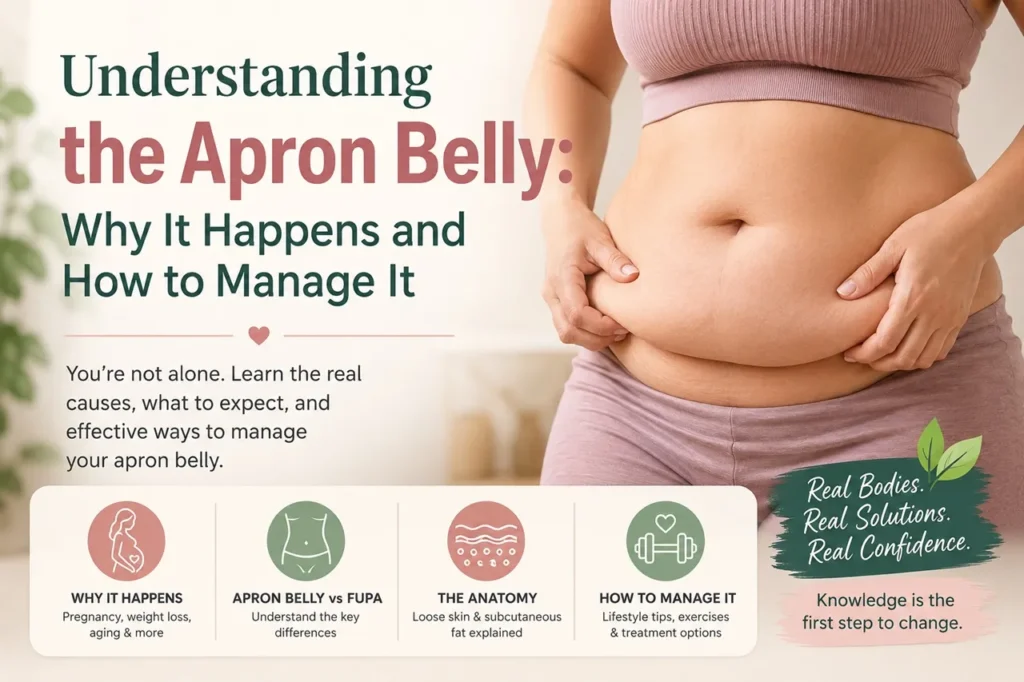
An apron belly on a skinny person surprises a lot of people. You eat well, your arms and legs are slim, your BMI sits in the healthy range, and yet a soft fold still hangs over your lower tummy. It can feel unfair and confusing. The good news is that there is usually a clear reason, and once you know which one applies to you, it becomes much easier to choose what actually helps.
This guide explains why a slim person can develop an apron belly, how to tell whether yours is skin, fat, muscle or posture, and which fixes are worth your time.
Can You Really Have an Apron Belly When You Are Thin?
Yes. An apron belly, or panniculus, is simply tissue that hangs down from the lower abdomen. Most people link it with higher body weight, and that is the most common cause. But a smaller apron can appear at any size, because the lower tummy stores fat and loses skin tone in a different way from the rest of the body.
In slim people the fold is usually small, often what we would call a Grade 1 on the apron belly grades scale. It might only cover the top of your knickers, or only appear when you sit down or bend forward. Our guide to a small apron belly shows what this early stage looks like.
The Five Most Common Causes in Slim People
1. Loose skin after pregnancy
Pregnancy is the most common reason a slim woman has an apron belly. The skin over the bump stretches a long way. Once the baby arrives, the womb shrinks, but the skin does not always follow. Skin elasticity depends on two proteins, collagen and elastin. If the fibres were stretched too far, or you have had several pregnancies close together, the skin may stay slightly loose and fold over the scar line or pubic area.
2. Loose skin after weight loss
If you are slim now but carried more weight in the past, the apron may be leftover skin. Fast weight loss, including with weight loss injections, gives skin less time to adapt. Our guide to an apron belly after weight loss covers this in detail.
3. Stubborn lower belly fat
Your body decides where to store fat, and genetics play a large part in that pattern. Many women store subcutaneous fat, the soft layer just under the skin, low on the tummy and over the mons pubis. This can happen even at a healthy weight. Two thin sheets of connective tissue, Camper’s fascia and Scarpa’s fascia, hold this lower fat in layers. When the fat pad sits below a natural skin crease, it can hang slightly and look like a small apron or a FUPA. Our apron belly vs FUPA guide explains the difference.
4. Diastasis recti
The rectus abdominis is the long “six pack” muscle that runs down the front of the tummy. During pregnancy its two halves can separate. If the gap stays open, the belly pushes forward, especially low down, even when you have very little fat. Combined with a bit of loose skin, this creates a pooch that folds over. NHS physiotherapy teams, such as Leeds Teaching Hospitals, note that up to one third of women still have some separation 12 months after birth.
5. Posture and anterior pelvic tilt
Anterior pelvic tilt means the front of your pelvis tips forward and your lower back arches more. It is common in people who sit for long hours. This posture pushes the lower tummy out and folds the skin at the bottom. The fold often looks much smaller when you stand tall and gently tuck the pelvis under. That quick test tells you posture is playing a part.
Skinny Fat, Bloating or a True Apron?
Not every lower belly bulge in a slim person is an apron belly. Two other things are often confused with it.
Skinny fat is a nickname for having a healthy weight but low muscle and a higher proportion of fat, often around the middle. It usually shows as a soft, round tummy rather than a fold that hangs.
Bloating comes and goes. If your tummy is flat in the morning and much larger by the evening, gas, food intolerance or hormones are the more likely cause. Our apron belly vs bloating guide has a quick home check.
| Sign | Loose skin | Lower belly fat | Diastasis recti | Posture | Bloating |
|---|---|---|---|---|---|
| Pinch test | Thin, crepey skin | Thick, soft pinch | Little to pinch | Normal pinch | Tight, hard tummy |
| Changes during the day | No | No | Worse when tired | Worse when slouching | Yes, often much bigger by evening |
| Ridge down the middle when sitting up | No | No | Yes, doming | No | No |
| Improves when standing tall | Slightly | Slightly | Slightly | A lot | No |
A Two-Minute Home Check for an Apron Belly on a Skinny Person
You can narrow down the cause of an apron belly on a skinny person with a few simple checks in front of a mirror.
- Stand side-on and relax. Note where the fold starts and how far it hangs.
- Stand tall and tuck your tailbone under. If the fold shrinks a lot, posture is a big factor.
- Pinch the fold gently. Thin, crepey skin points to loose skin. A thick, soft pinch points to fat.
- Lie on your back and lift your head slightly. Feel above and below your belly button. A gap wider than two fingers, or a dome along the middle, suggests diastasis recti.
- Check again in the evening. If your tummy is much bigger than it was in the morning, bloating is likely involved.
Most slim people find two causes working together, such as loose skin plus muscle separation. That is normal, and it simply means your plan needs to cover both.
Should a Slim Person Worry About an Apron Belly?
A small apron belly in a slim person is usually a cosmetic issue, not a health warning. The main health signal to watch is visceral fat, the deeper fat that wraps around your organs. BMI does not measure this well. A better guide is your waist-to-height ratio. The NHS advises keeping your waist to less than half your height. If your waist is under that line, a small fold of skin or subcutaneous fat is unlikely to be a health concern.
Skin care still matters. Even a small fold can trap sweat and cause a rash in hot weather or during exercise. Keep the crease clean and dry, and see our rash treatment guide if it gets sore.
What Actually Helps When You Are Already Slim
Here is the honest part. If you are slim, losing more weight will rarely fix an apron belly. It can even make loose skin look worse. The better approach depends on the cause.
If the cause is muscle separation
Deep core rehab is the most useful step. Focus on the transverse abdominis, the corset muscle that wraps around your middle, plus the pelvic floor. A women’s health physiotherapist can measure your gap and set a plan. Avoid crunches and sit-ups until you can do them without a ridge or dome appearing down the middle.
If the cause is posture
Strengthen the glutes and core, and stretch the hip flexors at the front of the hip. Simple moves like glute bridges, dead bugs and a kneeling hip flexor stretch done most days can change how your lower tummy sits within a few weeks. Our apron belly exercises guide includes a full routine.

If the cause is stubborn fat
Build muscle with regular strength training and keep protein high. This changes body composition without needing a smaller number on the scales. Some slim people with a small pinchable fat pad consider fat freezing or liposuction. These work best on a small, pinchable fat pad with good skin tone, and they do not remove loose skin. Our apron belly surgery guide compares the main treatments and UK costs.
If the cause is loose skin
Exercise and diet cannot remove extra skin. Good hydration, sun protection and strength training can improve how the skin looks, but not its amount. Some people try radiofrequency or other skin tightening treatments, which we cover in our guide on tightening apron belly skin without surgery. For a definite fold of loose skin, a mini tummy tuck is the only treatment that removes it.
Hormones and Age
Hormones affect where you store fat and how firm your skin stays. As oestrogen falls around the menopause, fat tends to move from the hips to the tummy, and collagen production slows. This is why some women who were always slim notice a small apron in their late forties or fifties. Our menopause apron belly guide covers this stage in detail.
Conditions like PCOS can also shift fat to the lower belly even at a normal weight. If you have irregular periods, acne or extra hair growth alongside a lower tummy that will not budge, mention it to your GP.
Frequently Asked Questions
Why do I have an apron belly if I am skinny?
Usually because of loose skin after pregnancy or weight loss, a stubborn lower fat pad, muscle separation or posture. Genetics also decide where your body stores fat.
Can you have an apron belly without having children?
Yes. Past weight changes, genetics, posture and hormones can all cause a small apron belly in people who have never been pregnant.
Will losing more weight get rid of my apron belly?
If you are already slim, probably not. It may even make loose skin look worse. Strength training, core rehab and posture work are usually more effective.
Is an apron belly on a thin person a sign of visceral fat?
Not by itself. Check your waist-to-height ratio. If your waist is less than half your height, your visceral fat is unlikely to be a concern.
Can exercise tighten the skin on a small apron belly?
Exercise builds the muscle underneath, which can make the area look firmer. It cannot shrink extra skin. Only surgery removes a true fold of loose skin.
What surgery helps a small apron belly?
A mini tummy tuck removes a small amount of lower skin. If muscle separation is part of the problem, a full tummy tuck with muscle repair may be advised.