
Quick Answer
The best apron belly exercises for seniors are gentle, low impact moves done from a chair or standing with support: sit to stand, seated marching, mini squats, wall press ups, calf raises and simple balance work, plus regular walking. No exercise burns fat from the belly alone, but these moves build the strength that supports a hanging tummy, help with fat loss and lower the risk of falls.
- Aim for some activity every day and 150 minutes of moderate activity a week
- Do strength and balance moves on at least 2 days a week
- Use a sturdy chair or wall for support and check with your GP if unsure
Finding safe apron belly exercises for seniors can feel hard when most workout plans start with floor crunches, jumping or planks. After 60, joints, balance and a heavy lower belly all need a different approach. The good news is that gentle chair and standing exercises can strengthen your core, legs and back, help you lose fat steadily and make everyday tasks such as getting out of a chair easier. This guide sets out a simple, low impact routine, a weekly plan and the safety points to know before you start.
This article is part of our belly exercises hub. For the wider plan that covers diet and treatment too, see our guide on how to get rid of apron belly.
What Exercise Can and Cannot Do for an Apron Belly After 60
Exercise helps with fat loss, strength and comfort, but it cannot spot reduce belly fat or tighten loose skin.
What exercise can do
- burn energy, which helps with overall fat loss when combined with sensible eating
- keep and build muscle, which tends to fall with age
- strengthen the core and back muscles that support the weight of a hanging tummy
- improve balance, which lowers the risk of falls
- ease stiffness and make walking, bending and standing up easier
What exercise cannot do
Crunches and twists do not burn fat from the tummy itself. An apron belly shrinks as you lose fat across the whole body. If much of the fold is stretched skin, exercise will not tighten it, though a stronger core can make it feel better supported. Our guide to apron belly in your 50s and 60s explains why the fold often changes with age.
Why age changes the approach
Skin loses elasticity, muscle mass drops and balance can become less steady after 60. A heavier lower belly also shifts your centre of gravity forward. Moves done seated or holding a chair keep you stable while you work, which is why they suit this age group better than floor based routines.
How Much Exercise Older Adults Need
The NHS guidelines for over 65s
The NHS physical activity guidelines for older adults advise being active every day, even if it is light activity. They recommend at least 150 minutes of moderate intensity activity a week, or 75 minutes of vigorous activity if you are already active, and activities that improve strength, balance and flexibility on at least 2 days a week. The NHS also advises reducing time spent sitting or lying down.
What moderate activity feels like
Moderate activity raises your heart rate and makes you breathe faster. The NHS test is that you can still talk but cannot sing. Walking for health, water aerobics, cycling and dancing all count. A brisk 20 to 25 minute walk on most days gets you close to the weekly target.
| Type of activity | How often | Examples |
|---|---|---|
| Light movement | Every day | Moving around the home, gardening, short walks |
| Moderate activity | 150 minutes a week | Brisk walking, water aerobics, cycling, dancing |
| Strength | At least 2 days a week | Sit to stand, wall press ups, resistance bands |
| Balance and flexibility | At least 2 days a week | Heel to toe walking, tai chi, chair stretches |
Safe and Gentle Apron Belly Exercises for Seniors
These moves are based on the NHS strength exercises for older people and its sitting and balance routines. Use a solid chair without wheels or arms, wear loose clothing and keep water nearby. Move slowly and stop if anything hurts.
1. Sit to stand
Sit near the front of the chair with your feet hip width apart and lean slightly forward. Stand up slowly using your legs, not your arms, then sit back down with control. Do 5 repetitions. This works the thighs, buttocks and core together, and it trains the exact movement you use every time you get up.
2. Seated hip marching
Sit upright without leaning on the backrest and hold the sides of the chair. Lift one knee, keeping it bent, then lower it with control. Repeat with the other leg. Do 5 lifts on each side. Your lower tummy muscles work to keep you upright, so this is a gentle core exercise with no floor work.
3. Seated upper body twist
Sit upright with your feet flat, cross your arms and rest your hands on your shoulders. Keeping your hips still, turn your upper body to one side as far as feels comfortable and hold for 5 seconds. Return to the centre and turn the other way. Do 5 on each side.
4. Mini squats holding a chair
Stand behind a chair with your hands on its back and feet hip width apart. Bend your knees a little, keeping them over your toes and your back straight, then stand tall and squeeze your buttocks. Do 5 repetitions. If your apron belly rests on your thighs, a supportive high waisted garment can make this more comfortable.
5. Wall press ups
Stand an arm’s length from a wall with your hands flat on it at chest height. Keeping your body straight and your tummy gently drawn in, bend your elbows to bring your chest towards the wall, then push back. Build up to 3 sets of 5 to 10. This strengthens the chest and arms and asks the core to hold your body in a straight line.
6. Calf raises and balance work
Holding the back of a chair, rise slowly onto your toes and lower down with control, 5 times. Then try standing on one leg for 5 to 10 seconds with your fingertips on the chair, 3 times on each side. Heel to toe walking along a wall is another good balance exercise. Stronger ankles and better balance lower your risk of falls.

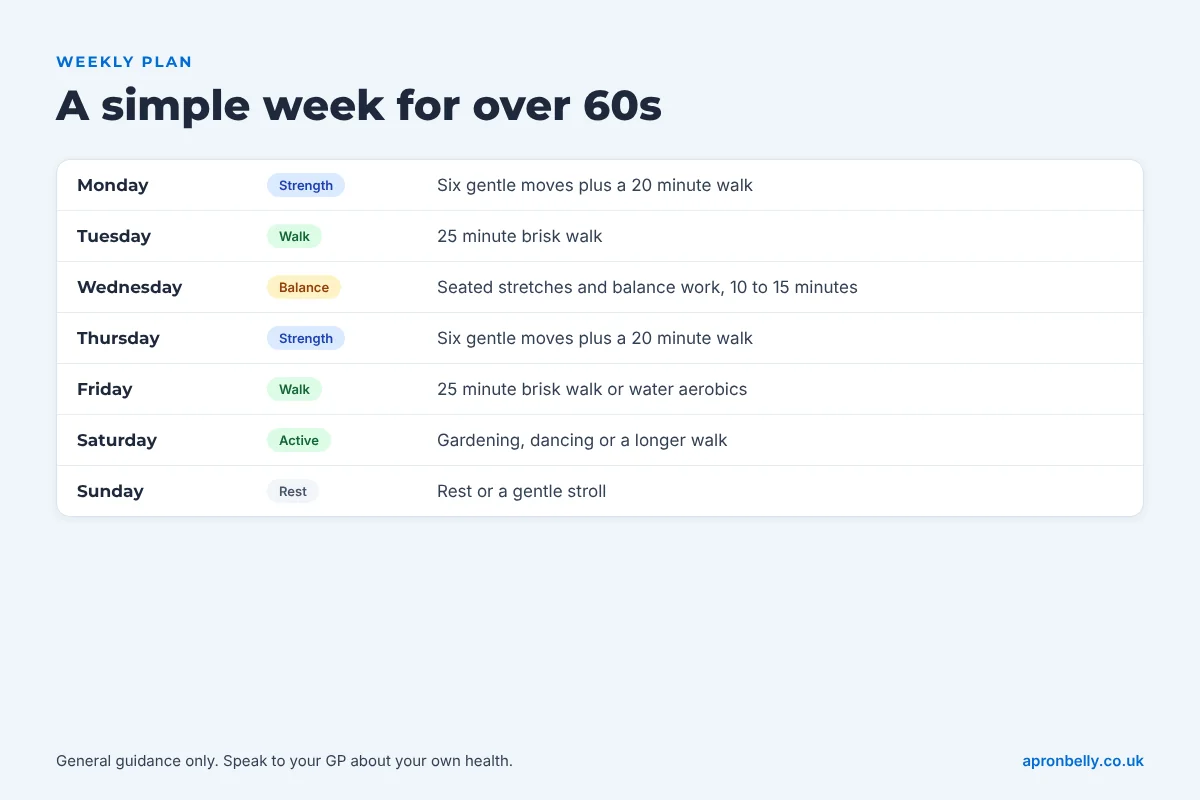
A Simple Weekly Plan for Over 60s
A sample week
| Day | Activity |
|---|---|
| Monday | Strength moves 1 to 6, plus a 20 minute walk |
| Tuesday | 25 minute brisk walk |
| Wednesday | Seated stretches and balance work, 10 to 15 minutes |
| Thursday | Strength moves 1 to 6, plus a 20 minute walk |
| Friday | 25 minute brisk walk or water aerobics |
| Saturday | Gardening, dancing or a longer walk |
| Sunday | Rest or a gentle stroll |
How to progress
Start with the repetitions above. When a move feels easy for a week, add 2 or 3 repetitions or a second set. Slower movements make an exercise harder without adding strain. When you are ready, a light resistance band or filled water bottles can add load. For more standing moves, see our standing exercises for apron belly, and for slow core work, our guide to controlled movement exercises for core strength.
Pair exercise with protein
Muscle is easier to keep when you eat enough protein at each meal. Our high protein diet for apron belly guide gives simple meal ideas.
Safety Tips for Exercising With an Apron Belly
Check with your GP first if needed
The NHS advises speaking to a GP before starting if you have not exercised for some time or have a medical condition. This is especially important if you have heart or lung problems, uncontrolled blood pressure, a hernia, recent surgery or have had falls.
Moves to avoid or adapt
- full sit ups and crunches, which strain the neck and can push the tummy outward
- getting down onto the floor if getting back up is difficult
- jumping and high impact moves, which jolt the joints and the fold
- holding your breath while you push; breathe out on the effort
Look after the skin in the fold
Exercise makes you sweat, and sweat trapped under the fold can lead to soreness. Wash and dry the crease after activity, wear breathable cotton or moisture wicking layers, and consider a support band during walks. If the skin becomes sore or itchy, see our guide to the apron belly rash.
Stop and get help if
Stop exercising and seek medical help if you have chest pain, feel very short of breath, dizzy or faint, or notice a new bulge or pain in your tummy. Call 999 for chest pain that does not settle.
A Worked Example
A 67 year old woman with a grade 2 apron belly has not exercised for years and finds it hard to get out of low chairs. After checking with her GP, she starts the six moves twice a week, doing 5 repetitions of each, and walks to the shops on 3 other days. After a month she can do 8 sit to stands without using her hands and walks for 25 minutes without stopping. Alongside a modest calorie deficit, her waist has gone down by 3 cm. The fold has not disappeared, but it feels better supported, and she is steadier on stairs.
What this shows
Small, regular sessions add up. Strength and balance improve first, while changes to the fold come more slowly with overall fat loss.
Frequently Asked Questions
What is the best exercise for an apron belly over 60?
There is no single best move, because no exercise burns fat from the belly alone. A mix of brisk walking, chair based strength moves such as sit to stand and wall press ups, and simple balance work helps with fat loss, strength and stability.
Can a 70 year old get rid of an apron belly with exercise?
Exercise and a modest calorie deficit can shrink the fat part of an apron belly at any age. Loose skin will not tighten with exercise, so some overhang may remain. A GP can talk through other options if the fold causes ongoing skin or comfort problems.
Are sit ups safe for seniors with an apron belly?
Full sit ups and crunches are not usually the best choice. They strain the neck and back and do little for belly fat. Seated marching, sit to stand and wall press ups work the core more safely.
How often should older adults exercise?
The NHS advises adults over 65 to be active every day, aim for at least 150 minutes of moderate activity a week, and do strength, balance and flexibility activities on at least 2 days a week.
Can I do these exercises if I have arthritis?
Many people with arthritis find gentle chair and standing exercises helpful, but check with your GP or physiotherapist first. Move within a comfortable range and stop any exercise that causes sharp pain.
The Bottom Line
The safest apron belly exercises for seniors are gentle, supported and done regularly: chair based strength moves, balance work and daily walking. They will not spot reduce the fold, but they build strength, support the tummy, lower the risk of falls and help with fat loss alongside sensible eating. For more ways to stay active with a heavier lower belly, visit our belly exercises hub.
Your next step
Today, try 5 slow sit to stands from a sturdy chair. Write down how they felt, and repeat them twice this week to start building the habit.
Featured image: light exercise equipment by Debora Cartagena, CDC, Wikimedia Commons, public domain, cropped.