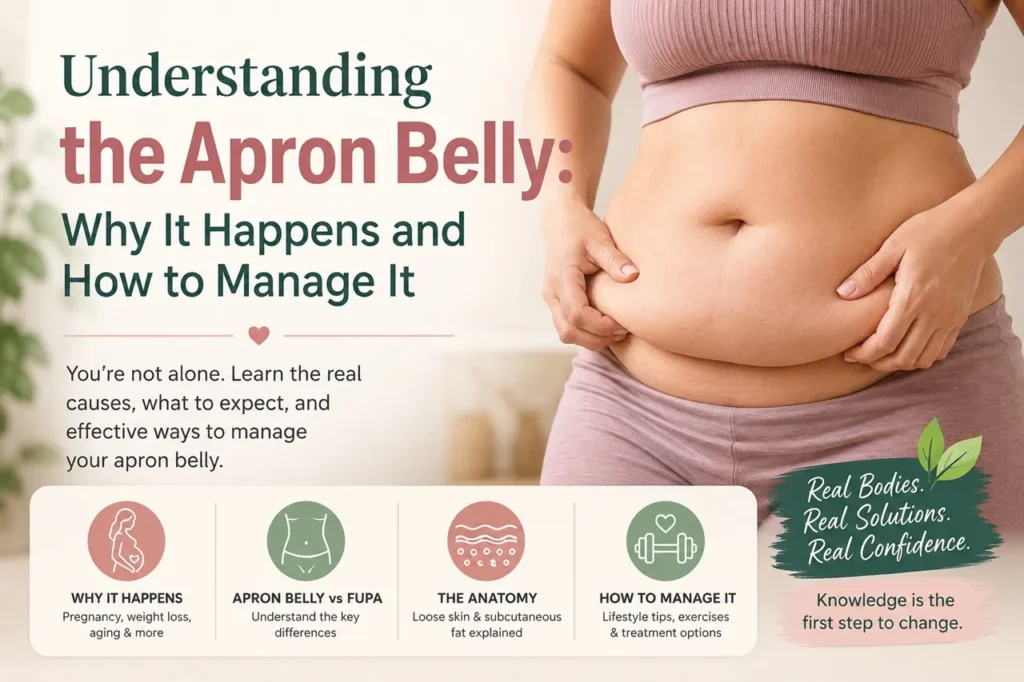
Quick Answer
The key difference in apron belly vs love handles is where the fat sits and how it behaves. An apron belly is a fold of fat and loose skin that hangs down from the front of the lower tummy. Love handles are bulges of fat on the sides of the waist, above the hips. Both shrink with overall fat loss, but an apron belly may also involve loose skin and rashes in the fold.
- Apron belly: front of the tummy, hangs down
- Love handles: sides of the waist, bulge out
- Your waist measurement matters more than the label
Apron belly vs love handles is a common question because both are ways the body stores fat around the middle, and the words are often mixed up. They are not the same thing. Knowing which one you have helps you understand what is going on, which health checks matter, and what will and will not help. This guide compares the two side by side, explains the causes of each, shows you how to check at home, and sets out your options.
This article is part of our belly guide hub. For a wider look at fat that hangs at the front, see our guide to the hanging belly.
Apron Belly vs Love Handles: The Key Differences
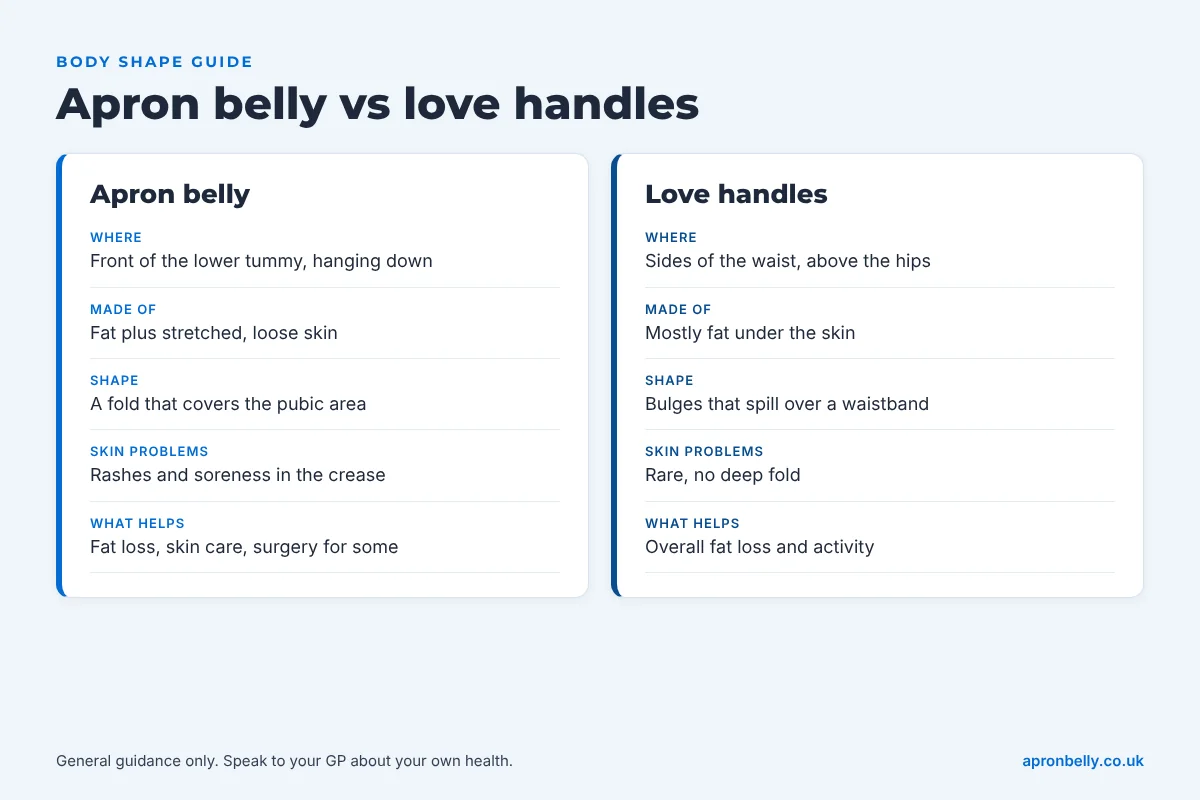
An apron belly hangs from the front of the lower tummy, while love handles sit on the sides of the waist.
| Feature | Apron belly | Love handles |
|---|---|---|
| Where it sits | Front of the lower tummy | Sides of the waist, above the hips |
| Shape | A fold that hangs down, sometimes over the pubic area | Bulges that push outwards, often over a waistband |
| Made of | Fat, often with loose, stretched skin | Mostly fat under the skin |
| Medical name | Pannus or abdominal panniculus | No medical term; sometimes called flank fat |
| Skin problems | Rashes, soreness and infection in the crease | Uncommon, as there is no deep fold |
| Main treatments | Fat loss, skin care, surgery in some cases | Overall fat loss and activity |
What an apron belly is
An apron belly is a fold of tissue that hangs down from the lower tummy. Doctors call it a pannus. It is graded by how far it hangs, from a small overhang that covers the pubic hairline to a large fold that reaches the thighs. Our guide on what an apron belly is explains the condition in full, and the apron belly grades page shows each stage.
What love handles are
Love handles is an everyday name for fat stored on the sides of the waist, just above the hip bones. The area is sometimes called the flanks. Love handles are most noticeable when clothing with a firm waistband pushes the fat up and out. They are not a medical condition and do not form a hanging fold.
How to Tell Which One You Have
A few simple checks in front of a mirror will usually tell you.
The mirror check
- Stand side on to a full length mirror in your underwear.
- Look at the front of your lower tummy. If tissue folds down over your knickers or pubic area, that is an apron belly.
- Now face the mirror. If the main bulges are on the sides of your waist, above your hips, those are love handles.
- Lift any front fold gently. If there is a crease underneath that stays warm or damp, it is an apron belly.
Signs it is an apron belly
- the tissue hangs down rather than pushing out
- you have a crease under the fold that can get sore or red
- the fold changed after pregnancy, a C-section or a large weight loss
- you may need to lift it to wash or dry the skin underneath
When you have both
Many people have both, along with some general tummy fat. If the fat at the front sits low and is more like a pad above the pubic bone, read our comparison of apron belly vs FUPA, and for fat that sits higher up, our page on apron belly vs belly fat. If the bulge mainly appears over the top of your jeans, our guide to apron belly vs muffin top explains how clothing shapes it.
What Causes Each One
What causes love handles
Love handles form when the body stores extra fat on the sides of the waist. Where you store fat is influenced by your genes, your sex and your age. Eating more energy than you use, and being less active, adds to fat stores in this area as in others.
What causes an apron belly
An apron belly forms when fat and skin at the front of the tummy start to hang. Common reasons include carrying extra weight, pregnancy stretching the skin and muscles, a C-section scar that holds tissue above it, and ageing skin that has lost its elasticity. It can also appear after a large weight loss, when the fat goes but the stretched skin stays. Our guide to apron belly fat vs loose skin helps you tell how much of your fold is each.
Why the difference matters
Love handles are mostly fat, so they usually shrink as you lose weight. An apron belly that is mostly loose skin may not shrink much with weight loss, which is why it can need a different plan.
What Your Waist Says About Your Health
Whichever shape you have, the size of your waist is a more useful health guide than whether you call it love handles or an apron belly.
Waist size targets
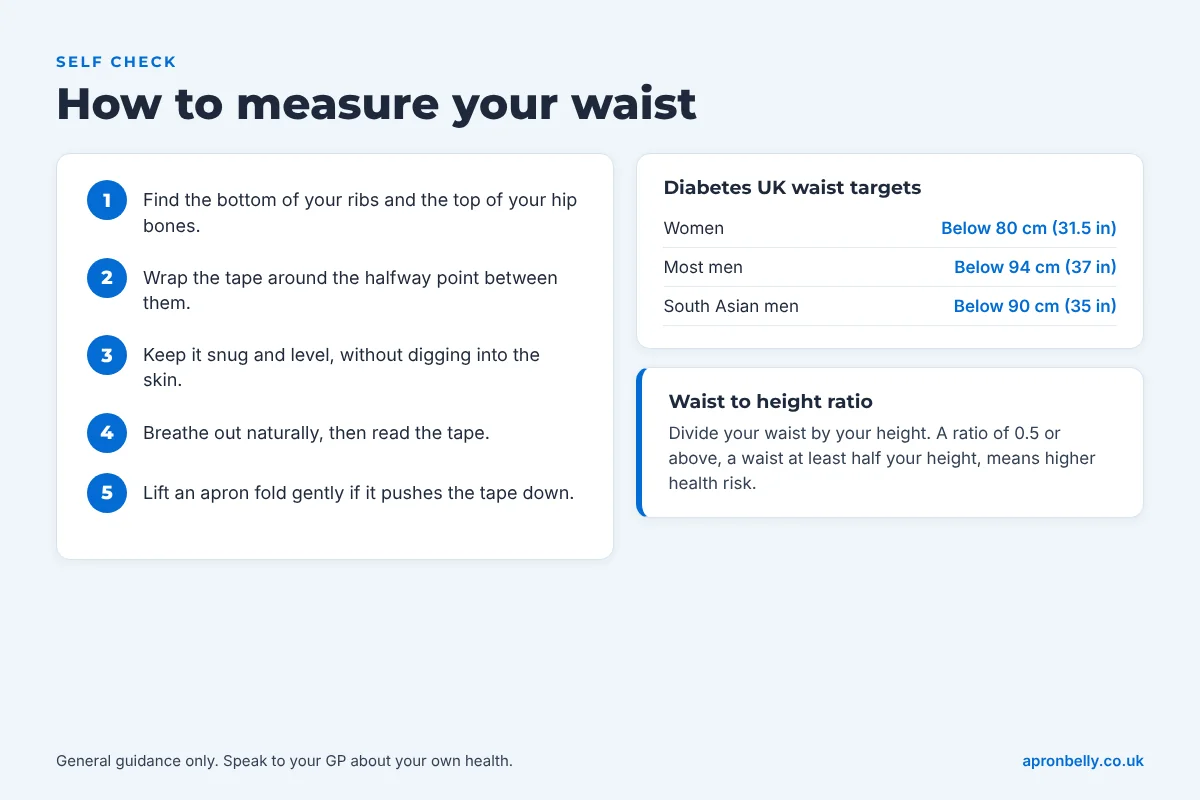
Diabetes UK advises aiming for a waist measurement below 80 cm (31.5 in) for women, 94 cm (37 in) for most men and 90 cm (35 in) for South Asian men. It explains that fat can build up around organs such as the liver and pancreas, which can lead to insulin resistance and raise the chance of high blood glucose, even when weight and BMI look healthy.
The waist to height ratio
The British Heart Foundation uses a waist to height ratio: divide your waist by your height. A ratio of 0.4 to 0.49 is the healthy range, 0.5 to 0.59 means increased risk, and 0.6 or above means the highest risk. In other words, try to keep your waist below half your height. The BHF notes this method is for adults with a BMI below 35, and that if your BMI is higher or you cannot measure your waist accurately, you should speak to a healthcare professional.
How to measure your waist correctly
- Find the bottom of your ribs and the top of your hip bones.
- Wrap a tape measure around the halfway point between them.
- Keep it snug and level without digging into the skin.
- Breathe out naturally and read the tape.
- If an apron fold pulls the tape down at the front, lift it gently so the tape stays level.
Skin problems only an apron belly brings
Love handles rarely cause skin trouble. An apron belly creates a warm, damp crease where rashes, soreness and infection can develop. If the skin under your fold is red or sore, see our guide to the apron belly rash.
What Helps Each One
Fat loss helps both
No exercise burns fat from one chosen place, so side bends will not remove love handles and crunches will not remove an apron belly. Our guide to apron belly myths explains why. Both shrink with overall fat loss from a modest calorie deficit, regular walking and strength training on at least 2 days a week. Our calorie deficit for apron belly guide shows how to set a safe target.
Extra care for an apron belly
An apron belly also needs daily skin care: wash and fully dry the crease, keep the skin surfaces apart with soft cotton and treat rashes early. Supportive high waisted underwear can stop the fold rubbing.
Surgery options
Where an apron belly is mostly loose skin, surgery is the only way to remove it. A panniculectomy removes the hanging fold, and a tummy tuck also tightens the muscles. Our comparison of panniculectomy vs tummy tuck explains the difference. Love handles are mostly fat, so surgery for them, such as liposuction, is a cosmetic choice that is not usually available on the NHS.
Clothing that suits each shape
For love handles, mid or high rise waistbands that sit above the bulge, rather than cutting into it, give a smoother line. For an apron belly, high waisted styles that sit above the fold and soft support layers work best. Our guide to the best shapewear for apron belly covers options for both.
A Worked Example
A 44 year old woman notices bulges at the sides of her waist when she wears jeans, and she also has a small fold at the front that has hung over her C-section scar since her second baby. In the mirror check, the sides push out while the front fold hangs and has a crease that gets sweaty. She has both love handles and a grade 1 apron belly. Her waist measures 86 cm and she is 164 cm tall, a ratio of about 0.52, so she aims to bring her waist under 82 cm, half her height. She starts a modest calorie deficit, walks daily and adds two strength sessions a week. She also washes and dries the crease each evening to stop it getting sore.
What she can expect
As she loses fat, her love handles are likely to shrink steadily. The front fold may shrink too, but some loose skin over the scar may stay. If it keeps causing rashes after her weight is stable, she can talk to her GP about her options.
Frequently Asked Questions
What is the difference between an apron belly and love handles?
An apron belly is a fold of fat and loose skin that hangs down from the front of the lower tummy, often over the pubic area. Love handles are areas of fat on the sides of the waist, just above the hips. The apron sits at the front and hangs, while love handles sit at the sides and bulge outwards.
Can you have an apron belly and love handles at the same time?
Yes. Many people carry fat both at the front and on the sides of the waist, so it is common to have both. The same steps, overall fat loss and regular activity, help both, but an apron belly may also involve loose skin that exercise cannot tighten.
Are love handles or an apron belly worse for your health?
Neither label tells you your health risk on its own. Your waist measurement is a better guide. Diabetes UK advises a waist below 80 cm for women, 94 cm for most men and 90 cm for South Asian men, and the BHF says a waist of half your height or more suggests higher risk.
Can you get rid of love handles with side exercises?
No. Side bends and twists strengthen the muscles under the fat, but they do not burn fat from that spot. Love handles shrink when you lose fat overall through a calorie deficit and regular activity.
Is an apron belly just bigger love handles?
No. They sit in different places and are made up differently. Love handles are mostly fat on the sides of the waist. An apron belly is a hanging fold at the front that often contains stretched skin as well as fat, and it can cause rashes in the crease underneath.
The Bottom Line
In the apron belly vs love handles comparison, the difference is position and make up. Love handles are fat on the sides of the waist that push outwards. An apron belly is a fold of fat and often loose skin that hangs from the front of the tummy and can cause skin problems in the crease. Both respond to overall fat loss, but an apron belly may also need skin care and, for some people, surgery. For the other shapes that are often confused with an apron belly, start with our belly guide.
Your next step
Measure your waist today and work out your waist to height ratio. It tells you more about your health than the shape alone, and gives you a number to track as you make changes.
Featured image: tape measure by Simon A. Eugster, Wikimedia Commons, CC BY-SA 3.0, cropped.