
Quick Answer
To work out how to choose a tummy tuck surgeon in the UK, check that the surgeon is on the GMC specialist register for plastic surgery, that the hospital is registered with the right regulator (the CQC in England), and that you meet the operating surgeon yourself before you pay or agree to anything.
- Search the GMC register and the Royal College of Surgeons certified list
- Ask about complication rates, aftercare and the full cost in writing
- Take at least two weeks to think before you agree to surgery
Apron belly surgery, whether a panniculectomy to remove the overhang or a full tummy tuck, is major surgery under general anaesthetic. The person who operates on you matters more than the price, the clinic’s adverts or how quickly you can be booked in. This guide explains how to choose a tummy tuck surgeon in the UK, using the checks recommended by the NHS, the General Medical Council (GMC) and the Royal College of Surgeons (RCS).
It is part of our apron belly surgery hub. If you are still deciding which operation you need, start with our comparison of panniculectomy vs tummy tuck.
Why Choosing the Right Surgeon Matters
The law allows any registered doctor to operate
In the UK, any doctor registered with the GMC can legally carry out cosmetic surgery in the private sector. There is no legal requirement for them to be listed as a specialist surgeon. The RCS has pointed out that this makes it hard for patients to tell an experienced, highly trained surgeon from someone who should not be doing the operation, which is why your own checks count.
Apron belly surgery is not a small procedure
Removing a large fold of skin and fat means a long wound across the lower tummy, drains in some cases, and a recovery measured in weeks. Problems such as seroma (a fluid collection), wound breakdown, infection and blood clots are known risks. A well trained surgeon working in a properly equipped hospital is better placed to lower those risks and to deal with them quickly if they happen.
NHS or private?
If your apron causes repeated skin infections or limits daily life, you may qualify for NHS surgery, where the surgeon is chosen within the hospital you are referred to. Our guide to asking your GP for a panniculectomy referral covers that route. The checks below matter most if you are paying privately.
How to Choose a Tummy Tuck Surgeon in the UK: 5 Checks
1. Check the GMC specialist register
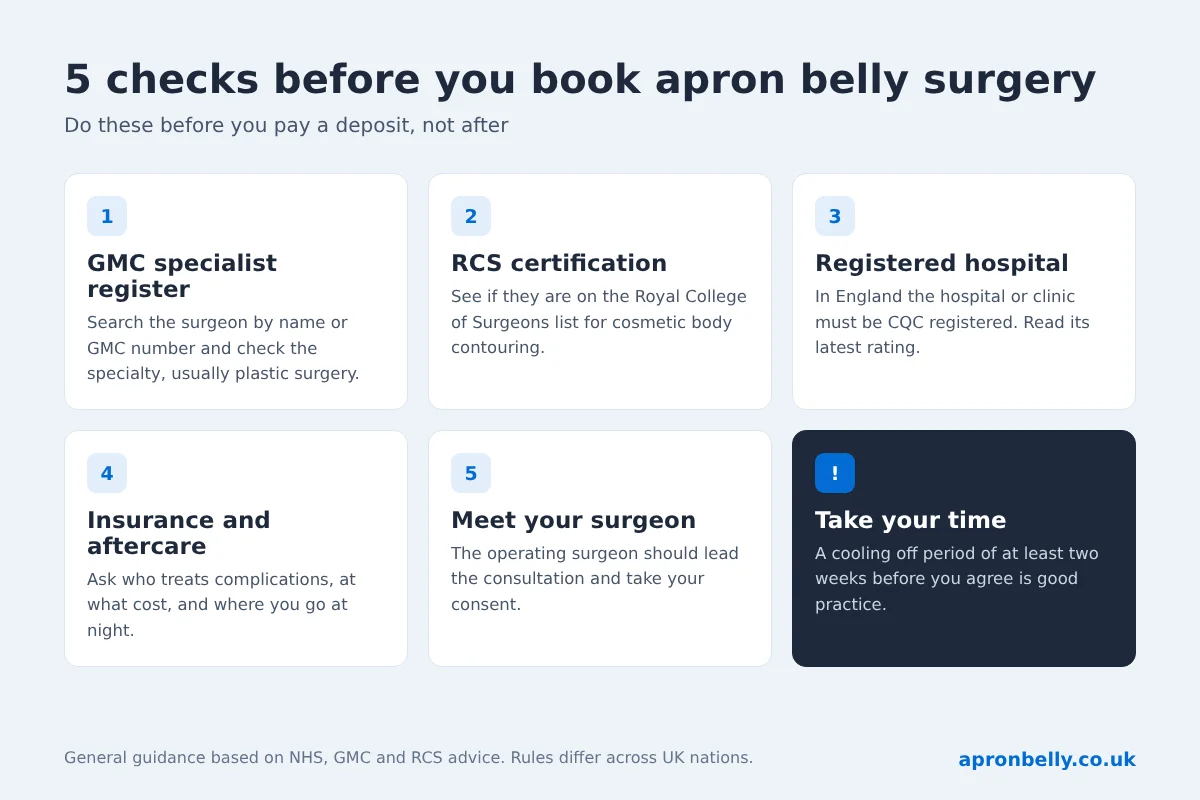
Search the surgeon’s name or GMC number on the GMC medical register. Look for two things: that they hold a licence to practise, and that they are on the specialist register in a relevant field. For tummy tucks and panniculectomies this is usually plastic surgery. If a surgeon is not on the specialist register, ask why, and treat a vague answer as a warning sign.
2. Look for RCS cosmetic surgery certification
The Royal College of Surgeons runs a voluntary certification scheme for cosmetic surgeons. Certified surgeons have shown that they meet an agreed national standard in a named area, such as cosmetic body contouring. The RCS publishes a searchable list of certified surgeons. Not every good surgeon has applied, so absence from the list is not a reason to rule someone out on its own, but it is a useful extra check.
3. Check professional association membership
Many plastic surgeons belong to the British Association of Plastic, Reconstructive and Aesthetic Surgeons (BAPRAS) or the British Association of Aesthetic Plastic Surgeons (BAAPS). Full members of these groups have the relevant training and agree to a code of practice. Membership is not a legal requirement, but it gives you another layer of assurance.
4. Check the hospital or clinic is registered
All independent hospitals and clinics that provide cosmetic surgery in England must be registered with the Care Quality Commission (CQC). You can search the CQC website and read the latest inspection rating. In Scotland the regulator is Healthcare Improvement Scotland, in Wales it is Healthcare Inspectorate Wales, and in Northern Ireland it is the Regulation and Quality Improvement Authority.
5. Meet the operating surgeon before you decide
NHS advice is to always book a consultation with the person who will do the procedure before making a final decision, and not to pay for a procedure until you have had that consultation. The RCS professional standards say the operating surgeon should lead the consultation and take your written consent themselves rather than passing it to a colleague or sales adviser.
Experience, Results and Complication Rates
How many apron belly operations have they done?
Ask how many panniculectomies or tummy tucks the surgeon performs each year, and how many involve a large or heavy apron like yours. Surgery after major weight loss, or on a grade 4 or 5 pannus, is different from a standard cosmetic tummy tuck. Our guide to measuring your apron belly grade helps you describe your own case clearly.
Complication and revision rates
A good surgeon will talk openly about their complication and re-operation rates and about the common problems after this surgery, including seroma, wound healing problems and visible scarring. Our guide to apron belly surgery scars explains what a typical scar looks like.
Questions to Ask at Your Consultation
About the surgeon and the operation
- What qualifications and specialist training do you have, and what is your GMC number?
- How many of these operations do you do each year?
- Which operation do you recommend for my apron, and why?
- Where will the scar sit, and how long will it be?
- Will I need drains, and how long will I stay in hospital?
About safety, aftercare and cost
- What are the most common complications, and how often do they happen in your patients?
- Who looks after me after I go home, and who do I call at night or at a weekend?
- What happens and who pays if something goes wrong or I need a revision?
- What is the full cost, and what does it include?
- Do you and the hospital hold insurance for this procedure?
Red Flags When Choosing a Clinic
Pressure to book
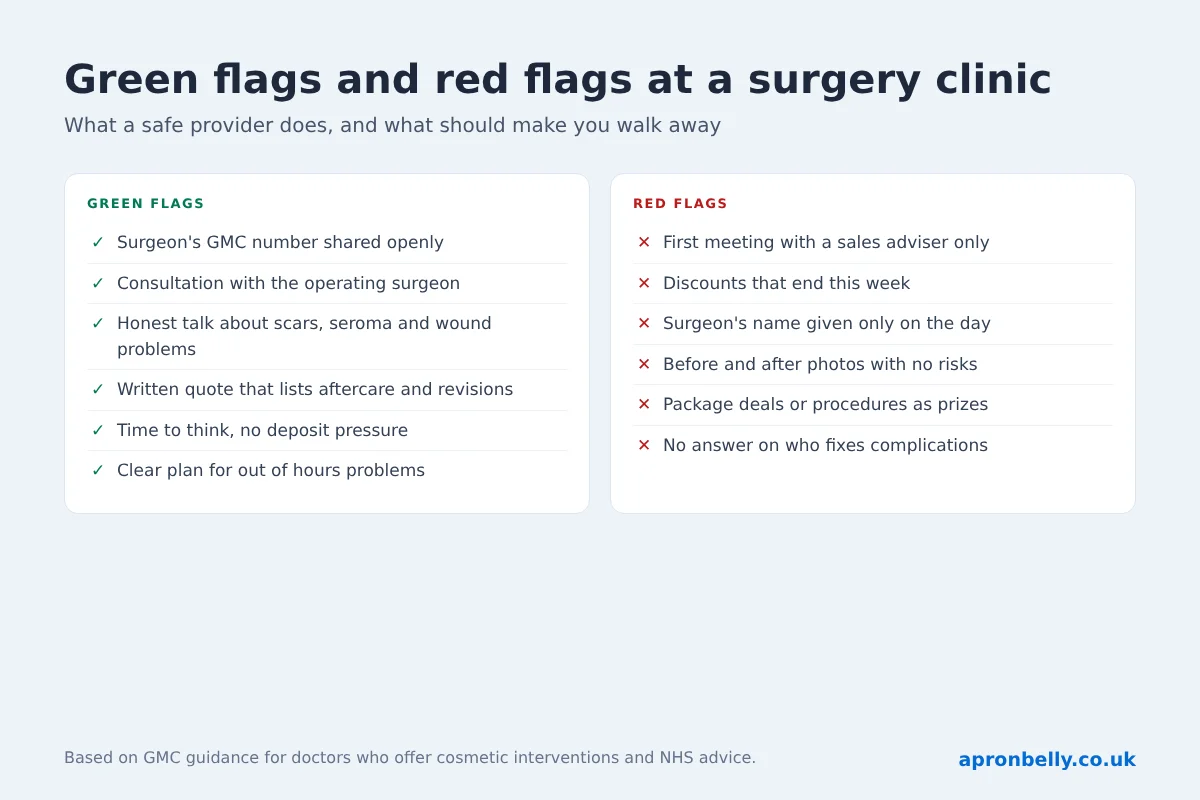
GMC guidance says doctors who offer cosmetic interventions must not use promotional tactics that might encourage people to make ill considered decisions, and must not offer procedures as prizes. The RCS says surgeons should not use financial inducements such as time limited offers and discounts. A clinic that pushes a deposit, a discount that ends this week, or a package deal is not putting your safety first.
Meeting only a sales adviser
If your first and only contact before booking is with a patient coordinator or sales adviser, and you meet the surgeon for the first time on the day of surgery, walk away. The consent conversation about risks and likely results must be with the surgeon.
Advertising that only appears on social media
NHS advice is to avoid practitioners who only advertise on social media, treatment vouchers sold on group discount sites, and procedures offered in places such as hotels or private homes. Surgery should take place in a registered hospital with full theatre and recovery facilities.
Cooling Off, Consent and Aftercare
Give yourself time to think
The RCS professional standards say patients should be offered a cooling off period of at least two weeks before they consent to an operation. The GMC also says doctors must give patients time to reflect. Use this time to reread the information you were given, check costs and talk to people you trust.
Aftercare is part of the choice
Ask how many follow up appointments are included, whether a nurse will check your wound, and where you would be treated if you developed a problem. Find out what support garments you will need and how long you will be off work. Our guides to preparing for tummy tuck surgery and recovery after apron belly removal cover the weeks after the operation.
Cost and Value
Why the cheapest quote is not the best value
Private prices vary between surgeons, hospitals and regions. A lower price may leave out follow up, revision surgery or overnight stays, which can cost much more later. Ask for a written quote that lists exactly what is included. Our guide to apron belly surgery cost in the UK explains typical price ranges and what drives them.
| What to check | Where to check it | What a good answer looks like |
|---|---|---|
| Surgeon’s registration | GMC medical register | Licensed, on the specialist register for plastic surgery |
| Extra certification | RCS certified cosmetic surgeons list, BAPRAS or BAAPS | Listed for body contouring or a full member |
| Hospital | CQC in England, or HIS, HIW or RQIA | Registered with a good recent rating |
| Consent | Your consultation | Taken by the operating surgeon, with time to think |
| Aftercare and cost | Written quote | Follow up, complications and revisions explained |
When to Talk to Your GP
Your GP can help you decide
BAPRAS advises speaking to your GP if you are thinking about cosmetic surgery. Your GP knows your medical history, can tell you whether you might meet NHS criteria, and can help you check that surgery is safe for you, especially if you have diabetes, heart or lung problems, or take medicines that affect healing. If your apron causes skin infections, read our guide to the panniculectomy NHS criteria first.
Frequently Asked Questions
How do I check if a surgeon is qualified in the UK?
Search the surgeon’s name or GMC number on the GMC medical register. Check that they hold a licence to practise and are on the specialist register in a relevant specialty, usually plastic surgery for a tummy tuck or panniculectomy. You can also check the Royal College of Surgeons list of certified cosmetic surgeons.
Does a tummy tuck surgeon have to be a plastic surgeon?
Not by law. Any GMC registered doctor can perform cosmetic surgery privately. The RCS and BAPRAS strongly recommend choosing a surgeon on the GMC specialist register for the relevant area, which for abdominal surgery like a tummy tuck is usually plastic surgery.
What is RCS cosmetic surgery certification?
It is a voluntary scheme run by the surgical royal colleges. Certified surgeons have shown they meet an agreed national standard in a named area of cosmetic surgery, such as body contouring. The Royal College of Surgeons publishes a list that patients can search.
How long should I wait before agreeing to surgery?
The RCS says patients should be offered a cooling off period of at least two weeks before consenting to cosmetic surgery, and the GMC says doctors must give patients time to reflect. Do not let a clinic rush you with a deposit or a time limited discount.
Should the clinic be registered with the CQC?
Yes, in England all independent hospitals and clinics providing cosmetic surgery must be registered with the Care Quality Commission. In Scotland, Wales and Northern Ireland the regulators are Healthcare Improvement Scotland, Healthcare Inspectorate Wales and the Regulation and Quality Improvement Authority.
The Bottom Line
Knowing how to choose a tummy tuck surgeon in the UK comes down to a few firm checks: GMC specialist registration, a registered hospital, an honest consultation with the operating surgeon, clear aftercare and enough time to decide. Price and convenience come after those. For more on your options, visit our apron belly surgery hub.
Your next step
Write down the names of any surgeons you are considering and check each one on the GMC register and the RCS certified list before you book a consultation.
Featured image: surgical instruments by آرمین, Wikimedia Commons, CC0, cropped. This article is for general information and is not medical advice. Speak to your GP about whether surgery is right for you.