Quick Answer
Pilates for an apron belly is a gentle way to build deep core strength, improve posture and ease back tension. It cannot remove loose skin or burn belly fat alone, but it helps your body feel stronger and steadier.
- Start slowly and focus on breathing and control
- Avoid crunches and any move that makes your tummy dome
- Check with a professional after a baby or surgery
If you live with an apron belly, the word “exercise” can bring up mixed feelings. Perhaps you’ve tried high-impact classes that left you sore and self-conscious. Perhaps you’ve avoided the gym altogether because the lower belly feels heavy, the fold rubs, and the idea of crunching on a mat feels like a bad joke. Pilates offers a different route. It’s slow, controlled, and built around breath and posture, which suits a body that wants strength without the strain. Pilates for belly overhang is also easy to start at home, with no equipment beyond a mat.
This guide explains how Pilates for an apron belly works, what it can and can’t change, and a gentle routine you can try at home. I’ll also flag the situations where you should get advice first, because a core that has been stretched or separated needs sensible handling.
If you’re still getting to grips with what an apron belly is, our apron belly overview explains it in plain English. And if you’d like a wider set of starting points beyond Pilates, our belly exercises guide is a good companion to this article.
Why Pilates Suits an Apron Belly
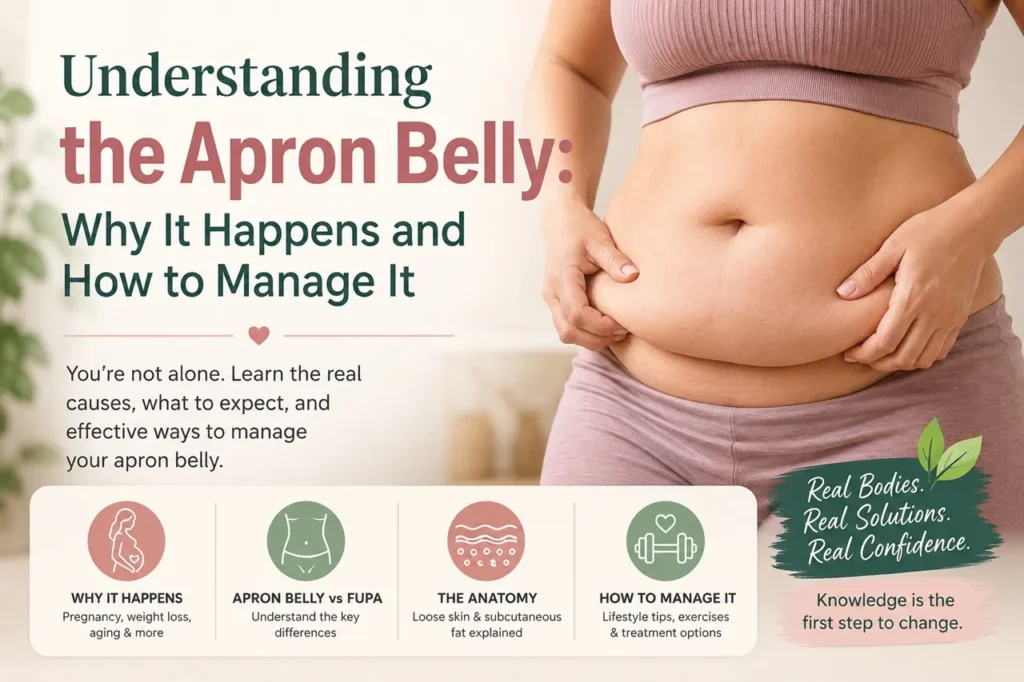
An apron belly is usually a mix of loose skin, a layer of fat, and sometimes weakened or separated abdominal muscles. When the deep core muscles aren’t doing their job well, the lower belly can push forward and hang. Your posture often changes too, with a tilted pelvis, an arched lower back, and rounded shoulders.
Pilates targets exactly that combination. Instead of chasing a burn, it trains the deep muscles that wrap around your trunk, including the transversus abdominis, which works like a natural corset. It also strengthens the pelvic floor, the glutes, and the muscles along your spine. These muscles support your lower belly from the inside and help you stand taller.
Two features make it especially suitable:
It’s low impact. There’s no jumping, and most moves happen lying down, kneeling, or sitting. That’s kinder on the joints and on a heavier lower belly.
It’s controlled. You move slowly and focus on form, which lowers the risk of pushing a weak abdominal wall outward.
What the Evidence Actually Says
It’s worth being honest about this, because Pilates is often marketed with big promises. Most of the research looks at low back pain rather than belly overhang, but it’s still relevant, since core strength and back comfort go hand in hand.
American Family Physician summarised a Cochrane review of 10 randomised controlled trials involving 478 people with chronic low back pain. Pilates gave pain relief compared with minimal or no intervention, with the benefit lasting for up to a year in some trials. Against other forms of exercise, though, the evidence suggested Pilates was no better. The authors rated the evidence as low to moderate quality, and side effects were uncommon, mostly mild muscle soreness.
What does that mean for you? Pilates is a reasonable, safe way to build core strength and ease back discomfort, but it isn’t magic. It works about as well as other sensible exercise, so the best programme is the one you’ll actually enjoy and keep doing. For many people with an apron belly, that’s Pilates, because it feels gentle and doesn’t require a gym.
What Pilates Can and Can’t Do for an Apron Belly
Here’s the honest picture, so you can set expectations that won’t disappoint you.
What it can do. Pilates can strengthen the deep core muscles, improve your posture, ease lower back tension, and help your stomach sit flatter and feel firmer. It can make your clothes fit better and help you move with more confidence. Over time, some people also notice a reduction in the fat sitting within the overhang, particularly when exercise sits alongside balanced eating and a generally active life.
What it can’t do. Pilates can’t shrink stretched skin. If your skin has lost much of its elasticity after pregnancy, weight loss, or ageing, a fold may remain even when your muscles are strong. Spot reduction isn’t possible either, so no routine will target belly fat alone. Our belly skin guide explains what supports skin health and what’s simply clever marketing.
None of that is a failure on your part. It’s simply where movement stops and skin begins. A stronger core still brings real benefits, including better posture, less back strain, and a body that feels more capable.
Before You Begin: Safety First
Most healthy adults can try gentle Pilates, but a few situations deserve a quick check with a professional first.
After a caesarean or recent birth. Your core, scar, and pelvic floor need time to recover. Wait for clearance from your GP, midwife, or a women’s health physiotherapist, usually at your six to eight week check or later. Our guide on apron belly after a C-section explains what recovery usually looks like.
If you have diastasis recti. This is a separation of the abdominal muscles, and it’s common after pregnancy. Avoid crunches, full roll-ups, and any move that makes your tummy dome or cone along the midline. A women’s health physiotherapist can assess the gap and tell you which moves are safe.
If you have a hernia or a bulge that has changed. Don’t exercise through a new lump, pain, or a bulge that appears when you strain. See your GP first.
If you have back pain, osteoporosis, or another medical condition. Check with your GP or physiotherapist, and tell your instructor about it.
Stop and seek advice if you feel sharp pain, dizziness, pelvic heaviness, or leaking urine during exercise. A little muscle soreness the next day is normal. Pain during the move isn’t.
Core Principles to Remember
Pilates has a few habits that make every move more effective. Learn these first and the exercises become easier.
Breathe sideways. Place your hands on the sides of your lower ribs and breathe so your ribs widen under your fingers. Breathe out slowly as you move. Holding your breath tends to push pressure down onto your belly and pelvic floor.
Find a neutral spine. Lying on your back with your knees bent, your lower back should keep a small natural curve, not flattened hard into the floor or arched high.
Draw in gently. On the out-breath, imagine drawing your lower belly softly in and up, as if zipping up a pair of snug trousers. About 20 to 30 per cent effort is plenty. Gripping hard defeats the purpose.
A Gentle Pilates Routine for Belly Overhang
Aim for two or three sessions a week, around 15 to 20 minutes each. Use a mat or a folded blanket, and wear something comfortable that doesn’t dig into your waistband. Stop any move that hurts or makes your belly dome.
1. Lateral breathing (2 minutes)
Lie on your back with your knees bent and your feet flat. Rest your hands on your lower ribs. Breathe in through your nose and feel your ribs widen. Breathe out through your mouth and let your ribs soften back in. Repeat for ten slow breaths. This is the foundation for every other move.
2. Pelvic tilts (8 repetitions)
Stay in the same position. As you breathe out, gently tilt your pelvis so your lower back presses toward the mat. Breathe in and return to neutral. Keep your buttocks relaxed and move only as far as feels comfortable. This wakes up the lower abdominals without any heavy effort.
3. Knee folds (6 to 8 per leg)
Keep your spine in neutral. Breathe out, draw in gently, and slowly lift one foot off the floor until your knee is over your hip. Breathe in and lower it. Swap sides. Keep your pelvis still, as if a glass of water were balanced on your belly. If your belly domes, go back to pelvic tilts.
4. Heel slides (6 to 8 per leg)
From a neutral spine, breathe out and slowly slide one heel along the mat until your leg is straight. Breathe in as you slide it back. This trains your core to stay steady while your legs move, which is how it works in everyday life.
5. Bridging (6 to 8 repetitions)
Breathe out, press through your feet, and lift your hips one vertebra at a time until your body forms a diagonal line from shoulders to knees. Breathe in at the top, then roll down slowly, one bone at a time. Bridging strengthens the glutes and the back of the body, which supports your pelvis and your posture.
6. Bird-dog (5 to 6 per side)
Start on your hands and knees, with your hands under your shoulders and your knees under your hips. Breathe out and slide one leg straight back. Hold for a moment, then return. Once that feels steady, add the opposite arm. Keep your hips level and your belly gently drawn in. This challenges balance and builds deep core stability without the strain of a sit-up.
Moves to Approach With Caution
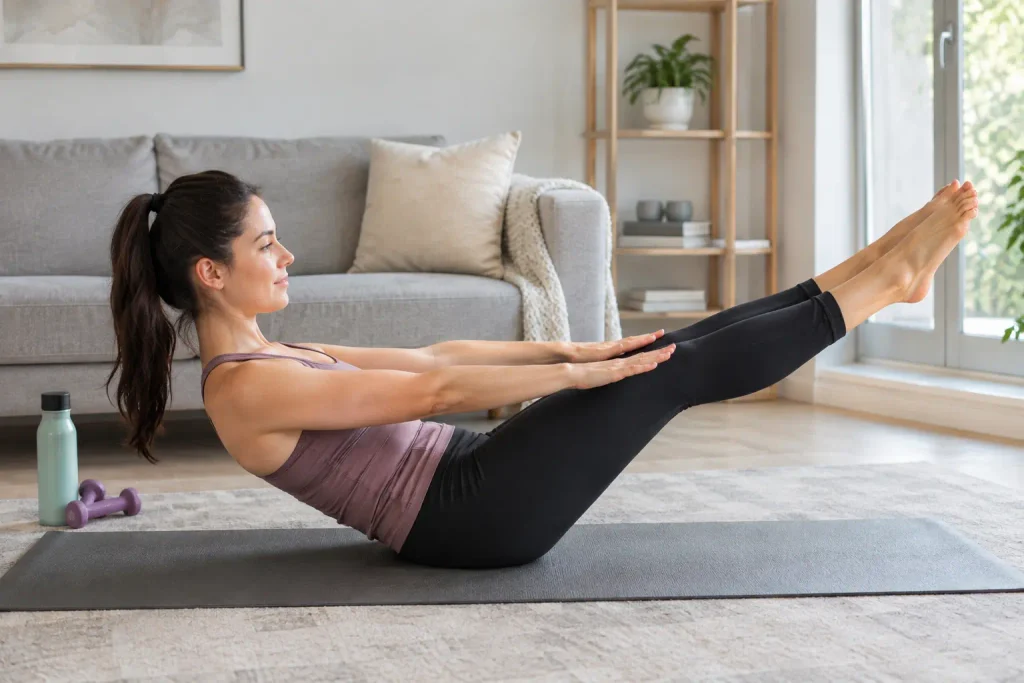
Some classic Pilates moves put heavy demand on the abdominal wall, so they’re best left until your core is stronger and has been checked, particularly if you have diastasis recti. These include the full “hundred”, roll-ups, double-leg stretches, and teaser. Full planks can also be tough in the early weeks.
Classes or Home Practice?
Both can work, and they suit different people.
Classes give you feedback from an instructor, and reformer sessions use spring-assisted machines, usually at higher cost. Tell any instructor about back pain, pregnancy history or diastasis recti first.
Home practice is free or cheap, private, and easy to fit around work or family. Free online videos can be a helpful starting point, and AAFP notes that Pilates instruction is widely available from many sources, including free online videos. The downside is that nobody checks your form.
When Exercise Isn’t Enough
Some women do everything right, including steady Pilates, a balanced diet, and plenty of patience, and still live with a fold of loose skin that bothers them. That’s not a failure of effort. It’s a limit of what exercise can change.
If the overhang causes irritation, discomfort, or a loss of confidence, it’s reasonable to explore your options. Surgery is a personal decision, and nobody should pressure you either way. If you’d like to understand what the operations involve, our tummy tuck guide walks through them.
The Bottom Line
Pilates for an apron belly is a gentle, sensible way to build deep core strength, improve your posture, and ease back tension. The research suggests it works about as well as other good exercise for back pain, and side effects are uncommon. It can’t remove loose skin or target belly fat alone, but it can help you feel stronger and more at home in your body.
Start slowly, breathe well, and stop if anything hurts. Check with a professional first if you’ve recently had a baby, have separated muscles, or have a bulge that worries you. Be patient and kind to yourself, and let your core build at its own pace.
Frequently Asked Questions
Is Pilates good for an apron belly?
It can be. Pilates strengthens the deep core muscles, improves posture, and is low impact, so it suits many people with an apron belly. It can’t remove loose skin or target belly fat on its own, but it can help your stomach feel firmer and your back feel better.
Can Pilates get rid of an apron belly?
Not by itself. Pilates can strengthen your core and improve posture, but it can’t shrink stretched skin or burn fat from one area. For a significant overhang of loose skin, surgery is the only option that removes the skin itself.
Is Pilates safe if I have diastasis recti?
Often, with modifications. Avoid crunches, roll-ups, and any move that makes your tummy dome along the midline. A women’s health physiotherapist can assess the gap and recommend safe moves. Start with breathing, pelvic tilts, and heel slides.
How often should I do Pilates for belly overhang?
Two to three sessions a week of about 15 to 20 minutes is a sensible starting point for most beginners. Build up gradually, and rest if your body feels sore or tired. Regular, gentle practice works better than occasional hard sessions.
Can I do Pilates after a C-section?
Yes, once your GP, midwife, or physiotherapist has cleared you. This is usually at your six to eight week check or later, depending on your recovery. Start with breathing and pelvic floor work before adding movements, and stop if your scar hurts.