You’ve noticed a bulge, and now a new worry has crept in alongside the usual frustration with your stomach: what if this isn’t just an apron belly? What if it’s something more serious? Is my apron belly a hernia, or are these two completely separate things happening to sit in the same area?
This is a fair question, and it deserves a clear, careful answer. Most of the time, an apron belly is exactly what it looks like: loose skin and soft tissue, sometimes alongside diastasis recti. But a hernia can genuinely develop in the same region, and a small number of warning signs separate a normal, harmless bulge from something that needs urgent medical attention. If you’re also working through the basics of your apron belly more generally, or if your bulge appeared after a caesarean section, our guide on recovering from an apron belly after a C-section is worth reading too, since both hernias and diastasis recti are more common after abdominal surgery.
What Is an Apron Belly, Again?
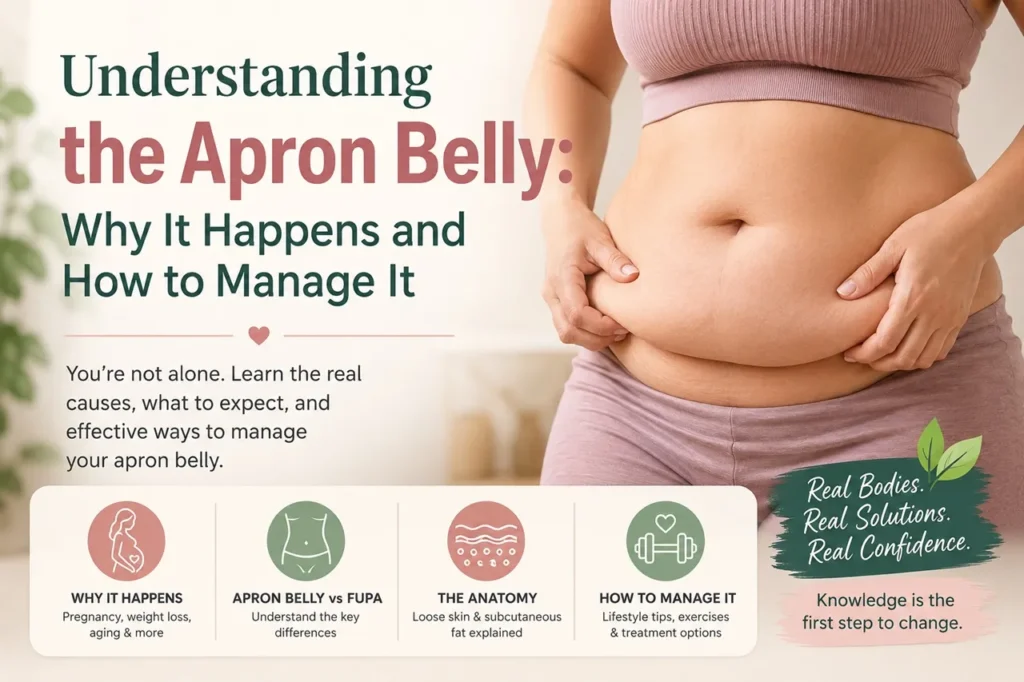
An apron belly, or panniculus, is a fold of loose skin and fatty tissue that hangs over the lower abdomen. It often develops after pregnancy, significant weight loss, or simply as a result of ageing skin. Many women with an apron belly also have diastasis recti, a separation of the abdominal muscles along the midline, which can make the area look more rounded or bulge slightly when the core is engaged.
Crucially, an apron belly by itself is a soft tissue and skin condition. It isn’t a hole or weak spot in your abdominal wall, and it doesn’t carry the same risks as a true hernia.
What Is a Hernia?
A hernia is a different kind of problem entirely. It happens when part of an internal organ, usually a piece of your bowel, pushes through a weak spot or gap in the muscle wall that normally holds everything in place. The NHS describes this directly: a hernia occurs where an internal organ pushes through a gap or weakness in the surrounding muscle.
In the abdomen, hernias often show up as a lump or bulge that may get bigger when you cough, strain, or stand for a while, and smaller when you lie down. Several types can occur in this area, including umbilical hernias near the belly button, incisional hernias at the site of a previous surgical scar, and more rarely, lumbar hernias toward the side or back.
Umbilical Hernia vs Apron Belly: Key Differences
An umbilical hernia vs apron belly comparison is one of the most common sources of confusion, since both can sit around or below the belly button. A few distinguishing features help separate the two.
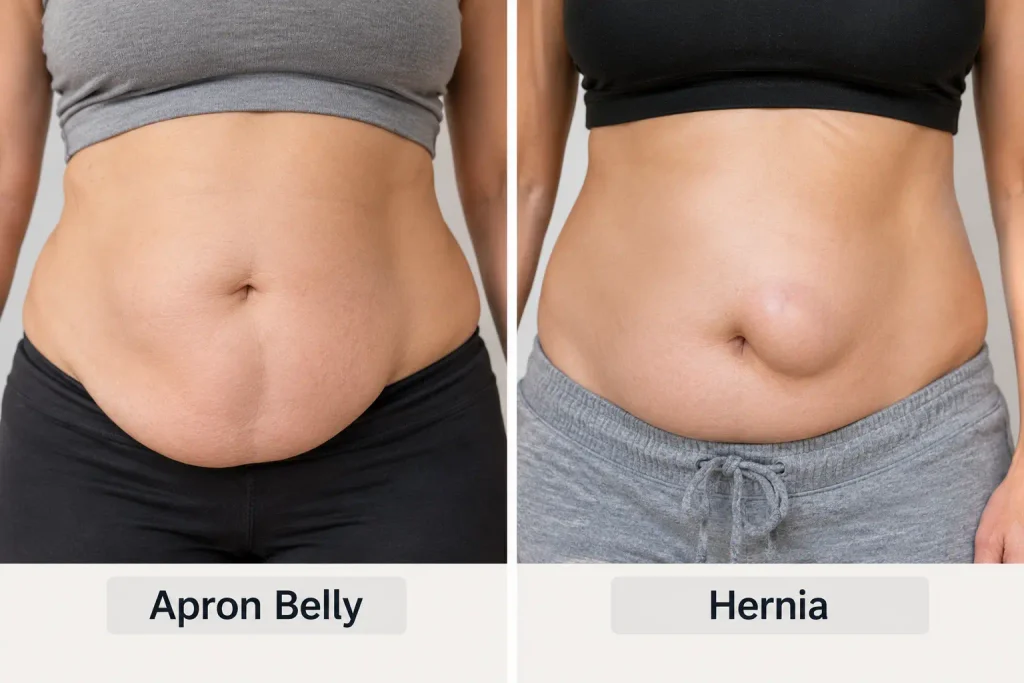
An umbilical hernia usually feels firmer than the surrounding tissue, almost like a small, distinct lump you can feel beneath the skin, rather than a soft fold of skin and fat. It often changes size depending on your position, appearing more prominent when you stand, cough, or strain, and sometimes reducing or disappearing when you lie flat and relax. An apron belly, by contrast, stays relatively consistent regardless of position, since it’s primarily skin and tissue rather than an organ pushing through a gap.
Location matters too. An umbilical hernia sits specifically at or very near the belly button itself, as a defined lump. An apron belly is broader, often extending well below the belly button and sometimes down toward the pubic area, presenting as a hanging fold rather than a single point of bulging.
Pain is another clue, though not a reliable one on its own. A hernia can cause localised pain or discomfort, particularly with smaller hernias, while an apron belly on its own is typically not painful unless skin irritation or back strain is also present.
Diastasis Recti vs a True Hernia
This is where things get genuinely confusing, even for some healthcare providers unfamiliar with postpartum changes specifically. Diastasis recti is a separation of the abdominal muscles, not a hole in the muscle wall. It can cause doming or bulging along the midline when you engage your core, which looks similar to a hernia at first glance.
The key difference lies in what’s actually happening underneath. With diastasis recti, your organs stay in their normal position, simply with less muscular support in front of them. With a hernia, tissue or organ content physically pushes through a gap and sits somewhere it shouldn’t. A hernia can technically develop within an area of diastasis recti, since the weakened, separated muscle creates a more vulnerable spot, but the two aren’t automatically the same thing.
How to Check What You’re Dealing With
A simple self-check can help you get a clearer picture, though it’s never a substitute for a proper medical assessment. Lie on your back with your knees bent and lift your head and shoulders slightly off the floor, as if starting a crunch. Feel along your midline above and below your belly button.
A gap you can press into, with no distinct firm lump, that lies flat again when you relax, points toward diastasis recti. A firm, localised lump that doesn’t flatten the same way, especially one that becomes more noticeable when you cough or strain, warrants a GP visit to rule out a hernia specifically.
If you’re ever unsure, don’t try to diagnose yourself with certainty. A GP can usually tell the difference quickly through examination, and an ultrasound can confirm it when needed.
When to Worry About a Stomach Bulge
So when to worry about a stomach bulge specifically, beyond simply noticing it’s there? A bulge that’s soft, consistent, and doesn’t change much with position or straining is usually not an emergency concern, even if it’s uncomfortable or something you want addressed eventually.
Pay closer attention if the bulge is new, grows larger over a short period, becomes more prominent specifically when you cough or strain, or causes localised discomfort that wasn’t there before. These features don’t necessarily mean an emergency, but they’re a good reason to book a GP appointment rather than wait and see.
Warning Signs of a Medical Emergency
This is the most important section of this entire article, so please read it carefully. According to NHS guidance, you should go to your nearest A&E immediately if you have a hernia or a suspicious bulge and any of the following develop:
The bulge becomes firm, tender, or painful, and you can no longer push it back in, where previously it moved or reduced with position changes. You experience sudden, severe pain at the site of the bulge. You develop nausea, vomiting, or a complete inability to pass wind or have a bowel movement alongside the bulge.
These symptoms can indicate a strangulated hernia, where the blood supply to trapped tissue has been cut off, or an obstructed bowel, where part of the intestine becomes trapped and blocked. Both are genuine medical emergencies that need immediate treatment, since a strangulated hernia can become life-threatening if blood supply isn’t restored quickly.
To be clear: an ordinary apron belly, even one involving diastasis recti, does not carry this risk. These emergency warning signs specifically relate to a true hernia. If you’ve already been told your bulge is diastasis recti or soft tissue rather than a hernia, you don’t need to carry this fear forward. But if you’ve never had it properly assessed, or if anything changes suddenly, treat these symptoms seriously and seek urgent care rather than waiting.
What Happens If It Is a Hernia?
A confirmed hernia doesn’t always mean immediate surgery. Many hernias, particularly small or symptom-free ones, are simply monitored over time. Surgery becomes more likely if the hernia causes ongoing pain, grows larger, or starts affecting your daily activities. In some cases, particularly where a hernia coincides with an apron belly and diastasis recti, surgeons can address the hernia repair alongside a tummy tuck or panniculectomy procedure, tightening the muscle wall and removing excess skin in a single operation.
Exercising Safely If You’re Unsure
Until you’ve had a proper assessment, it’s worth being cautious with your exercise routine. Avoid heavy lifting, intense core exercises, and anything that causes straining or significant abdominal pressure. Our belly exercises guide includes gentle, low-risk options that are generally safe even if a hernia hasn’t yet been ruled out, though it’s always worth checking with your GP first if you have any doubt about your specific situation.
Conclusion
Most of the time, what you’re noticing is an apron belly, sometimes alongside diastasis recti, and neither carries the same risk as a true hernia. But the two can look similar enough on the surface that a proper check matters, especially if your bulge is new, firm, growing, or behaves differently to how it used to. Know the emergency warning signs: a bulge that becomes firm and won’t push back in, sudden severe pain, or nausea and vomiting alongside it. These need urgent care immediately. Everything else is worth a calm, unhurried conversation with your GP, who can examine you properly and give you the clarity you’re looking for.
Frequently Asked Questions
Can diastasis recti turn into a hernia over time?
Diastasis recti itself doesn’t become a hernia, but the weakened, separated muscle tissue can create a more vulnerable area where a true hernia is slightly more likely to develop, particularly under strain.
Is a hernia under an apron belly harder to spot?
Yes, a hernia can be more difficult to notice or feel under an apron belly, since the overlying skin and fat can mask a smaller lump. This is part of why a proper examination matters if you’re unsure.
Can you push a hernia back in, and is that safe to do yourself?
Many hernias are reducible, meaning they can be gently pushed back in, and this is often fine for an established, previously assessed hernia. However, if a bulge suddenly becomes firm and won’t go back in, this is an emergency sign and needs immediate medical attention rather than continued attempts at home.
Do all hernias need surgery?
No, many hernias are simply monitored, especially if they’re small and symptom-free. Surgery is more often recommended if the hernia causes pain, grows larger, or risks complications like strangulation.
Is it common to develop a hernia after pregnancy, alongside an apron belly?
Yes, pregnancy increases pressure on the abdominal wall and can weaken areas prone to hernias, particularly around the belly button. It’s one of several reasons a proper check is worth having if you notice any new bulge postpartum.