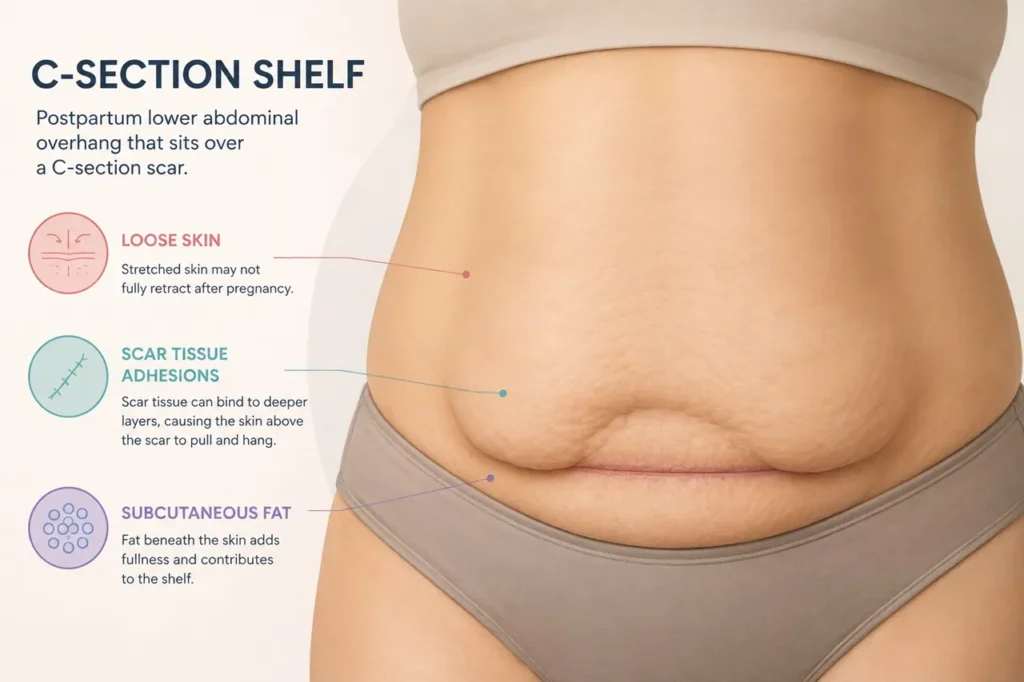
An apron belly hanging over a C-section scar is often called a C-section shelf. It is a fold of skin and fat above the incision. It forms from stretched skin, scar tissue that tethers to deeper layers, and sometimes diastasis recti. Scar massage, gentle core rehabilitation and time can help. Surgery is an option if the overhang persists.
Key takeaways
- A C-section shelf can come from loose skin, fat, scar adhesions or diastasis recti.
- Scar massage usually starts around six to eight weeks, once the incision has fully closed.
- Avoid crunches and sit-ups early on, as they can worsen diastasis recti.
- Compression garments give support but do not permanently reshape tissue.
- A tummy tuck or panniculectomy may help if non-surgical methods do not work.
If you’re noticing an apron belly hanging over your C section scar, you are far from alone. Many postpartum mothers experience this exact overhang, often called a c-section shelf, and it can feel confusing, frustrating, and even a little isolating in the months after surgical delivery. Your body has just done something remarkable; however, that does not make the physical changes any easier to process.
This shelf typically forms from a combination of factors: stretched skin that has not fully retracted, scar tissue that has bonded to deeper layers during surgical incision healing, and sometimes an underlying separation in the abdominal wall. As a result, the area above the scar can protrude or fold, creating the pouch-like appearance many describe as an “apron.”
This guide walks you through why the overhang happens, how to tell what you’re actually dealing with, and which management options are genuinely safe during postpartum recovery.
What is a C-Section Shelf? (Understanding the Overhang)
Defining the Postpartum Skin Apron
A postpartum skin apron refers to the fold of overhanging abdominal skin that sits above or around a C-section scar. Because pregnancy stretches the skin a great deal, the skin does not always return to its pre-pregnancy tightness once the baby arrives. Additionally, if the scar has tethered to the underlying tissue, the skin above it can appear to hang rather than lie flat.
The Role of Subcutaneous Fat vs Visceral Fat
Not all of the overhang is skin. Subcutaneous fat, which lies just beneath the skin’s surface, often contributes to the shelf’s fullness. Visceral fat, on the other hand, sits deeper around the organs and is not usually what causes the visible overhang. Understanding this distinction matters because it changes which strategies will actually be effective for you.
Why Does an Apron Belly Form After a Caesarean Delivery?
The Impact of Surgical Incision Healing
Surgical incision healing is not a simple, linear process. As the body repairs the incision, it lays down new tissue in layers, and this tissue does not always heal with the same elasticity as the surrounding skin. Because the incision sits low on the abdomen, the skin directly above it is the area most likely to fold or hang once swelling subsides.
How Fibrous Scar Tissue Causes Adhesions
Fibrous scar tissue can form scar tissue adhesions, which are essentially areas where the healing tissue binds to the layers beneath it, such as the fascia or abdominal muscles. When this happens, the skin above the adhesion has less mobility, so it tends to pucker, pull, or hang rather than move freely. This is one of the most overlooked reasons an apron belly hanging over a C-section scar persists even after weight has stabilised.
Is It Fat, Loose Skin, or Scar Tissue Adhesion?

How to Tell the Difference Between Fat and a “Shelf”
A useful way to check is to lie flat and gently lift the overhanging tissue with your hand. If it moves freely and feels soft throughout, it is likely mostly skin and fat. However, if you feel a tight band, dimpling, or resistance near the scar line itself, scar tissue adhesion may be playing a bigger role than fat.
Checking for Underlying Diastasis Recti (Abdominal Separation)
Diastasis recti, or abdominal muscle separation, is common after both vaginal and caesarean births. To check, lie on your back with your knees bent, lift your head slightly, and feel along the midline of your stomach for a gap between the muscles. A noticeable gap can add greatly to the appearance of overhanging skin, because the abdominal wall is no longer providing the same underlying support it did before pregnancy.
Safe Ways to Manage and Reduce a C-Section Shelf
The Power of Scar Massage and Mobilisation Techniques
Scar massage techniques are one of the most effective, low-risk ways to address adhesions once your incision has fully closed and your GP or midwife has cleared you for touch, usually around six to eight weeks postpartum. Gentle circular motions and scar mobilisation along and around the incision line can help loosen bound tissue over time, potentially reducing the tethered, hanging appearance.

Postpartum Core Strengthening Exercises (What to Avoid & What to Do)
Postpartum core strengthening should begin gently, focusing on deep core activation, such as diaphragmatic breathing and pelvic floor engagement, before progressing to more intense exercises. Avoid traditional crunches or sit-ups early on, because these can worsen diastasis recti if the connective tissue is not yet ready to handle that load. Instead, exercises like heel slides, modified planks, and transverse abdominis activation tend to be safer starting points.
Using Compression Garments for Postpartum Support
Compression garments, including postpartum belly wraps, can provide support to the abdominal wall as it heals, and many mothers find them reassuring during the early recovery weeks. That said, they are a support tool rather than a permanent fix, so they work best alongside scar mobilisation and core rehabilitation, not as a standalone solution.

Medical and Advanced Options for Severe Overhangs
When Non-Invasive Methods Aren’t Enough
For some mothers, consistent scar work, core rehabilitation, and time still leave a persistent overhang. This does not mean anything was done wrong; it often simply reflects how much the skin and tissue were stretched, or how severe the scar adhesion became during healing.
Considering Surgical Correction (Tummy Tuck / Panniculectomy)
Surgical correction, such as a tummy tuck or panniculectomy, remains an option for those whose overhang does not respond to non-surgical approaches. Abdominoplasty removes excess skin and can tighten the underlying muscles, while a panniculectomy focuses specifically on removing the hanging apron of tissue without necessarily addressing muscle separation.
These are major operations. Before deciding, book a consultation with a consultant plastic surgeon on the GMC Specialist Register. NHS funding for this surgery is rare and has strict criteria, so speak to your GP first. Private medical insurance usually excludes cosmetic surgery. See our guide to apron belly surgery costs in the UK.
Frequently Asked Questions
For some mothers, a mild overhang improves gradually over 12 to 18 months as swelling settles and scar tissue softens. However, if adhesions or diastasis recti are the main cause, the shelf often needs targeted scar massage or core rehabilitation to improve noticeably.
Most clinicians advise waiting until the incision is fully closed and checked at your postnatal check with your GP, usually around six to eight weeks. Starting scar mobilisation too early can irritate tissue that is still actively healing.
Not always. Loose skin is one contributor, but fibrous scar tissue adhesions and underlying diastasis recti can also create the hanging appearance, even in mothers with relatively little excess skin.
Core strengthening can improve muscle support and posture, which often reduces how prominent the shelf looks. That said, exercise generally cannot resolve scar tissue adhesions or remove excess skin, so it works best alongside scar work rather than as the only approach.
No. Compression garments offer temporary support and comfort during healing, but they do not permanently reshape tissue. Once you stop wearing them, the underlying tissue returns to its natural state unless other changes have taken place.
Surgical correction is usually considered only after non-invasive methods, such as scar mobilisation and core rehabilitation, have been consistently attempted for a meaningful period without sufficient improvement. A consultation with a qualified surgeon can clarify whether abdominoplasty or panniculectomy is appropriate for your specific situation.
Final Thoughts
Recovery from a caesarean birth is rarely quick, and the postpartum recovery timeline looks different for every mother. Because tissue healing and scar remodelling can continue for well over a year, patience matters as much as any specific technique. If you’re unsure which category your overhang falls into, or you want tailored guidance, consulting a women’s health physiotherapist or your GP is always a sensible next step, and it can help you feel more confident about the path forward.