

If you’ve spent months trying to flatten your stomach and nothing seems to work, there’s a good chance you’ve been treating the wrong problem. People use “Belly fat” and “apron belly” interchangeably online, but they describe two genuinely different conditions, and the advice that works well for one can do almost nothing for the other. Understanding which one you actually have changed everything about your approach, from the exercises worth prioritising to whether diet alone can ever get you the result you’re picturing.
This distinction matters more than most articles let on. Apron belly vs belly fat isn’t just a semantic difference; it’s the difference between a fat-storage issue that responds predictably to a calorie deficit, and a structural issue involving skin elasticity and muscle separation that often needs a completely different plan. Getting this right early can save months of frustration with a routine that was never going to work for your specific situation.
What Is Belly Fat?
Belly fat refers to fat that has accumulated in and around the abdomen, and it generally comes in two forms. Subcutaneous fat is the soft, pinchable layer that sits directly beneath the skin, while visceral fat sits much deeper, wrapping around internal organs such as the liver, pancreas, and intestines. Of the two, visceral fat is the one worth paying closer attention to, since it is metabolically active. It releases hormones and inflammatory compounds that researchers linked to insulin resistance, type 2 diabetes, and cardiovascular disease, regardless of how visible it is from the outside.
The encouraging part of dealing with belly fat, in either form, is that it responds to the same well-established levers that affect fat everywhere else in the body: calorie balance, physical activity, sleep quality, and stress management. There is no way to spot-reduce fat from just the stomach with targeted ab exercises alone, but consistent overall fat loss does reduce abdominal fat along with fat stored elsewhere. This is why belly fat, frustrating as it can be, is usually the more straightforward of the two conditions to address once you commit to a sustainable routine.
What Is an Apron Belly?
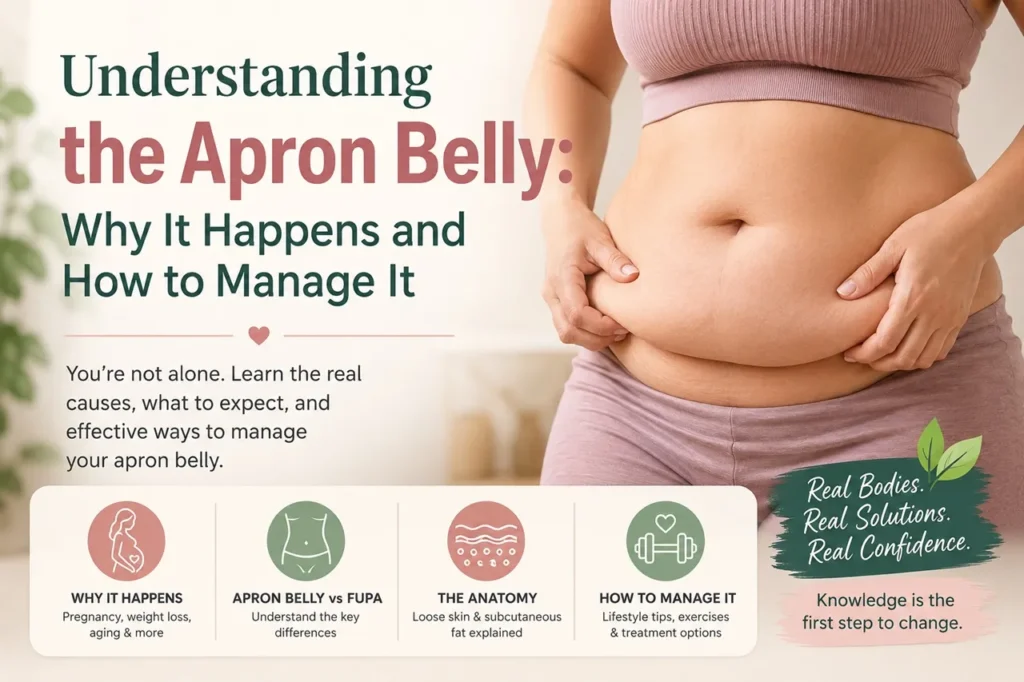
An apron belly, medically referred to as a panniculus, is a different phenomenon altogether. Rather than being an even layer of stored fat, it is a fold of loose skin and fatty tissue that hangs down over the lower abdomen, sometimes far enough to drape over the pubic area or a C-section scar. It tends to develop after pregnancy, significant weight loss, or simply as a result of aging skin losing its elasticity over time.
What sets an apron belly apart from ordinary belly fat is the combination of factors involved. Pregnancy or weight loss often stretches the skin beyond its ability to fully retract., which is a structural issue rather than a fat-storage issue. Many women also develop diastasis recti alongside it, a separation of the abdominal muscles along the midline that reduces core support and can make the overhanging tissue look and feel more pronounced. The result is a hanging, draping shape rather than the smoother, evenly distributed layer typically associated with belly fat. In short, belly fat is primarily a volume problem, while an apron belly is largely a structural one, involving skin and often muscle, not fat alone.
How Apron Belly and Belly Fat Actually Differ
The clearest way to separate the two is to think about causes and composition rather than appearance alone. Belly fat tends to build up gradually as a result of diet, inactivity, genetics, or hormonal shifts, and it responds fairly predictably to diet and exercise changes. An apron belly, on the other hand, is much more strongly associated with specific life events: pregnancy, a caesarean section, or a substantial and often rapid amount of weight loss. Because an apron belly frequently involves diastasis recti, it also comes with functional concerns that plain belly fat does not, such as reduced core stability, lower back discomfort, and in some cases skin irritation in the folded area.
Another important difference lies in what treatment can realistically achieve. Diet and exercise can meaningfully reduce belly fat over time, and improvements are usually visible within weeks to months of consistent effort. An apron belly responds only partially to the same approach. Exercise can rebuild the underlying core muscles and reduce the fat component within the overhang, and this often improves both appearance and comfort, but loose skin does not shrink through diet or exercise alone. For more pronounced cases, this is where surgical options such as a panniculectomy sometimes enter the conversation, something that is rarely relevant for belly fat on its own.
How to Tell Which One You Actually Have
A simple combination of observation and a basic physical check can usually clarify which condition you’re dealing with. Start by looking at the shape of your stomach while standing naturally: belly fat tends to sit as one rounded area, while an apron belly visibly hangs, folds, or drapes, particularly when you sit down or bend forward. Next, try gently pinching the tissue at your lower abdomen. Belly fat generally feels like a consistent, even layer, whereas the tissue involved in an apron belly often feels looser, with a fold of skin that can be lifted away from the body rather than simply pinched.
It’s also worth checking for a gap along your abdominal midline, since a wider-than-normal separation points toward diastasis recti rather than fat alone. Your personal history matters here too. If the change in your stomach appeared fairly suddenly after pregnancy, a C-section, or a significant and rapid weight loss, it is considerably more likely to involve loose skin and possible muscle separation rather than fat accumulation on its own. If you remain unsure after considering all of this, a GP or a women’s health physiotherapist can assess the area properly in a matter of minutes and give you a clear answer.
What Actually Helps Belly Fat
Because belly fat responds to general fat loss, the underlying strategy is fairly straightforward, even though it requires consistency to see results. A modest, sustainable calorie deficit remains the most reliable driver of fat loss over time, and it works far better than short-term crash diets that are difficult to maintain. Regular physical activity supports this process from two directions: cardiovascular exercise increases the calories you burn, while strength training helps preserve lean muscle mass as fat is lost, which keeps your metabolism working in your favour. Sleep and stress management are often overlooked, but both directly affect the hormones that influence where and how the body stores fat, so improving either can meaningfully support your progress. Rather than relying solely on the bathroom scale, tracking your waist measurement over several weeks tends to give a clearer picture of whether abdominal fat specifically is decreasing.
What Actually Helps an Apron Belly
Because an apron belly usually involves skin and muscle in addition to fat, an effective approach needs an extra layer beyond standard fat-loss advice. Deep core rehabilitation is the priority for anyone with diastasis recti, and this means gentle, staged exercises that reconnect and strengthen the deep abdominal muscles, rather than jumping straight into crunches or sit-ups, which can worsen the separation if done too early. General fat loss still plays a meaningful role here as well, since reducing the fat component within the overhanging tissue can make the remaining skin considerably less prominent, even if it doesn’t disappear completely.
Supporting skin health through adequate protein intake, proper hydration, and sufficient vitamin C can help collagen production, although it’s worth being realistic that this has real limits once skin laxity becomes significant, and no supplement or cream will fully reverse stretched skin on its own. For more pronounced cases, particularly after major weight loss or multiple pregnancies, a conversation with a GP about surgical options like a panniculectomy becomes a reasonable and often necessary part of the discussion, rather than something to feel discouraged about needing.
When Both Conditions Overlap
It’s entirely possible, and actually quite common, to have both an apron belly and a layer of general belly fat at the same time. In these cases, the two approaches described above aren’t mutually exclusive; they work best when combined. Reducing overall body fat through diet and activity shrinks the fat component of the apron belly while also addressing any separate visceral or subcutaneous fat elsewhere in the midsection, and building deep core strength alongside this supports both conditions simultaneously by improving posture, stability, and the overall appearance of the area.
In Summary
If your midsection presents as one consistent layer regardless of your personal history, you are most likely dealing with belly fat, and general fat-loss strategies should produce steady, visible improvement over time. If the area hangs, folds, or appears specifically after pregnancy, a C-section, or major weight loss, you’re more likely dealing with an apron belly, which requires addressing skin and core strength directly rather than relying on calorie counting alone. Getting an accurate read on which condition you’re facing, ideally with input from a GP or physiotherapist where diastasis recti is suspected, is the single most useful step you can take before choosing a plan, since it stops you wasting months on an approach that was never designed to solve your specific problem.
Frequently Asked Questions
Can losing weight get rid of an apron belly?
Weight loss reduces the fat component of an apron belly and can noticeably improve its appearance, but it typically won’t resolve loose skin on its own, since skin laxity is a structural change rather than a fat-storage issue.
Is apron belly the same as visceral fat?
No. Visceral fat is internal fat stored around your organs and isn’t usually visible as loose or hanging tissue, whereas an apron belly is an external fold of skin and fat, sometimes accompanied by muscle separation.
Should I focus on cardio or core exercises first?
Both matter, but if diastasis recti is present, deep-core rehabilitation should generally come before intense ab work, since traditional crunches and sit-ups can widen the muscle separation rather than close it.
How long does it take to see results from apron belly exercises?
Many women notice improved core strength and stability within a few weeks of consistent, appropriately staged exercise, though visible changes to the overhanging tissue typically take several months and depend on how much fat versus skin is involved.
Does an apron belly always require surgery?
No. Many cases improve meaningfully with core rehabilitation and general fat loss alone. Surgery such as a panniculectomy is generally considered only when excess skin is significant and isn’t responding to non-surgical approaches, or when it’s causing ongoing discomfort or skin irritation.
Can men develop an apron belly too?
Yes. While it’s most commonly discussed in relation to pregnancy and childbirth, men can develop an apron belly as well, most often following substantial weight loss or as a natural result of ageing skin.
What’s the difference between an apron belly and a FUPA?
The two are often confused, but a FUPA (fat upper pubic area) refers specifically to localised fat above the pubic bone, whereas an apron belly involves a broader area of hanging skin and tissue that can extend well above the pubic region, often including the navel area.
Is it normal for an apron belly to cause back pain?
It can, particularly when it’s accompanied by diastasis recti, since weaker core muscles provide less support for the spine. Persistent back pain alongside an apron belly is worth discussing with a GP or physiotherapist rather than assuming it will resolve on its own.
Can I prevent an apron belly during pregnancy?
You can’t fully prevent it, since skin stretching is a normal and necessary part of accommodating a growing baby, but maintaining steady, gradual weight gain within recommended ranges and staying active where possible may help reduce the extent of skin stretching for some women.