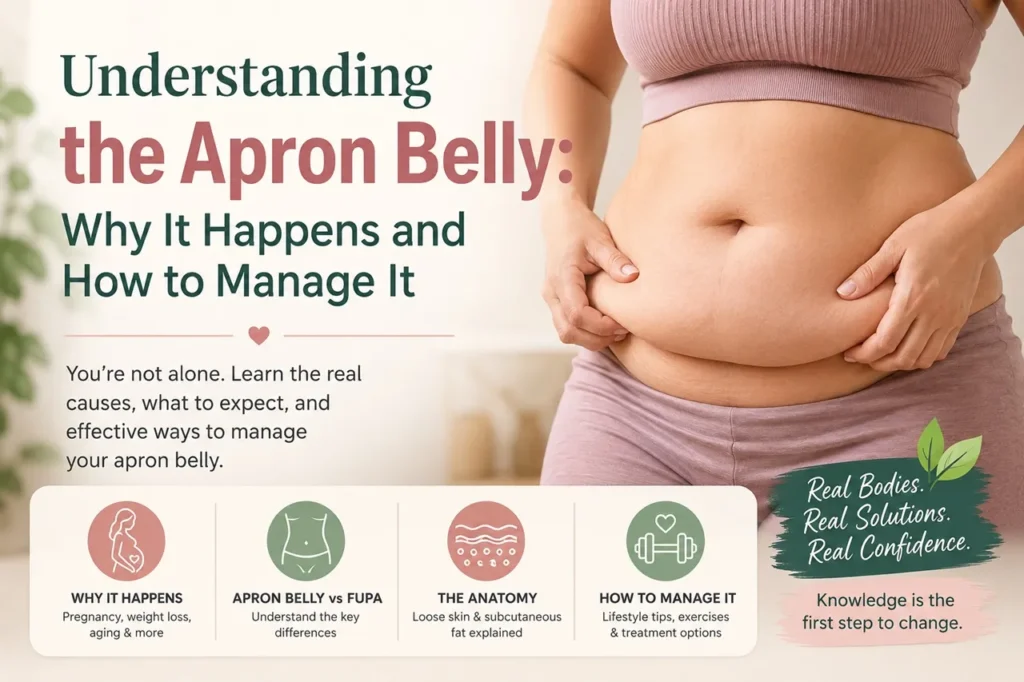

To reduce an apron belly naturally, focus on a consistent, moderate calorie deficit paired with enough protein and fibre to preserve muscle and manage hunger. No single food targets the lower abdomen. Diet and nutrition are the most controllable levers most people have, but results depend on what’s actually driving your apron belly.
If you’ve landed here wondering whether changing what you eat can actually make a difference to an apron belly, the short answer is: it depends on what’s driving yours. Diet and nutrition are central to managing body fat, and for many people that’s a large part of the picture.
But this guide won’t pretend that eating more broccoli will target your lower abdomen specifically, because that’s not how the body works. What it will do is cut through the noise and give you a clear, practical framework, grounded in UK food reality, for using nutrition and diet in a way that’s actually sustainable.
What do diet and nutrition mean in practice?
Your diet is the pattern of food and drink you consume over time: your habitual eating rather than a temporary restriction. Nutrition is the science of how those foods affect your body: how they’re broken down, what they provide, and what happens when you consistently get too much or too little of something.
The phrase “diet and nutrition” gets used so loosely that it’s worth pinning down what it actually means before going any further. Understanding what is nutrition and diet in this combined sense matters because the two are inseparable. You can follow a “diet” that cuts calories dramatically but delivers almost no protein, fibre, or micronutrients, and it will likely fail you. Equally, you can eat nutritiously but in quantities that maintain or increase body fat. Effective apron belly management requires both sides of that equation working together.
Here is a plain-English example. Imagine two people who both eat about 1,800 kcal a day. One eats mostly processed foods: white bread, crisps, sugary drinks and ready meals. The other eats lean protein, vegetables, wholegrains and some healthy fats. Their calorie intake is the same, but the second person is likely to feel fuller, keep more muscle and find the pattern easier to stick with. That is what good nutrition adds to a calorie budget: food that does more work for your body.
In the UK context, this means working with real food (supermarket staples, meal deals and the occasional takeaway) rather than an idealised plan that assumes unlimited time, money, and willpower. The principles below are designed with that in mind.
How should you think about reducing an apron belly through diet?
Before jumping to meal plans or food lists, it helps to build a mental model of what you’re actually trying to achieve. An apron belly can involve subcutaneous fat (the soft fat directly under the skin), visceral fat (deeper fat around the organs), loose or stretched skin, or some combination. If you’re unsure which applies to you, it’s worth reading our guide to what an apron belly is first, because diet can only directly influence the fat components, not skin laxity.
Once you understand what you’re working with, the nutrition and diet framework becomes clearer. The goal isn’t a crash diet. It’s a consistent, moderate calorie deficit combined with enough protein and fibre to preserve muscle, manage hunger, and support overall health.
What is the core problem to understand?

The fundamental issue with most attempts to improve diet and nutrition is that people try to change too much at once. They overhaul breakfast, lunch, dinner, and snacks simultaneously, cut out foods they enjoy, and then find the whole thing unsustainable within two weeks.
The more useful framing is this: body fat accumulates when energy intake consistently exceeds energy expenditure over time. To reduce it, you need the reverse: a consistent, modest deficit. The NHS weight loss plan is based on cutting about 600 kcal a day, which supports gradual, sustainable fat loss. That doesn’t mean obsessively counting every calorie, but it does mean having a realistic sense of what you’re eating and where the excess is coming from.
Protein deserves particular attention here. It’s the macronutrient most people in the UK under-consume relative to what supports fat loss. Adequate protein (roughly 1.2 to 1.6 grams per kilogram of body weight per day is a commonly cited range) helps preserve lean muscle during a calorie deficit, keeps you fuller for longer, and has a higher thermic effect than fat or carbohydrate, meaning your body uses more energy to process it. Practical sources include eggs, chicken, tinned fish, Greek yoghurt, lentils, and cottage cheese, none of which require a specialist health food shop.
Fibre is the other underappreciated pillar. Most adults in the UK consume well below the recommended 30 grams per day. Fibre slows digestion, blunts blood sugar spikes, feeds beneficial gut bacteria, and, importantly for anyone managing appetite, makes meals feel more substantial. Oats, beans, lentils, wholegrain bread, and vegetables are the most accessible sources.
How do you choose a diet approach you can actually maintain?

When deciding how to structure your nutrition and diet, the most useful criteria aren’t about finding the “best” diet in the abstract. They’re about finding an approach that you can actually maintain.
Start with one simple diagnostic question: is your current eating pattern creating a calorie surplus, poor food quality, or both? If your portions are large and your weight has been creeping up, the calorie side needs attention first. If you already eat around maintenance but rely on ultra-processed foods with little protein or fibre, improving food quality is likely to give you the best return. Most people benefit from working on both, one small step at a time.
A typical UK example is the supermarket meal deal. Swap a white-bread sandwich, crisps and a sugary drink for a wholegrain wrap with chicken or eggs, a piece of fruit and water. That single change lowers the calorie density of your lunch and improves its nutritional quality at the same time. It is not dramatic, but swaps like this add up over weeks and months.
Ask yourself: Can I eat this way most of the time, not just for a fortnight? Does it include enough protein to protect muscle? Does it include enough fibre to manage hunger and digestion? And does it allow for social eating, work lunches, and the occasional takeaway without derailing everything?
If the answer to any of those is no, the approach probably isn’t right for you regardless of how well it works in theory. There is no single correct nutrition and diet pattern for fat loss. Mediterranean-style eating, higher-protein approaches, and simple portion control all have evidence behind them. Put simply: a higher-protein approach suits people who struggle with hunger, while Mediterranean-style eating works best for those who want variety and flexibility. The common thread is a sustained calorie deficit with adequate protein and fibre. The vehicle matters less than the consistency.
Meal structure also plays a practical role. Skipping meals to create a deficit often backfires because it increases hunger later in the day, leading to larger portions or impulsive choices. Three meals with protein and fibre at each tends to distribute appetite more evenly. That said, some people do well with two larger meals. What matters is that the structure works for your schedule and keeps hunger manageable.
What are the most common mistakes to avoid?

The most common mistake in diet and nutrition for fat loss is treating it as a binary: either you’re “on” a diet or you’re not. This thinking makes every imperfect meal feel like a failure, which often leads to abandoning the effort entirely. A more useful frame is that nutrition operates on averages. One high-calorie meal doesn’t undo a week of good habits; equally, one salad doesn’t compensate for a week of excess.
A second mistake is prioritising restriction over quality. Cutting calories by removing protein and fibre, eating less but not better, leaves you hungry, low in energy, and more likely to lose muscle rather than fat. The deficit should come primarily from reducing ultra-processed foods, excess refined carbohydrates, and calorie-dense drinks (alcohol, sugary drinks, high-calorie coffees), not from eating less of the foods that keep you full and nourished.
A third mistake, particularly relevant when people are trying to figure out how to get rid of apron belly, is expecting rapid results. Subcutaneous fat in the lower abdomen is often among the last to reduce as overall body fat decreases. That’s not a reason to give up. It’s a reason to set realistic expectations and focus on the process rather than a specific area.
Another mistake is assuming that “healthy” means low calorie. Avocado, nuts and olive oil are nutritious, but they are also calorie-dense. Large portions of healthy food can still keep you in a calorie surplus, so food quality and calorie awareness need to go together.
Liquid calories are also easy to overlook. Fruit juice, flavoured coffees and some shop-bought smoothies can add several hundred calories a day without feeling like food. Cutting back on these drinks is often the easiest way to reduce intake without feeling deprived.
Sleep and stress are easy to forget, too. Poor sleep and ongoing stress can both increase hunger, which makes a calorie deficit harder to stick to. Treat rest and stress management as part of the same plan as your food choices.
Finally, bloating is often confused with fat. If your lower abdomen feels distended and uncomfortable, particularly after certain meals, that may be a digestive issue rather than (or in addition to) fat accumulation. Common culprits include carbonated drinks, high-FODMAP foods, eating too quickly, and insufficient water intake. Addressing these can make a meaningful difference to how your abdomen looks and feels, even before any fat loss occurs.
How do you apply this to daily diet and nutrition?
Translating the above into daily practice doesn’t require a nutritionist or a meal prep obsession. It requires a handful of consistent habits applied most of the time.
- Anchor each meal around a protein source. This single habit tends to improve the nutritional quality of a meal automatically, because it crowds out less useful foods and keeps hunger in check for longer.
- Add a fibre source. Build the rest of the meal around vegetables, legumes, or wholegrains alongside your protein anchor.
- Reduce, rather than eliminate, calorie-heavy extras. In the UK diet, the biggest contributors tend to be alcohol, crisps and snack foods, high-sugar drinks, and large portions of refined carbohydrates. You don’t need to cut these out permanently, but being honest about how often and how much you’re consuming them is a necessary step.
- Watch portion sizes of calorie-dense foods. Oils, cheese, nuts, and sauces add up quickly and are easy to underestimate. This isn’t about fear of these foods; it’s about accuracy. It also helps to think about energy density, which is how many calories a food contains for its weight or volume. Vegetables and broth-based soups are low in energy density, so you can eat a large portion for relatively few calories. Biscuits and fried foods are high in energy density, so a small portion carries a lot of calories. Leaning towards lower energy-density foods is one of the most practical ways to eat less without feeling constantly hungry.
- Track loosely rather than obsessively. A food diary for even a week can be revealing, because most people are surprised by where their calories are actually coming from. You don’t need to track forever, but doing it periodically keeps your awareness calibrated.
- Stay hydrated. Thirst is frequently misread as hunger, and adequate water intake supports digestion, reduces bloating, and helps with overall energy levels. Aim for around 1.5 to 2 litres per day as a baseline, more if you’re active or the weather is warm.
Review your progress every 2 to 4 weeks. Fat loss, especially from the lower belly, is slow and rarely follows a straight line. Look for steady change over months rather than day-to-day swings on the scales, and adjust your portions or habits if nothing has moved.
If you have had a baby recently, the same principles apply, but the pace should be gentler. Avoid aggressive calorie restriction in the early months after birth, especially if you are breastfeeding. Speak to your GP or health visitor before making major changes to how you eat. The guide to the lower belly pooch after pregnancy covers postpartum changes in more detail.
For more detail on building habits that keep hunger manageable day to day, the guide on nutrition habits that keep you full covers the practical mechanics in depth.
FAQ about reducing apron belly through diet and nutrition
Can you reduce an apron belly naturally without surgery?
Yes, if the apron belly is driven primarily by fat rather than loose skin. A sustained, moderate calorie deficit with adequate protein and fibre reduces overall body fat over time, which can gradually shrink an apron belly. Loose or stretched skin, however, does not respond to diet alone.
How long does it take to reduce an apron belly through diet?
There is no fixed timeline, as it depends on your starting point, the size of your deficit, and your consistency. Lower-abdominal subcutaneous fat is often among the last to reduce, so meaningful change is usually measured in months rather than weeks.
What is diet and nutrition?
Diet refers to the foods and drinks you habitually consume; nutrition is the science of how those foods affect your body. Together, they describe both what you eat and what it does.
How can I improve my diet and nutrition?
Start by increasing protein and fibre at each meal, reducing ultra-processed foods and calorie-dense drinks, and eating at regular intervals to manage hunger. Small, consistent changes outperform dramatic short-term overhauls.
Can any food target apron belly fat?
No food or diet targets a specific body area. Improving nutrition and diet reduces overall body fat over time, which may gradually affect an apron belly if fat is a contributing factor.
Is a specific “apron belly diet” necessary?
No. There is no special apron belly diet. Mediterranean-style eating, higher-protein approaches, and simple portion control all work if they create a sustained calorie deficit with enough protein and fibre. The best approach is the one you can maintain within your real schedule and budget.
Should I focus on calories or food quality?
Both. A calorie deficit is what drives fat loss. Food quality helps you stay full, protects muscle and supports your overall health, which makes that deficit easier to keep up.
What diet mistakes hold back apron belly progress?
Avoid treating nutrition as all-or-nothing, cutting protein and fibre to create a deficit, and expecting rapid spot reduction. These patterns undermine both results and long-term adherence.
Recommended next steps
If you’ve read this far, you have a clearer foundation than most people who start searching for how to get rid of apron belly. The next step isn’t finding a more complicated plan. It’s applying the basics consistently. Anchor meals around protein and fibre, reduce the foods that add calories without satiety, and give the process enough time to work.
For those working with a limited food budget, the guide on eating well on a tight UK budget translates these principles into practical, affordable choices without requiring premium ingredients.
Diet and nutrition are not a quick fix, but they are the most controllable lever available to most people. Understanding what nutrition and diet mean, and applying that steadily, is where meaningful, lasting change begins.