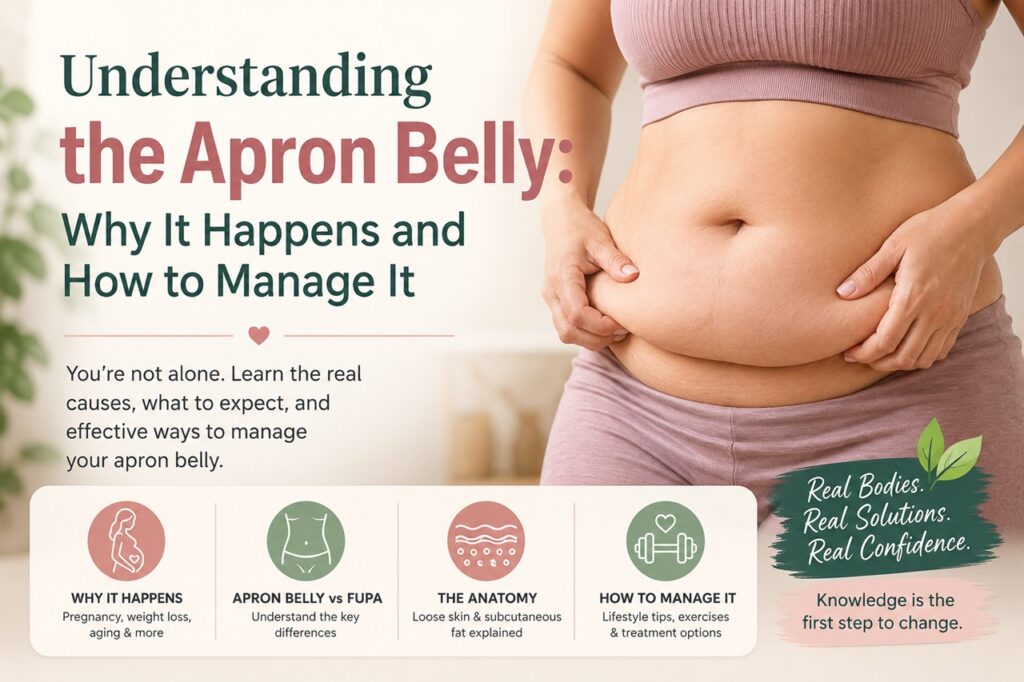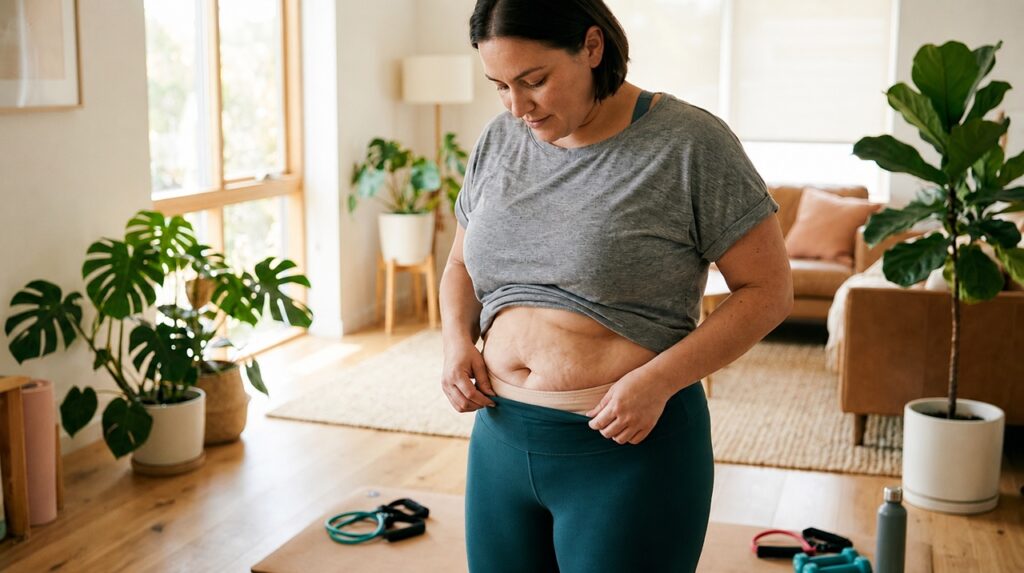

You cannot spot-reduce fat from an apron belly through exercise alone. However, consistently strengthening the transverse abdominis and pelvic floor muscles can significantly improve core strength, posture, and the overall appearance of the lower belly. The most effective approach combines targeted apron belly exercises with a sustained caloric deficit.
If you’ve been searching for apron belly exercises late at night, you already know the frustration. You’ve probably tried crunches. Maybe a few leg raises. And yet that lower belly overhang, medically called a panniculus, seems completely unmoved by your efforts. That doesn’t reflect how hard you’re working. It reflects how most ab workouts are designed.
Crunches alone won’t reduce a lower belly pouch. The real work happens deeper, literally. The muscles you need to target sit beneath the surface, and most traditional ab exercises never reach them.
This guide by the Apron Belly Experts breaks down which apron belly exercises are worth your time, how to do them safely, and what else you need to do alongside your workouts for real, lasting change. Whether you’re postpartum, recovering from a C-section, or dealing with the effects of weight changes on your body, there’s a smarter way to approach this.
Does Spot Reduction Work for Apron Belly Fat?
No. Spot reduction does not work. No exercise targets fat loss from one specific area of the body. When you burn calories, your body decides where to pull fat from based on genetics, hormones, and overall energy balance.
So why bother with targeted apron belly exercises?
Because while you can’t direct fat loss, you absolutely can strengthen and tone the muscles beneath the overhang. A stronger, more engaged deep core improves posture, reduces lower-belly protrusion, and creates a tighter, better-supported midsection. Over time, especially when combined with overall fat loss strategies, these changes become genuinely noticeable.
The goal of apron belly exercises isn’t to shrink fat through ab work. The goal is to build the internal support structure that holds everything in more effectively.
Why Does Targeting the Deep Core Matter for Apron Belly Results?
Most people train the superficial muscles, the rectus abdominis, the so-called “six-pack” muscles. These flex during a crunch; they’re visible, and they dominate most fitness content. But for apron belly toning, the real work happens one layer deeper.
Why the Transverse Abdominis (TVA) Is the Key Muscle
The transverse abdominis (TVA) is your deepest abdominal muscle. It wraps around your midsection like a corset, compressing the abdominal contents and stabilizing the spine. When the TVA is weak or disengaged, the lower belly tends to push forward and downward, making the panniculus appear more pronounced.
Strengthening the TVA pulls everything in from the inside. This creates a flatter, more supported appearance even before significant fat loss occurs.
The Role of the Pelvic Floor in Apron Belly Exercises
The pelvic floor and TVA function as a team. Think of them as the floor and walls of a pressure chamber. When you engage your pelvic floor, the sensation of gently lifting and closing, similar to stopping urination mid-flow while activating your TVA, you create true deep core stability.
Postpartum recovery specialists and pelvic floor physiotherapists prioritize this kind of deep core strengthening because it delivers apron-belly results.
Best Apron Belly Exercises That Are Worth Doing
These movements focus on controlled activation rather than high-speed repetitions. Quality of engagement matters far more than quantity. Perform each exercise slowly, breathe consistently, and focus on feeling the correct muscles working.
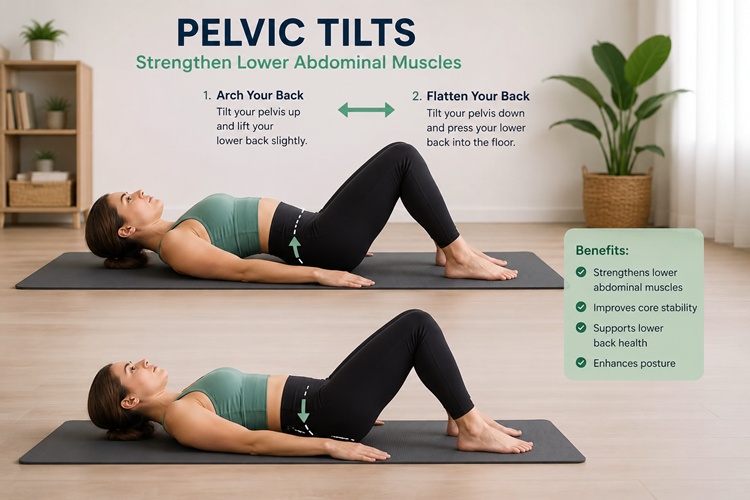
1. Pelvic Tilts
Pelvic tilt exercises are one of the safest and most effective starting points, especially for postpartum recovery or those new to core training.
How to do it:
- Lie on your back with your knees bent and feet flat on the floor.
- Breathe in to prepare. As you exhale, gently flatten your lower back against the floor by tilting your pelvis upward.
- Hold for 3 to 5 seconds, then release.
- Repeat 10 to 15 times.
What it does: Pelvic tilts engage the lower abs and reset posture by teaching the pelvis to move independently from the spine. They also activate the TVA in a controlled, low-impact way, making them ideal for building core engagement without strain.
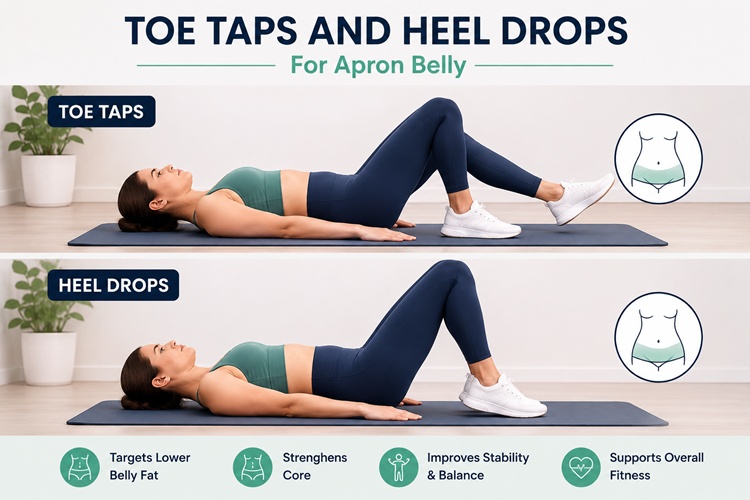
2. Toe Taps and Heel Drops
These movements isolate the lower rectus abdominis while protecting the lumbar spine. They’re more demanding than pelvic tilts but remain highly accessible.
How to do it:
- Lie on your back and lift both legs to a 90-degree angle (tabletop position).
- Breathe in. As you exhale, slowly lower one heel toward the floor, keeping the lower back pressed flat.
- Tap the floor (or stop just before), then return the leg to tabletop.
- Alternate sides for 10 to 12 reps per leg.
What it does: Lower ab exercises like this one teach you to stabilize the pelvis while moving the legs, a key skill that directly reduces lower belly protrusion. If your lower back arches off the floor, stop and reset. That arch signals the core has lost control of the movement.
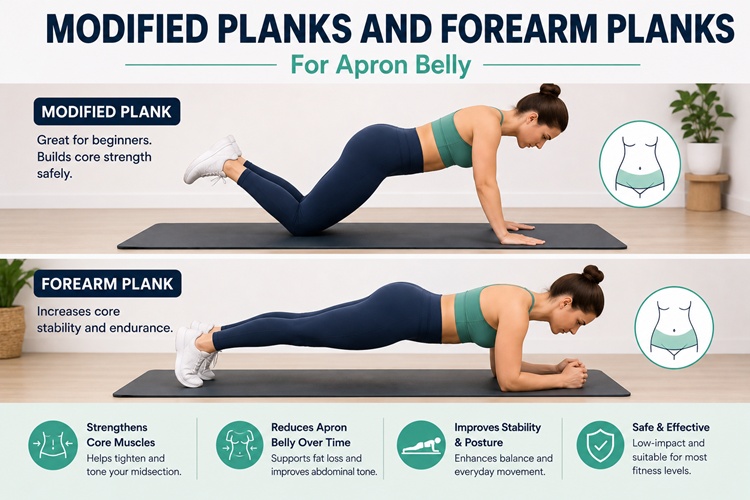
3. Modified Planks and Forearm Planks
Planks are among the most efficient core stability movements available at the same time. They train the TVA, obliques, and pelvic floor simultaneously without a single crunch.
How to do it (modified version):
- Start on your hands and knees.
- Walk your hands forward until your body forms a straight line from your head to your knees.
- Hold for 20 to 30 seconds, keeping your hips level and core gently braced.
Progressing to a forearm plank:
- Lower onto your forearms, with elbows directly beneath your shoulders.
- Extend your legs so your body forms a straight line from head to heels.
- Hold for 20 to 45 seconds.
What it does: These positions build overall core stability and endurance. They’re especially useful for strengthening the connection between the TVA and the rest of the core, which is essential for apron belly toning over time.
4. Bird-Dog Exercise
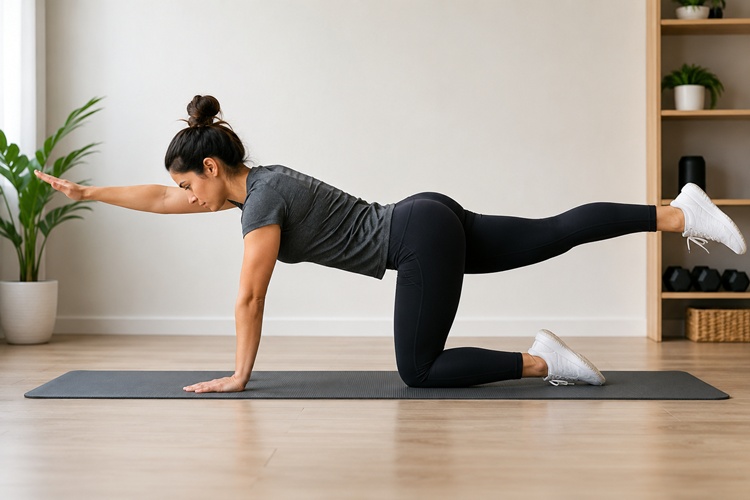
The bird-dog is a brilliantly underrated movement. It strengthens the posterior chain, deep core, hip flexors, and obliques at the same time, without straining the neck or lower back.
How to do it:
- Start on all fours with your wrists beneath your shoulders and knees beneath your hips.
- Breathe in. As you exhale, simultaneously extend your right arm forward and your left leg back, keeping your hips square.
- Hold for 3 seconds, then return slowly.
- Alternate sides for 10 reps each.
What it does: The bird-dog challenges your ability to maintain a stable, neutral spine while moving your limbs, a direct test of deep core strength. Improved posture from this exercise can also change how the lower belly appears when you stand and move throughout the day.
How Does Postpartum or C-Section Recovery Affect Apron Belly Exercises?
Postpartum and C-section recovery significantly affect which apron belly exercises are safe to perform and in what order. These situations require a modified approach.
Understanding Diastasis Recti
Diastasis recti is the separation of the two halves of the rectus abdominis along the midline. It’s extremely common during and after pregnancy. Traditional crunches and sit-ups can worsen diastasis recti by increasing intra-abdominal pressure in the wrong direction.
Before beginning any postpartum ab workout routine, check for diastasis recti. Lie on your back, place your fingers vertically along your midline, and gently crunch up. If you feel a gap wider than two finger-widths, consult a pelvic floor physiotherapist before progressing to more demanding exercises.
Safe Postpartum Exercises for C-Section Overhang
For C-section recovery specifically, scar tissue above the incision line can tether the skin to the fascia below, creating the characteristic shelf. Gentle scar tissue massage once the incision is fully healed, typically after 8 weeks, alongside TVA activation exercises can help significantly.
Start with pelvic tilts and diaphragmatic breathing before progressing to planks or bird-dogs. Patience here isn’t optional; it’s protective.
What Else Do You Need Alongside Apron Belly Exercises for Real Results?
Exercise is one piece of the puzzle, but it’s not the whole picture. Several additional factors directly influence apron belly results.
- Caloric deficit: Overall fat loss through a caloric deficit is the only proven way to reduce subcutaneous fat, including in the lower belly. No amount of core work will shrink fat cells, but eating in a modest deficit over time will. Pairing apron belly exercises with consistent, sustainable nutrition changes accelerates results considerably.
- Progressive overload: As exercises become easier, increase the duration, add resistance, or reduce rest time. The body adapts quickly, and keeping it challenged drives continued improvement.
- Hydration and sleep: Both affect cortisol levels, which directly influence where the body stores and holds fat. Chronic stress and poor sleep tend to increase fat retention in the abdominal area specifically.
- Consistency over intensity: Three focused, well-executed sessions per week will outperform seven rushed, disengaged ones.
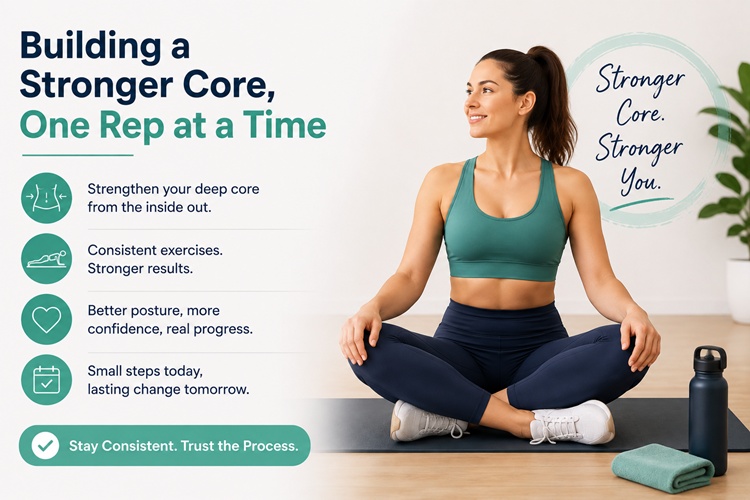
Building a Stronger Core, One Rep at a Time
An apron belly doesn’t define your fitness or your health. It does indicate that your deep core may need more targeted attention than standard ab workouts provide.
The apron belly exercises in this guide won’t deliver overnight results. Nothing honest will promise that. But done consistently three to four times per week, with proper form and genuine focus on muscle engagement, they will change how your core functions, how you stand, and how your midsection looks and feels over time.
Start with pelvic tilts. Add toe taps. Progress to bird-dogs and planks as you build strength. Pair it all with a sustainable approach to overall fat loss. That combination moves the needle.
Your deep core is there, waiting to be trained. Give it the right work, and it will show up.
Frequently Asked Questions About Apron Belly Exercises
Can you get rid of a belly apron with exercise?
Exercise alone rarely eliminates an apron belly. While movement helps reduce overall body fat and builds stronger muscle tone beneath the overhang, significant skin laxity often remains. Setting realistic expectations early makes it far easier to stay consistent long enough to see meaningful changes in posture and core strength.
How do I flatten my apron belly?
Flattening the overhang requires consistent cardio, resistance training, and targeted deep core work to shrink the underlying fat layer. Exercise alone can’t always tighten loose skin that depends heavily on your skin’s natural elasticity and, in some cases, surgical options.
Does weight loss medication help with an apron belly?
Weight loss medication can support overall fat reduction, which can help shrink the apron belly. However, medication does not address the loose skin component. It works best alongside physical activity and healthy eating habits, not as a replacement for an active lifestyle.
What is the best exercise for an overhang belly?
No single exercise targets this area in isolation. A well-rounded routine delivers the best results; focus on a combination of low-impact cardio, compound resistance training, and deep core movements like dead bugs, glute bridges, and diaphragmatic breathing to strengthen the entire midsection.
Can an apron belly ever become completely flat?
For some people, sustained fat loss and dedicated core work significantly reduce the overhang until it is barely noticeable. For others, particularly after major weight fluctuations or pregnancy, loose skin remains even after dropping body fat. In those cases, achieving a completely flat appearance without medical intervention is unlikely.
What actually tightens the apron belly?
Reducing subcutaneous fat through consistent physical activity helps shrink the belly’s projection, while strengthening the deep core improves muscle tone underneath. Real skin tightening beyond that is largely controlled by genetics, age, and how much the skin was previously stretched.
How long does it take to see apron belly exercise results?
Most people begin to notice improvements in posture, core engagement, and overall midsection firmness within 6 to 12 weeks of consistent training three to four sessions per week. Visible fat reduction takes longer and depends on nutrition, sleep, stress levels, and individual metabolism.
Are apron belly exercises safe during pregnancy?
Certain low-impact movements, such as diaphragmatic breathing and pelvic tilts, are generally considered safe during pregnancy when performed correctly. However, clear any exercise program with a qualified healthcare provider or pelvic floor physiotherapist before starting.