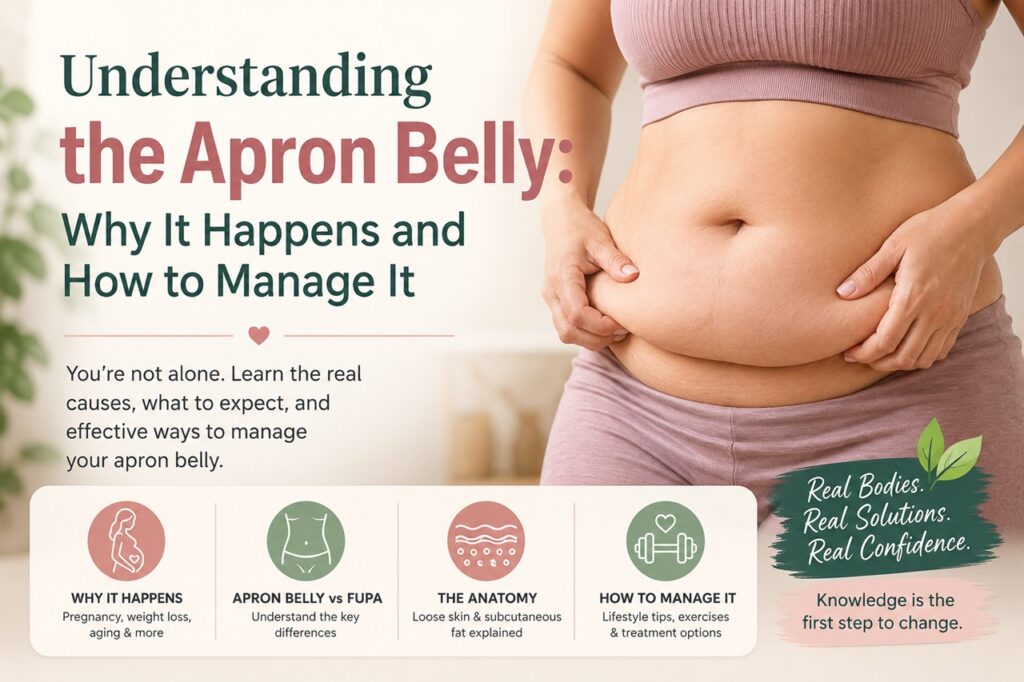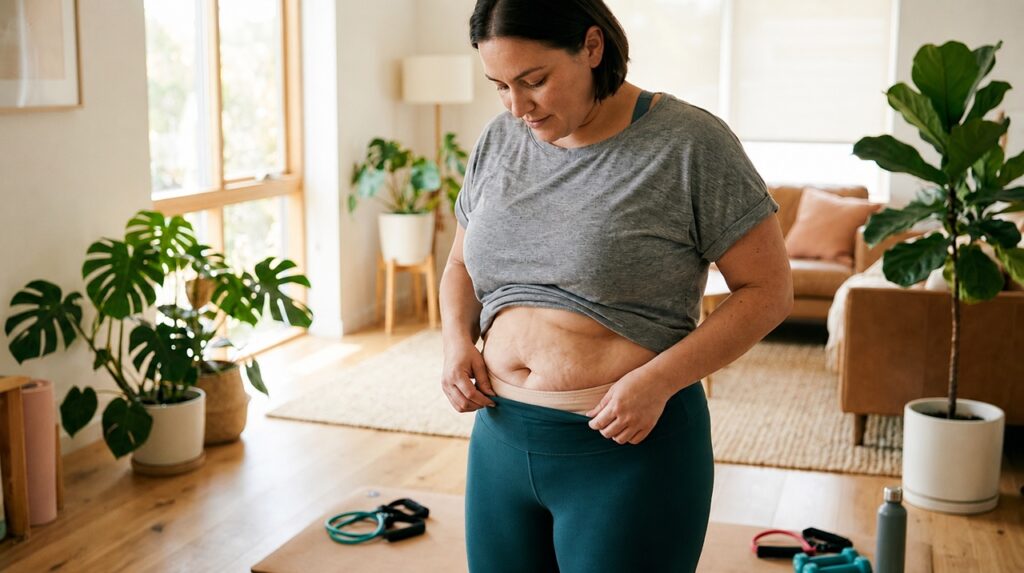

An apron belly is the fold of skin and fat that hangs down over the lower abdomen, often drooping past the pubic area or upper thighs. It forms when the lower belly accumulates enough volume — through weight gain, pregnancy, or significant weight loss — that gravity pulls the tissue downward into a visible overhang. The term is blunt, which is exactly why people search for it: they want a straight answer about what they are looking at and what, realistically, they can do about it.
This guide explains what an apron belly actually consists of, how it differs from related conditions like a FUPA, and what changes are genuinely possible through lifestyle adjustments versus what typically requires medical intervention.
Quick answer: An apron belly is a pannus — a fold of excess skin and subcutaneous fat that hangs over the lower abdomen. It can range from a small soft pouch to a large, pendulous flap. Weight loss can reduce the fat component; loose skin from stretched tissue is less responsive and often requires surgical removal to resolve fully.
What an apron belly means in practice
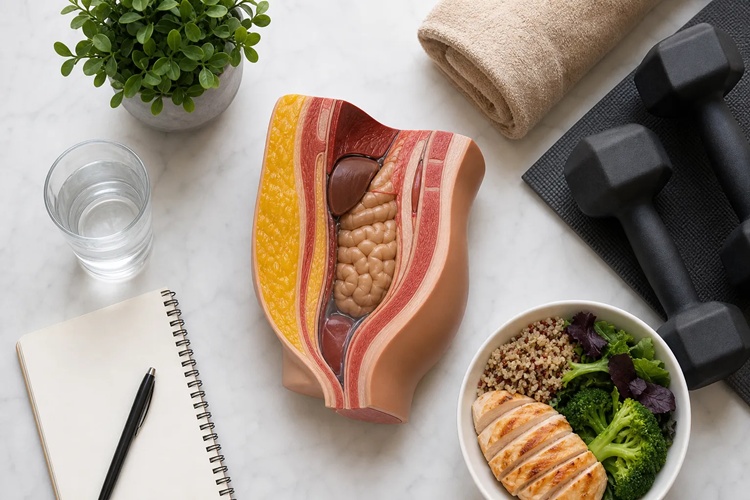
The word “apron” describes the shape accurately. The tissue folds forward and downward, much like an apron tied at the waist. Medically, this structure is called a pannus or panniculus, and it sits in the subcutaneous layer — the fat directly beneath the skin, above the abdominal muscles.
What makes an apron belly distinct from ordinary lower-belly softness is the overhang itself. A soft lower abdomen that sits flat or slightly rounded is normal for most adults. An apron belly creates a defined fold where the skin and fat actually hang away from the body, sometimes resting on the thighs when sitting.
The tissue involved is almost always a combination of two things: subcutaneous fat, which can be reduced through a sustained calorie deficit and exercise, and stretched or excess skin, which has lost elasticity and does not contract back on its own. The ratio of fat to loose skin varies considerably from person to person, and that ratio matters enormously when thinking about how to get rid of apron belly concerns.
Common causes include:
- Significant weight gain followed by weight loss, which stretches the skin beyond its elastic capacity
- Pregnancy, particularly multiple pregnancies or pregnancies that involve large weight changes
- Rapid weight loss after bariatric surgery, which can leave substantial loose skin
- Gradual accumulation of lower-abdominal fat over time, particularly after menopause or with age-related changes in fat distribution
For a thorough overview of causes, contributing factors, and the full range of management options, the understanding and managing apron belly resource covers the topic in depth.
How to think about what is an apron belly
Understanding an apron belly properly means separating it into its components, because the same visual result can have very different underlying causes — and those causes determine what will actually help.
The core problem to understand
The central issue is that an apron belly is rarely just one thing. Most people assume it is purely a fat problem, which leads them to expect that losing weight will resolve it entirely. Sometimes that is true, particularly when the overhang is relatively recent and the skin has not been stretched for long. In those cases, reducing body fat through diet and exercise can meaningfully reduce the size of the apron belly, and the skin may partially retract.
However, when skin has been stretched significantly — through a large pregnancy, many years of carrying excess weight, or rapid post-surgical weight loss — the collagen and elastin fibres in the dermis are permanently altered. The skin no longer has the structural capacity to snap back. This is not a failure of effort or willpower; it is a physiological reality. No cream, wrap, or abdominal exercise will rebuild those fibres once they are gone.
This distinction matters because it sets realistic expectations. If your apron belly is primarily fat, lifestyle changes are your most effective tool. If it is primarily loose skin, lifestyle changes will improve your overall health and may reduce the fat component, but the skin fold itself is unlikely to disappear without surgical intervention such as a panniculectomy or abdominoplasty.
The practical decision criteria

Knowing which component dominates your apron belly helps you decide where to focus your energy. A useful self-assessment: when you lie flat on your back, does the overhang flatten significantly or largely disappear? If so, the tissue is predominantly soft fat that redistributes with gravity, which suggests a meaningful fat component that can respond to lifestyle changes. If the fold remains prominent even when lying down, there is likely a substantial component of loose skin involved.
Age, skin quality, and how long the stretch has been present all influence the extent of natural retraction. Younger skin with good baseline elasticity has more potential to tighten modestly after fat loss. Skin that has been stretched for decades, or skin that has been through multiple pregnancies, has less capacity to retract.
The distinction between an apron belly and a FUPA is also worth understanding here. A FUPA (fatty upper pubic area) refers specifically to fat accumulation in the mons pubis — the soft tissue directly above the pubic bone. An apron belly sits higher, originating from the lower abdomen, and hangs downward. The two can coexist, and they often do, but they are anatomically separate. Exercises and dietary changes that reduce overall body fat will affect both areas, but neither responds to spot reduction.
Common mistakes to avoid
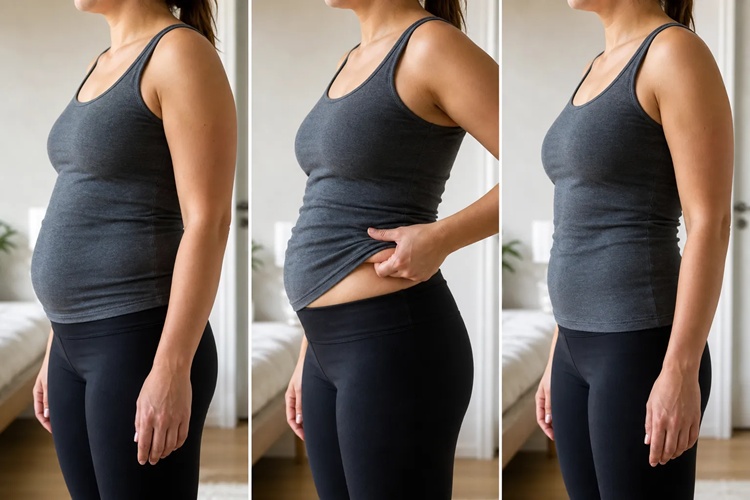
The most common mistake people make when trying to get rid of apron belly tissue is focusing exclusively on abdominal exercises. Crunches, leg raises, and planks strengthen the underlying muscles, which has genuine health benefits, but they do not directly reduce the fat or skin in the overlying pannus. Core strengthening can improve posture and make the abdomen appear flatter, but it will not eliminate the overhang itself.
A second mistake is expecting rapid results. Fat loss is a slow process even under consistent effort, and skin retraction — where it occurs at all — is slower still. Timelines of many months to over a year are realistic for meaningful change in the fat component. Anyone promising faster results through a supplement, device, or topical product is overstating what the evidence supports.
A third mistake is conflating normal lower-belly softness with an apron belly. The lower abdomen is naturally one of the last places the body loses fat, and a small, soft pouch below the navel is typical for most adults, particularly women. This is not the same as an apron belly. An apron belly involves an actual fold or overhang — tissue that hangs away from the body under gravity. Treating normal anatomy as a problem to be fixed leads to frustration and, sometimes, unnecessary interventions.
How to apply this to your situation
Once you understand what an apron belly is and what it consists of, the practical path forward becomes clearer. The starting point is honest assessment: how much of what you are seeing is fat, and how much is loose skin? The lying-flat test described above is a rough guide. A GP or a plastic surgeon can give a more precise assessment if you are considering surgical options.
If fat reduction is the primary goal, the approach is straightforward in principle, if not always in practice: a sustained calorie deficit, combined with regular physical activity, will reduce subcutaneous fat across the body over time. The lower abdomen tends to be one of the more stubborn areas, so patience matters. Resistance training helps preserve muscle mass during weight loss, which supports a better body composition outcome overall.
If loose skin is a significant component, it is worth knowing what non-surgical options can and cannot do. Strength training can add muscle volume beneath the skin, which may improve the appearance of the area. Good nutrition, particularly adequate protein and hydration, supports skin health. But these measures address the appearance at the margins; they do not remove excess skin. For people whose apron belly causes practical problems — hygiene difficulties, skin infections in the fold, or significant physical discomfort — a panniculectomy (surgical removal of the pannus) is a recognised medical procedure that may be available on the NHS in specific circumstances.
The understanding and managing apron belly resource goes into further detail on both the lifestyle and medical management routes, including what to discuss with a healthcare provider if you are considering your options.
Setting realistic expectations is not pessimistic — it is the most useful thing you can do. Knowing that lifestyle changes will improve your health, reduce the fat component, and may modestly improve the appearance of an apron belly, while also knowing that loose skin has real physiological limits, allows you to make informed decisions rather than chasing outcomes that are not achievable through effort alone.
FAQ about what is an apron belly
How do you get rid of apron belly?
Reducing body fat through a calorie deficit and regular exercise addresses the fat component. Loose skin that remains after fat loss typically requires surgical removal to resolve fully.
What’s the difference between a fupa and an apron belly?
A FUPA is fat accumulation specifically over the pubic bone, while an apron belly is a fold of skin and fat originating from the lower abdomen that hangs downward. They are separate structures that can coexist.
Can an apron belly be fixed without surgery?
The fat component can be reduced through diet and exercise. Loose skin has limited capacity to retract on its own, so a significant skin overhang usually cannot be fully resolved without surgery.
What does a belly apron look like?
An apron belly is a fold of tissue that hangs down from the lower abdomen, sometimes covering the pubic area or resting on the upper thighs, particularly when standing or sitting.
Can you tighten up an apron belly?
Strength training and fat loss can improve the area’s appearance and reduce its size, but they cannot tighten skin that has permanently lost elasticity. Surgical options exist for more significant cases.
How long does it take to lose an apron belly?
The fat component can be reduced over many months of consistent effort, but timelines vary widely depending on the starting point, overall fat loss, and the extent of loose skin.
What should readers know first about what is an apron belly?
An apron belly is a combination of subcutaneous fat and stretched skin — not purely a fat problem. Understanding which component dominates your situation determines which approaches are likely to help.
How do you choose the right approach for an apron belly?
Assess whether your overhang is primarily fat or loose skin, then match your strategy accordingly: lifestyle changes for fat, and a conversation with a healthcare provider if loose skin is the dominant issue. —
Recommended next steps
If you have identified that you have an apron belly and want to take action, the most useful first step is clarifying what you are working with. Use the lying-flat test as a starting point. If the fold largely disappears when you lie down, a consistent approach to fat loss — calorie-controlled eating and regular exercise — is a reasonable place to begin.
If the fold persists regardless of position, or if it causes physical discomfort or hygiene problems, it is worth speaking to a GP. They can assess whether the skin component is significant, advise on whether a referral to a plastic surgeon is appropriate, and discuss what NHS criteria apply in your area for procedures like a panniculectomy.
For anyone at the earlier stages of understanding what an apron belly is and what the full range of management options looks like, understanding and managing apron belly provides a comprehensive starting point covering causes, lifestyle strategies, clothing considerations, and when to seek medical advice.
The most important thing is to work from accurate information. An apron belly is a real anatomical structure with specific characteristics — knowing what it actually is makes every subsequent decision more grounded and more likely to lead somewhere useful.