Quick Answer
NHS weight management programme: the NHS offers free weight loss support in levels, from local lifestyle courses and a 12 week online programme to specialist clinics, medicines and surgery. Which level you can use depends on your BMI, your health conditions and where you live, and most routes start with your GP.
- The NHS Digital Weight Management Programme is for adults with a BMI of 30 or more (27.5 for some ethnic groups) plus diabetes or high blood pressure
- Specialist services and weight loss medicines have stricter local criteria
- Weight services can shrink the fat in an apron belly but not loose skin, and a stable lower weight is usually needed before NHS surgery
If an apron belly is part of a wider weight problem, the NHS may be able to help you lose weight for free. The NHS weight management programme is not one single course. It is a ladder of services, each with its own entry rules, and knowing which rung you can reach makes your GP appointment far more useful. This guide explains each level, who qualifies, how to ask for a referral and what weight loss can and cannot do for an overhanging belly.
This article is part of our belly fat hub. For the bigger picture on shrinking an overhang, read our guide to the best way to get rid of apron belly.
How NHS Weight Management Services Are Organised
The tier system
Health services in England usually group weight support into four tiers. The names differ a little between areas, but the structure is similar everywhere.
| Tier | What it is | Typical route in |
|---|---|---|
| Tier 1 | General advice, NHS Better Health resources and checks with your GP or practice nurse | Anyone, no referral needed |
| Tier 2 | Lifestyle weight management: group or one to one courses on eating, activity and habits, including the NHS Digital Weight Management Programme | Self referral in some areas, or GP referral |
| Tier 3 | Specialist weight management service with dietitians, psychologists and doctors, and access to some weight loss medicines | GP referral when local criteria are met |
| Tier 4 | Weight loss (bariatric) surgery and the follow up care around it | Referral from a specialist weight management service |
Why your area matters
Each integrated care board (ICB) decides which services it buys and who can use them. One area may offer a free local slimming course to anyone with a BMI over 28, while the next asks for a higher BMI or a health condition. Your GP surgery, or your ICB website, can tell you what is available where you live.

The NHS Digital Weight Management Programme
Who can join
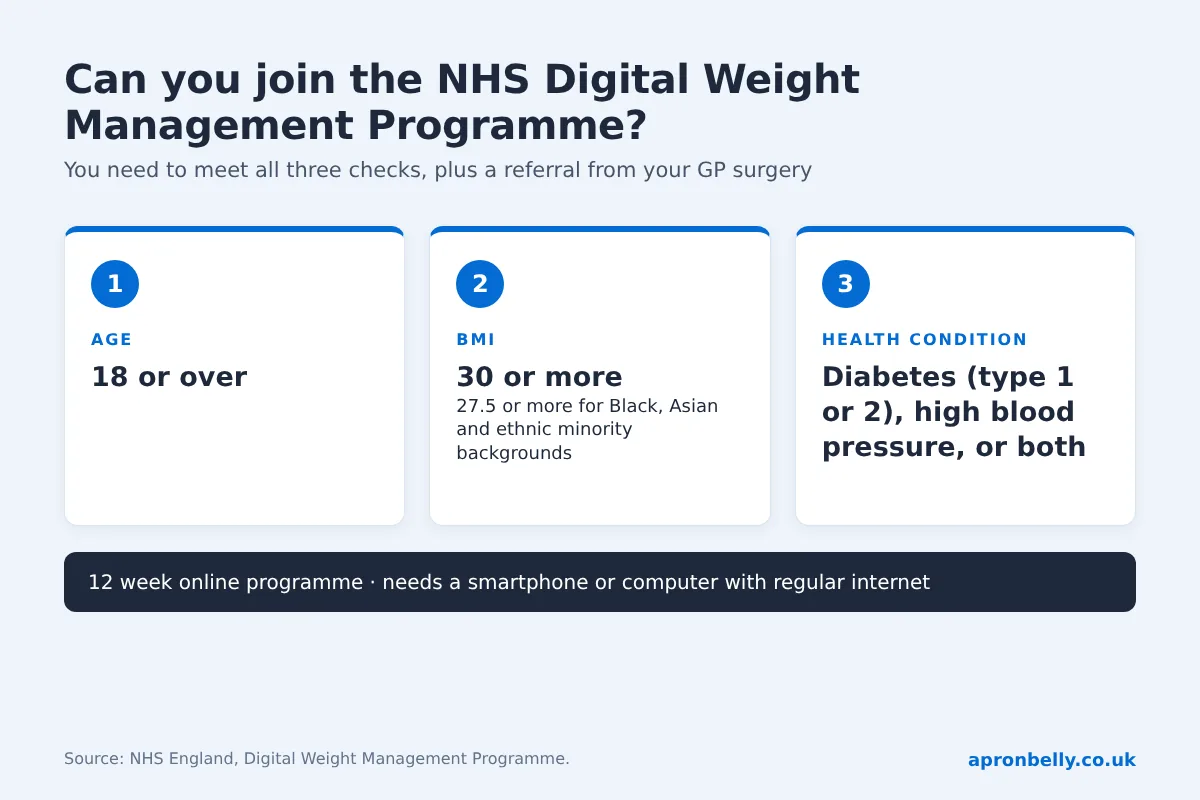
The national online programme is aimed at adults whose weight is affecting their health. According to the NHS England programme page, you can take part if you are aged 18 or over, have a BMI of 30 or more (27.5 or more if you are from a Black, Asian or ethnic minority background) and have a diagnosis of diabetes (type 1 or 2), high blood pressure, or both.
What the 12 weeks involve
The programme runs online for 12 weeks, so you need regular internet access on a smartphone or computer. It focuses on the everyday habits that drive weight: what and how much you eat, how active you are and how you keep changes going once the course ends. Because it is digital, you can fit it around work, childcare or caring for someone else.
If you do not qualify
If you do not meet the criteria, the NHS points people towards the free NHS Better Health weight loss resources, and your GP surgery can tell you about any local alternatives. Not qualifying for one programme does not mean there is no help at all.
Local Lifestyle Weight Management Services
What they usually offer
Tier 2 services are often run by councils or providers on behalf of the NHS. The NHS describes them as programmes that may include one to one coaching, cognitive behavioural therapy (CBT), group support, online exercise classes and healthy eating advice with recipes. Most run for a set number of weeks and include regular weigh ins.
Self referral
Some lifestyle programmes let you sign up without seeing a GP. Search your council website for “healthy weight” or “weight management”, or ask at your GP reception. If your apron belly makes group exercise uncomfortable, ask whether the service offers online or one to one options.
Specialist Weight Management Services
Who gets referred
Tier 3 services are for people who need more intensive support. The entry rules are set locally and are stricter than for Tier 2. As one example, Bath and North East Somerset, Swindon and Wiltshire ICB lists a BMI of 40 or more (37.5 or more for some ethnic groups) with several weight related conditions for its hospital based specialist service. Other areas use different thresholds, so ask your GP what applies to you.
What a specialist team provides
A specialist service brings together dietitians, doctors and often psychologists. The NHS says a dietitian may support a very low calorie diet, of under 800 or 1,200 calories a day, but only when weight is affecting other health conditions and faster loss is needed. These diets are not suitable for everyone and should only be followed with medical supervision.
Weight loss medicines
The NHS lists semaglutide, tirzepatide, liraglutide and orlistat as medicines that may be prescribed alongside diet and lifestyle advice. Eligibility depends on your BMI and on whether you have health conditions affected by your weight. Our guides to Wegovy and apron belly and Mounjaro and apron belly explain what these medicines can do for an overhang.
Weight Loss Surgery on the NHS
Who may be considered
The NHS obesity treatment guide says weight loss surgery may be an option with a BMI of 40 or over, or a BMI of 35 or over with conditions that could improve with weight loss, such as type 2 diabetes or high blood pressure. For people from South Asian, Chinese, other Asian, Middle Eastern, Black African or African Caribbean backgrounds, the thresholds are a BMI of 37.5 or over, or 32.5 to 37.4 with such conditions.
What it involves
Surgery is usually reached through a specialist weight management service, not straight from your GP. The NHS says the hospital stay is usually 1 to 2 days, recovery takes around 3 to 4 weeks and regular check ups continue for 2 years afterwards.
How NHS Weight Support Can Help an Apron Belly
What weight loss can change
An apron belly is usually a mix of fat and stretched skin. As your overall weight falls, the fat inside the fold tends to shrink too, so the apron often becomes lighter and shorter. Many people find that rashes in the crease, back strain and chafing ease as a result. Our guide on how long it takes to lose an apron belly sets out realistic timelines.
What it cannot change
No diet, medicine or exercise plan can tighten skin that has been stretched for years. If most of your overhang is skin rather than fat, it may still hang after weight loss. Our guide to apron belly fat vs loose skin helps you work out which you have.
The link to NHS surgery later
This is where weight services matter most for an apron belly. NHS policies for apron removal surgery usually ask for a BMI within a set range that has been stable and recorded for 12 months to 2 years. Derby and Derbyshire ICB, for example, asks for a BMI of 18 to 25, or at least 75 per cent of excess weight lost, held for a year. Losing weight with NHS support creates the recorded history those policies look for. Our guide to getting an apron belly operation on the NHS explains the next stage.
How to Ask Your GP for a Weight Management Referral
Before the appointment
- Know your numbers. Weigh yourself and measure your height so you can work out your BMI, or ask the practice to do it.
- List your health conditions. Include diabetes, high blood pressure, sleep apnoea, joint pain or high cholesterol, as these can open up more services.
- Note what you have tried. Write down past diets, apps, slimming groups and exercise, with rough dates.
- Record apron belly problems. Rashes, infections, pain, mobility limits and difficulty washing all belong in your notes.
What to say
Be direct: say that your weight is affecting your health and daily life, and ask which NHS weight management services you are eligible for in your area. Ask the GP to record your weight and BMI today, because an accurate history helps with any future referral. The NHS suggests seeing a GP if your BMI is in the overweight or obese range and you want help, or if your waist measures more than half your height.
Other ways in
In some areas a local pharmacist can also refer you to the digital programme, and some lifestyle services accept self referral. If you are turned down for one level, ask what you would need to qualify and when you should be reviewed.
A Worked Example
A 49 year old woman is 1.63 m tall and weighs 92 kg, which gives a BMI of about 34.6. She has type 2 diabetes and a grade 2 apron belly that rubs and gets sore in warm weather. Because her BMI is over 30 and she has diabetes, she meets the national criteria for the NHS Digital Weight Management Programme, and her GP refers her. In her area she does not yet meet the stricter rules for the specialist service, so the GP also records her weight and agrees to review her progress after the 12 weeks.
What this shows
The right NHS service depends on your BMI, your health and your local rules. Starting at the level you qualify for, and having your weight recorded, keeps the next steps open.
Frequently Asked Questions
What is the NHS weight management programme?
It is a set of NHS services that help adults lose weight safely. They range from local lifestyle courses and the 12 week NHS Digital Weight Management Programme to specialist weight management services and weight loss surgery. Your GP can tell you which ones are offered in your area.
Can I get NHS help to lose an apron belly?
The NHS does not treat an apron belly on its own through weight services, but it does help with the weight that often sits behind it. If your BMI and health meet the local criteria, your GP can refer you to a programme that may reduce the fat in the fold.
Who can join the NHS Digital Weight Management Programme?
Adults aged 18 or over with a BMI of 30 or more, or 27.5 or more for people from Black, Asian and ethnic minority backgrounds, who also have diabetes, high blood pressure or both. You need a referral from your GP surgery and regular internet access.
Can I refer myself to an NHS weight loss service?
Some local lifestyle services accept self referrals, so check your council or GP surgery website. The NHS Digital Weight Management Programme and specialist services need a referral from a health professional, usually your GP.
Will losing weight on an NHS programme help me get apron belly surgery?
It can. Most NHS policies for apron removal surgery only consider people whose BMI is in a set range and has been stable for 12 months to 2 years. Losing weight with NHS support, and having it recorded, is often the first step towards meeting those rules.
The Bottom Line
The NHS weight management programme is a ladder of free support, from self help and local courses to specialist clinics, medicines and surgery. It can shrink the fat in an apron belly and ease sore skin, though it will not tighten loose skin. A recorded, stable weight is also the first step towards NHS apron surgery if you need it later. For more on losing an overhang, visit our belly fat hub.
Your next step
Book a GP appointment, take your weight history and a list of health conditions, and ask which NHS weight management services you can use in your area.
Featured image: a tailor’s tape measure by Jacek Halicki, Wikimedia Commons, CC BY-SA 4.0, cropped. This article is for general information and is not medical advice.